


 Francais
 Deutsch
 Italiano
Refine Your Search
US-Gliders- stock footage and images
- Showing 17365 to 17370 of 21918 results more
more Hide
Hide
Famous football games between Chicago Bears and Washington Redskins and between Cornell and Dartmouth
Some 1940 U.S. football highlights. Scenes of a long touchdown run and an interception and touchdown run from the 1940 National Football League Championship Game that the Chicago Bears won 73-0, on December 8, 1940. Scenes from the Dartmouth-Cornell "Fifth-Down" game of November 16, 1940, with Cornell quarterback "Pop" Scholl throwing a "winning" touchdown pass to William Murphy.
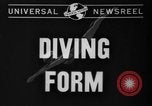
Marjorie Gestring exhibits diving skills in the United States.
U.S. diving exhibition in the United States. Marjorie Gestring dives with another girl. Gestring dives from a spring board with a man. Gestring swims.

USS Newcomb and the USS Leutze damaged by Japanese suicide planes in the Pacific Ocean during World War II.
U.S. Destroyers USS Newcomb (DD-586) and the USS Leutze (DD-481) attacked by Japanese kamikaze suicide planes in the Pacific Ocean during World War II. Sailors on ship observe damaged parts of a ship. Water splashes on a ship. A sailor loads gun. Sailor seated at a damaged ship.
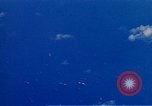
Operations Crossroads plutonium bomb nuclear test "ABLE" in Marshall Islands
U.S. Nuclear weapons test ABLE in Bikini Atoll also called Bikini Lagoon, on July 1, 1946. Ships anchored in the lagoon in the foreground are seen from aircraft flying above. The nuclear device with yield of 23 thousand tons of TNT equivalent, is dropped from the high flying B-29 bomber named Dave's Dream (not seen) and detonates at a height of 520 feet above sea level. The screen goes white from the light of the resulting fireball. As that light dissipates, the characteristic mushroom cloud is seen billowing upwards, at the same time as a surge of water occurs at the base of the explosion. The upper part of the mushroom begins to separate from the stem, below.
Operation Redwing Nuclear Test: Zuni
United States conducts nuclear test shot "Zuni" as part of Operation Redwing nuclear tests at the Pacific Proving Grounds. Bright flash appears due to the Zuni shot bomb blast, the first ever of a three-stage thermonuclear design. Huge fireball boils upward into the sky. Spots of fire in sky as darkness spreads. Zuni was a 3.5 Megaton Hydrogen bomb with 85% of its yield from fusion. This was a companion test to the "dirty" (87% fission) Tewa shot using the same bomb design.
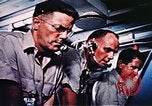
Detonation of liquid thermonuclear device MIKE, the first hydrogen bomb, at Enewetak Atoll, Marshall Islands.
Full-scale thermonuclear test of ultracold liquid deuterium, codenamed Ivy MIKE at Enewetak Atoll in the Pacific Proving Ground in the Marshall Islands (sometimes spelled Eniwetok or Eniewetok). (Left to right) Chief engineering and firing commander, Stan Burris -- later the leader of the Strategic Ballistic Missile development, including Polaris and later editions; retired as CEO of Rockwell Aerospace -- military firing and security commander, Colonel Richard Lunger, and ultracold refrigeration engineering commander for thermonuclear liquid fuel state monitoring, Robert Gibney. The intense nuclear radiation ignited the atmosphere around the device, creating a fireball 4.2 miles across. A remote firing control was created, using a televison tower beam signal to safely trigger the detonation from the USS Estes, approximately 35 miles south/southeast of the detonation. White hot device remnant specks are visible throughout the surface of the fireball. Shockwave from Operation Ivy Mike explosion is seen spreading across the water, then a white mushroom cloud spreading above. View of crew on ship deck observing blast. Device yield: 10.4 megatons.
CRITICALPAST.COM: About Us | Contact Us | FAQs - How to Order | License Agreement | My Account | My Lightboxes | Shopping Cart | Advanced Search | Featured Collections | Website Terms & Conditions | Privacy Policy ©2026 CriticalPast LLC.
License Agreement |
Terms & Conditions |
Privacy Policy
©2026 CriticalPast LLC.