


 Francais
 Deutsch
 Italiano
Refine Your Search
US-Gliders- stock footage and images
- Showing 17521 to 17526 of 21918 results more
more Hide
Hide
United Auto Workers Union (UAW) initiate 1939 Tool and die workers strike against General Motors that spreads to other General Motors workers.
Opening Slate reads: "International Union United Auto Workers (UAW) of America " over-layed on medalion reading: "Affiliated with C.I.O."This is followed by the title of the film: "United Action Means Victory, Story of the General Motors Tool and Die Strike 1939." This is followed by numerous credits, and a foreward signed by UAW President, R. J. Thomas and Secretary-Treasurer, George F. Gaddes. Next, Camera shows Walter Reuther, Director of the General Motors Department of the UAW, seated behind Union President R.J. Thomas, as he speaks to members of the union executive board. Camera pans over the board members. Views of a tool and die makers at work, in measuring and in machine shops, using grinders, drilling machines, welding equipment and other machinery. Walter Reuther is seen meeting with Union officials after they decide to strike. Actors supposedly brawling outside an auto plant. (They all pull their punches.) Newspapers announcing peaceful settlement of labor complaints. Walter Reuther insists on waiting for General Motors response to the Union's demands. Strikers marching outside an auto plant. One carries a sign calling for Fisher Pontiac workers to strike. Most of these are women. View of a Chevrolet plant with picketers marching in a courtyard. Slate reads:"Chevrolet Gear and Experimental." More views of picketers. One wears a hat reading: "UAW-CIO Picket Captain." Building with sign reading: "Chevrolet Engineering Laboratory." Engineers from the Lab shake hands with strikers and join them. More views of pickets. Some receiving drinks from folks supporting the strike. Union members seen paying their dues to union cashiers.
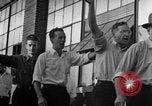
Union-sponsored film about the 1939 Tool and Die Makers Union strike against General Motors in Detroit, Saginaw, and Cleveland.
Union members march beside a building singing about "solidarity." Slate reads "Fleetwood" superimposed on "Detroit." Closeup of flag reading: "Fleetwood Local 15, U.A.W. Detroit." Marcher carries American flag. One carries sign calling for: "Time and a half for overtime, and double time for Sunday and Holidays." Among other signs, one reads: "Equal Pay for Equal Work." Bronze plaque on building reads: "Frederick Coleman and Sons, Inc." Yard filled with striking workers. Trucks sent by General Motors Company (GM), to remove tool and die shops, from a factory, are prevented from moving by the mass of strikers from the unionized Frederick Coleman plant, who refuse to become "Scabs" (strike breakers). Meeting inside their own factory building, Coleman workers promise George F. Addes, Secretary Treasurer of the U.A.W. (Union of Auto Workers) that not a GM tool or die will leave their shop. They pose near auto parts waving their hats. A new slate appears reading: "Fisher" overlaying "Cleveland." A picket line is seen in a Fisher Body Factory yard, guarded by uniformed policemen, including some on horseback. One striker walks to a building identified by a sign as Strike Headquarters. Narrator says he can get a meal there. Inside, a strikers women's auxilliary has set up a Strike Kitchen, where he receives a cup of coffee and converses with a woman of the auxilliary. Next, he is seen reading a Cleveland newspaper with headline: "Police and Pickets clash at Fisher Plant." He is then seen at his home, having supper as his wife reads the newspaper. (Narrator notes that strike has lasted 19 days.) The man and his wife argue about the wisdom of striking. Their little girl runs to her father. The three of them hug and the man then goes to join the picketing. Scene reverts to earlier conversation with the womens' auxilliary person. She sympathizes with the man's concerns. Next, three union auxilliary women visit the man's wife. They try to assuage her fears about the labor strife. (In background, voice of a union auxilliary woman speaks about the Wagner Labor Act.) More views of the Fisher Plant factory yard, with police and strikers struggling. Still photograph of men running as shots ring out. Closeup of hand holding a tear gas shell. Still photograph of police using tear gas to disburse strikers. The women visiting the wife convince her of the soundness of the strike and she joins them as a union auxilliary worker in their Strike Kitchen. View of the film's protagonist man and his wife conversing amicably in their kitchen. Final scene shows the wife with her husband on a picket line holding a sign reading: " Women's Auxilliary Stands Behind Local No. 45 in this Fight." Camera focuses on one striker riding a horse bearing two signs. One points to the front of his horse and reads: "This is the C.I.O end." The other points to the horse's rear and reads: "This is the Company end."

Pilots and their wives at a backyard barbecue and cookout in Goldsboro, North Carolina
Backyard barbecue picnic at a private home near Seymour Johnson Air Force base. U.S. Air Force pilots and their wives at a barbecue and cookout in the backyard of a house in Goldsboro, North Carolina. People in typical 1960s fashions sitting on lawn chairs, drinks in hand, and talking. A man cooks on a grill.
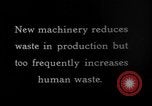
Human skills and talents replaced due to the dawn of machine age in United States
Emphasizes upon the need to avoid waste of human skills and talents in industries due to the dawn of machine age in United States. Enlists the problems brought about due to mechanization of industries: loss of job, keeping pace with machines, loss of wages and monotony of work. Due to increase in dial telephone system and a reduction in manual telephone system displaced women workers being given other jobs such as information operators, special operators and switch board attendants. View of telephone switchboard operators and people using rotary telephones, talking on the phone. Close up view of face of a rotary dial telephone "JERome 8901" home location listed. Hand dialing the rotary telephone. A graph shows a decline in the need for human beings at industries due to coming of machine age.
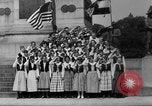
Lithuanian artists perform at the Independence Day celebrations in Washington DC, United States
Lithuanian singers perform during Independence Day celebrations in Washington DC, United States. The singers are seen assembled at the base of the General William Tecumseh Sherman Monument in President's Park. They have just completed a performance and begin to file out of the camera view. The American and Lithuanian flags are held by U.S. soldiers in uniform with campaign hats. They follow behind the singers as they leave.

Citizens march at a loyalty parade in New York City, carrying anti-communism signs.
One hundred thousand people march down Fifth Avenue during a loyalty parade in New York City, timed close to communist celebrations of May 1 "May Day". Men and women carry banners expressing their loyalty to America, and decrying the Soviet Union, Russia, and the Communist threat. Some signs include, "Communism Denies Faith to God and our Country" and "Soviets Enslave". A decorated floats with children dressed as Mother Mary and disciples on board it has a sign reading, "Pray for the Conversion of Russia." National League of Masonic Clubs marches carrying a banner. Next is a group of women telephone switchboard operators with signs, "Hello Girls say: 'The Kremlins' the wrong number...Let us break the connection!". They are followed by Boy Scouts carrying American flags as they march.
CRITICALPAST.COM: About Us | Contact Us | FAQs - How to Order | License Agreement | My Account | My Lightboxes | Shopping Cart | Advanced Search | Featured Collections | Website Terms & Conditions | Privacy Policy ©2026 CriticalPast LLC.
License Agreement |
Terms & Conditions |
Privacy Policy
©2026 CriticalPast LLC.