


 Francais
 Deutsch
 Italiano
Refine Your Search
US-Gliders- stock footage and images
- Showing 18307 to 18312 of 21918 results more
more Hide
Hide
Election campaign of Richard Nixon-Spiro Agnew in United States.
Richard Nixon-Spiro Agnew election campaign for the office of Presidency in United States. Democratic National Convention. A huge crowd gathered to protest. People stand with the U.S. flags. A sign reads 'Illinois'. Banners read 'Boycott McGovern' and others reflect support for McGovern. Domestic violence in United States. A man holds a pistol. A fire in a building. People protest on streets. A protesting group carries banners. A banner reads 'Independent Socialism'. Another group carries banners reading 'To give aid and comfort to Viet Cong, Treason'. Wreckage on street. United States soldiers in Vietnam. Unemployed citizens and poor people in United States. A man stands in a building. A poor woman with her child. Reflection of light in water. The campaign stresses on choosing the right leader in United States. (Vietnam War period).
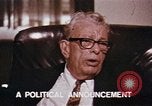
Senator Everett Dirksen of Illinois talks about Richard Nixon in United States.
Richard Nixon-Spiro Agnew election campaign for the Presidency in United States. Senator Everett Dirksen of Illinois talks to a man about Richard Nixon. They sit in an office. He favors Richard Nixon for the Presidential election. Everett Dirksen states that Richard Nixon is capable of taking responsibilities of the U.S. President's job.
Governor of California Ronald Reagan talks about Richard Nixon in United States.
During the 1968 Richard Nixon-Spiro Agnew election campaign for the Presidency in United States. Governor of California Ronald Reagan talks to an interviewer about Richard Nixon. They sit in an office. Reagan favors Richard Nixon for the Presidential election. Ronald Reagan states that people should not waste a vote by voting for a 3rd party or splinter party candidate, but that they should vote for the Republican Party candidate Richard Nixon in the U.S. Presidential elections. Reagain states that the Republican Party "is where the action is."
Volunteers work at the polling place on Election Day in Riverton, California.
Voting process of United States Presidential elections. Aerial view of city of Riverton, California. A cyclist and a car pass on the street. Houses in the street. A woman gets out of a car and enters a school building. The school is one of the polling places. Signs read 'Election Today', and 'Closed Election Day'. Volunteers work at the polling place. Voters list kept on the table. Traces of campaign activities are removed before the election starts. U.S. flag in the classroom. First citizen arrives in a milk-van to vote. He enters the voting booth and closes the curtain. He first votes for the President and Vice-President, then for Senator of State and Representative from district. A document reads 'Constitution of United States of America'.
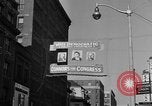
Excerpt from film about national elections in the United States. This segment covers election of November 7, 1944, in World War II
Excerpt from film about national elections in the United States. Opening scene show a banner stretched across a downtown street, reading: "Vote Democratic, vote for full employment. Below that are pictured two local candidates and Franklin D. Roosevelt (running for an unprecedented 4th term as President). Underneath, the banner reads:"Conners for Congress.Glimpses of other political signs are shown, on telephone poles, buildings,and automobile windows. Citizens discuss the elections in various places: A man and woman in their living room; workers in a machine shop; men in a diner restaurant; a man and woman at home; a farmer and a delivery man; a housewife speaks to another homemaker over a back fence; a dentist and his patient; school boys; and politicians. Representative Clare Booth Luce speaking. New York Governor, Thomas E. Dewey, at a podium. Vice Presidential candidate Harry Truman about to speak. People gathered in local forums and other political campaign activities. President Roosevelt driving along a city street, on a rainy day, in an open car with Secret Service agents riding on the running boards of his car. Crowds jamming the sidewalks in spite of the weather. Other gatherings of people waving American flags and showing support for their politcal parties and candidates. Philip Murray, President of the CIO Labor Union and AFL Head, William Green. Radio broadcast antenna shown denoting importance of radio for political communications. Harry S. Truman (Democrat), Thomas E. Dewey (Republican) and incumbent President Roosevelt are seen delivering speeches in front of numerous microphones. Various views of many men, women, children, and families gathered around radios listening to radio campaign speeches, in various places, including American soldiers at the front (This election is during World War 2) and Nurses in a hospital. President Roosevelt speaking at a political dinner. Views of people at political party conventions. Next, people are seen calmly walking in and out of polling places. Three members of an election board begin counting votes. After checking, one member telephones the results from their precinct to headquarters. Views of recorded votes being reported by telephone. People using tabulating machines to compile the results. Views of spectators in vote posting centers awaiting the results. Final results being brought to news media for dissemination to the nation. People gathered in Times square, New York, where news is posted in moving lights on the Times building marquee. Others gathered around their radios. Marquee Lights on the Times Building announce the reelection of President Roosevelt.
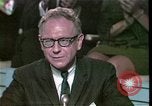
Presidential candidate Richard Nixon appears in a television program, Michigan, United States.
Presidential candidate Richard Nixon appears before a panel of citizens in a program, Michigan, United States. The television program is named 'Man in the arena'. The panel sits in the center of the studio. Audience seated in the studio. Stanley Krajewski seated in the panel asks Richard Nixon a question about his stand on Soviet Russia and Czechoslovakia. Richard Nixon states that as a President he would use economic and diplomatic powers of United States. He says that he is against the proliferation of nuclear weapons. Audience applauds Richard Nixon as he answers in the arena.
CRITICALPAST.COM: About Us | Contact Us | FAQs - How to Order | License Agreement | My Account | My Lightboxes | Shopping Cart | Advanced Search | Featured Collections | Website Terms & Conditions | Privacy Policy ©2026 CriticalPast LLC.
License Agreement |
Terms & Conditions |
Privacy Policy
©2026 CriticalPast LLC.