


 Francais
 Deutsch
 Italiano
Refine Your Search
US-Gliders- stock footage and images
- Showing 1849 to 1854 of 21921 results more
more Hide
Hide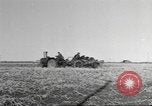
Food and rations supplied by New Zealand to U.S. Army Quartermaster South Pacific operations during World War II.
Cooperation between New Zealand and the U.S. Army Quartermaster Corps during World War II. A tractor on a farm in New Zealand. A tractor plows the field. The Pukekohe Golf Club, near Wellington, converted from golf to farm to grow crops for the war effort. New Zealand farmers works in the field. Farmers load a truck with sacks of potatoes. Close up view of potatoes on a sorting belt and farmers sort potatoes and bag them. Women workers sort cabbage and package the cabbage for shipment. Men and women farmers picking fruits and vegetables in farm fields. A factory shows apples being moved on a belt driven machine, and peeled and cored by a machine, cut into very small pieces and dehydrated in order to conserve shipping space. Canning operations are shown as the dehydrated fruits and vegetables are packed in moisture proof tins in packing houses. Meat and vegetable are mixed in proportions to prepare Quartermaster combat rations. Combat ration cans being filled and sealed at a factory plant. A machine re-generating chocolate bars from old chocolate by melting them down and reprocessing them. Soldiers unloading cartoons from the truck. Rations from New Zealand are loading on to ships by cranes with nets at large shipyards, with ships bound for the Solomon Islands. A dairy warehouse of the New Zealand Co-op Dairy Company (later Tatua) is seen at an airport near Auckland (Possibly Tatuanui or Pauanui). Milk is loaded into a specifically converted B-24 aircraft at the airport. Soldiers loading the aircraft with milk containers. The B-24 aircraft takes off. The aircraft arrives at the Tontouta Air Base in New Caledonia. A nurse serves milk to a wounded soldier patient in a hospital. Sign over the patient's bed says "Pappy Shooter, 27th Division; Saipan; Oahu, Hawaii". The patient drinks milk. Bread being made in Quartermaster bakery. A group of Army bakers working together to form loaves of bread dough on a large work surface. Workers making bread. A worker opens an oven revealing many loaves of baked bread. Ice slabs being formed at an ice plant, and soldiers picking up ice blocks for use in preserving meats and other foods, and in making ice cream. A soldier making ice cream using an ice cream churn in the field. View of a larger Quartermaster ice cream plant that was setup at a large base.
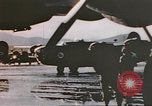
U.S. Air operations from Adak, and views of.the island's defenses during the Aleutians campaign of World War II.
As film begins, two U.S. B-24 bombers are seen taxiing across the Adak airfield to takeoff on a bombing run against the Japanese airfield at Kiska Island. Closeup of B-24 with engines running. About an inch of water covers the ramp. The two bombers take off (followed by others unseen). Airmen on the ground watch them depart. Scene shifts to the port of Adak. A cargo ship and a tugboat moving a barge are seen in the water. Trucks drive along the beachfront. Mountains loom in the background. Military supplies, including munitions are seen piled along the beach. Soldiers carry some goods over their shoulders. Closeup of items piled on the beach. A dog trots along with soldiers walking the beach. Change of scene highlights guns installed as coastal defense on the island, including fixed heavy guns, anti-aircraft guns and machine guns. A sailor viewed through a life safer buoy, paints part of a warship. A Navy PBY Catalina on patrol is seen overhead. U.S. gunboats patrol the harbor. Crew members are seen aboard a U.S. destroyer patrolling deep waters off Adak. They exchange blinker light messages with a Bancroft-class (four-stacker) destroyer. Glimpse of the Bancroft-class destroyer flashing blinkers lights. Sailors on a destroyer respond to alarm of sonar sound contacts and man battle stations. Closeup of a Bancroft-class destroyer, followed by views of depth charges being launched from a destroyer underway. Exchanges of blinker light messages between camera destroyer and a Bancroft-class destroyer.
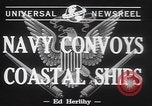
U.S. Navy ships, patrol boats and vessels underway in the Atlantic Ocean during World War II.
A U.S. Naval Fleet underway in the Atlantic Ocean during World War II. U.S. ships and vessels underway in the Atlantic Ocean. A U.S. Navy barrage balloon in flight. A navy patrol aircraft in flight. Patrol boats and ships underway at sea.

U.S. soldiers operate M36B1 tank destroyers in Germany and Allied cargo arrives at the port of Rouen in France.
Activities in the European Theater of Operations during World War II. M36B1 tank destroyers in Germany. The tank destroyers advance through slush and mud. Soldiers of the 692nd Tank Destroyer Battalion attached to the U.S. Army 104th Infantry Division, seated on the tank destroyers. A 90mm gun is test fired. A soldier removes the barrel cover and fires the gun. Soldiers observe the impact. First United States Army soldiers instruct the 8th Infantry Division troops about the use of captured German guns. A soldier demonstrates the use of a captured German Panzerfaust, a recoilless anti- tank launcher. A tank is hit. Damage caused by the hit. France: The port of Rouen along the Seine River. Various ships arrive with cargo for the Allies battling at the Rhine. A LIberty and Victory ship arrives. The Marine Division of the Army Transportation Corps on board. Women soldiers at work. A soldier near an organizational chart on the ship.
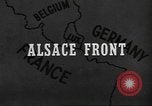
U.S. troops of the 79th Infantry Division engage German forces in the Alsace Front during World War II
Opening shows animated map of Alsace front at junction of Belgium, Germany, and France, in World War 2. Allied forces are schematically shown sweeping toward Wissembourg, Haguenau, and Strasbourg. Next, several U.S. Army M4A3(75) medium tanks are seen driving toward the camera on a rural road, during a pull back by the 7th Army in the first week of January, 1944, from advanced positions at the front. Some are filled with infantry riding atop them. The last of them is seen crossing a bridge 13 miles Northeast of Haguenau. The engineers of the 79th Division place demolition charges to destroy the bridge. Closeup of them placing and then remotely igniting the charge. A huge explosion ensues that completely destroys the bridge. Scene shifts to several U.S. soldiers of an engineer combat battalion preparing 100 pound of TNT in a captured blockhouse at Lauterbach, Alsace. Closeup of engineer carrying the explosives into the blockhouse and preparing the remote detonation device. The engineers string wire in the snow and setup their remote detonation device. One depresses a plunger to ignite the charge and blow up the blockhouse, which explodes in a huge cloud of black smoke. Next, elements of the 79th Infantry Division supported by tanks, are seen moving forward to counter German gains Southeast of Haguenau. (On January 5th the German forces had established a bridgehead across the Rhein (Rhine) river near Gansheim, Germany.) Scene shifts to Drusenheim, Germany where U.S. forces are engaging a Battalion of occupying German forces. Machine gun fire is heard constantly, as American infantry battle the hidden German defenders and tanks drive them from defensive positions near a bridge at the far end of town. Infantry move from behind tanks toward the bridge and are seen crossing it. An M4A3(75) medium tank risks crossing the narrow bridge and is immediately followed by many 79th Infantry troops. The battle continues on the other side of the bridge.
U.S. Army Air Force C-47 Skytrain transports drop parachute supplies for Cayuga Team members and Italian partisans in Italy.
U.S. OSS (Office of Strategic Services) Operational Group's assistance in helping to organize and coordinate partisan, anti-fascist activities in Italy during Cayuga Mission of World War 2. A U.S. radio operator receives a radio message at Operational Group headquarters after Cayuga Team (OSS Operational Group members) are parachuted in a drop zone. An officer takes a look at the message detailing requirement of equipment needed for the mission. The material is loaded in waiting U.S. Army Air Forces C-47 Skytrain transport airplanes. The C-47s warm up before taking off. They taxi and take off from an airstrip. Formations of C-47s. Parachute supplies are dropped in drop zones in mountainous terrain.
CRITICALPAST.COM: About Us | Contact Us | FAQs - How to Order | License Agreement | My Account | My Lightboxes | Shopping Cart | Advanced Search | Featured Collections | Website Terms & Conditions | Privacy Policy ©2026 CriticalPast LLC.
License Agreement |
Terms & Conditions |
Privacy Policy
©2026 CriticalPast LLC.