


 Francais
 Deutsch
 Italiano
Refine Your Search
US-Gliders- stock footage and images
- Showing 18535 to 18540 of 21918 results more
more Hide
Hide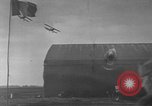
French Air Force in World War I. Formations of airplanes from successive eras.
Opening scene shows French Nieuport airplanes returning to their base from a mission, during World War 1, circa 1918. They fly over their hangar. The French tricolor flag flies from a flagpole nearby. A crashed airplane sits, nose to the ground and tail in the air, near the hangar. An airplane taxis close to the hangar, as mechanics work on airplanes in various stages of damage and repair. Next shown are a succession of formations containing aircraft from different periods of time. A loose formation of biwing aircraft fly overhead, toward the camera. They are followed by a loose formation of twin engine biplanes. Next is seen a large loose formation of American Army training biplanes from the period between the World Wars. Finally, a formation of U.S. 1950 era B-36 bombers is seen in formation.
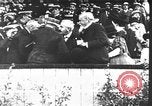
Wright Brothers give first public demonstration of their Wright flyer in Le Mans, France.
Officials and interested spectators fill the stands at Hunaudieres race course, near Le Mans, France, to watch a demonstration of a Wright Flyer airplane. Wilbur Wright places a large wheel under the aircraft as he and his team prepare a Model A Wright Flyer, for movement.Horses are seen towing it across a field. A man checks the planes launching track. Closeup of men maneuvering the aircraft into position on the launching track. Next, several of them are seen pulling together on a rope to raise a heavy weight up a small tower, to provide the launching power for the airplane. Next, two men pull the propellers through to start the Flyer’s engine. A passenger is already seated as Wilbur Wright climbs aboard and puts his hands and feet on the plane’s controls. View of the launching weight dropping to the ground and causing the Flyer to accelerate along its track and take off. A group of officials, wearing white armbands, watch the takeoff and the Flyer as Wilbur Wright maneuvers it skillfully above the race track grounds. Complete change of scene shows U.S. President Theodore Roosevelt on a platform, covered with a huge American flag. He is giving a speech. Scene shifts back again to Le Mans, where the Wright Flyer is still maneuvering all about in the air, above the grounds. Scene shifts again to World War I. American volunteer flyers with the French Lafayette Escadrille are seen in flight gear, by their Spad airplanes (marked with their distinctive Indian in head dress logo). They run to their respective planes and board them. View of the Spad airplanes with engines running and then taxiing out for takeoff.
The explosion of German fighter aircraft Messerschmitt-110 in the European Theater during World War II.
U.S. Army Air Forces VIII Fighter Command Operation during World War II. German fighter aircraft Messerschmitt-110 in flight. 2nd Lt A Roberson from 362 Sqdn.,357 F.G. attacks the Messerschmitt-110.The aircraft explodes.
Attack on the German fighter aircraft Messerschmitt-110 and Focke Wulf-190 in the European Theater during World War II.
U.S. Army Air Forces VIII Fighter Command Operation during World War II. Capt G V Davis from 364 Sqdn.,357 F.G. attacks the German fighter aircraft Messerschmitt-110 (ME-110). The fighter aircraft Focke Wulf-190 (FW-190) taxis and leaves the ground. FW-190 under attack. Grasslands seen.
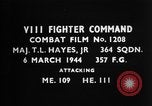
Attack on the German fighter aircraft Messerschmitt-110 and Heinkel-111 in the European Theater during World War II.
U.S. Army Air Forces VIII Fighter Command Operation during World War II.Maj T L Hayes from 364 Sqdn.,357 F.G. attacks the German fighter aircraft Messerschmitt-110 (ME-110) and Heinkel-111. The aircraft strafes buildings and small town. Parked aircraft and aircraft hangar seen.
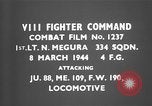
Attack on German fighter aircraft Focke Wulf-190, ME-109 and Junker JU 88 in the European Theater during World War II.
U.S. Army Air Forces VIII Fighter Command Operation during World War II. 1st LT N Megura from 334 Sqdn.,4 F.G. attacks on German fighter aircraft Focke Wulf-190 (FW-190) ,Messerschmitt-109 (ME-109) and German twin engine multi role Junker JU 88 (JU 88) aircraft. Snow covered terrain in background. The aircraft strafes a locomotive on the track.
CRITICALPAST.COM: About Us | Contact Us | FAQs - How to Order | License Agreement | My Account | My Lightboxes | Shopping Cart | Advanced Search | Featured Collections | Website Terms & Conditions | Privacy Policy ©2026 CriticalPast LLC.
License Agreement |
Terms & Conditions |
Privacy Policy
©2026 CriticalPast LLC.