


 Francais
 Deutsch
 Italiano
Refine Your Search
US-Gliders- stock footage and images
- Showing 18673 to 18678 of 21918 results more
more Hide
Hide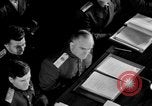
Members of Allied nations during 1st meeting of Allied Control Council in Allied Council Authority Building in Berlin, Germany.
First meeting of the Allied Control Council in the Allied Council Authority Building in Berlin, Germany. Members seated around a meeting table in a hall talk to each other. Members of the British delegation on the meeting table read a document. British members include Lieutenant Colonel Eric Green Wood, Allied Secretary Sir William Strang, Field Marshall Bernard L Montgomery and others. Members of U.S. and Russian delegations listen to them. (World War II period).

Hanging of a Nazi war criminal in Landsberg, Germany after end of World War II
Hanging of a Nazi war criminal in Landsberg, Germany after end of World War 2. . American Military officers stand and converse near the gallows. The condemned man, attended by guards and a priest, comes out of a building. They climb the stairs of the scaffold for hanging. An American Field Grade Officer speaks of charges against the condemned man. Soldiers stand near the gallows and watch the hanging. The hooded, condemned man is dropped through a trap by the executioner, Johann Reichhardt, who wears the traditional German executioners’ attire of black coat, white shirt and, black bow tie and black hat. (Reichardt who is clearly seen standing on the platform, was a principal executioner for the Third Reich. But he was subsequently employed by the Occupation Authorities from November 1945, through May, 1946. to help execute Nazi war criminals at Landsberg am Lech by hanging. He was subsequently arrested in 1947, interned, and tried in a tribunal at Munich, where he was sentenced to strict punishment measures.) A military doctor uses a stethoscope to confirm death of the hanging man.

A Company of Military Police authorized by the military government, do drill on roads in Cologne, Germany after World War II.
Military Police in Cologne, Germany after World War II. They do daily exercises instructed by an officer of the United States Army Pedestrian and cyclists civilians on roads near huge buildings. Company of Military Police authorized by military government, arranged in files on roads. The company is inspected and drilled by a U.S. Army officer.
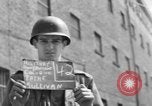
A United States army officer and a German man read papers near a wrecked building in Cologne, Germany after World War II.
A large building damaged due to bombing by the Allied bombers is inspected by Allied Government officers in Cologne, Germany after World War II. A United States Army officer talk to a German man and reads some documents. Other U.S. soldiers walk near the building. A large crack in the building wall.
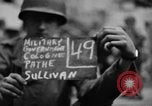
Officers of German Military Police instructed by soldiers of Allied Military Government in Cologne, Germany after World War II.
The officers of the newly formed German police under the supervision of the Allied Military Government in Cologne, Germany after World War II. The officers of the Military Government Police get instructions from United States Army Captain. A company of officers stand outside a partially damaged police headquarter building and wear armbands given by the Army Captain. The U.S. Army soldiers talk to each other. The junior soldier distributes armbands inscribed with the words 'MG Police' to the officers.
German Army officers meet Allied military officers to sign surrender document in Haar, Germany during World War II.
German General Hermann Foertsch, Commander of German 1st Army, and members of his surrender delegation, examine and markup maps delineating the areas and forces that they will be surrendering to the Allies. The allied contingent, prepared to receive the German surrender details, are seated at a conference table in the Thorak estate, Haar, Germany. Leading the Allied representatives is U.S. General Jacob Loucks Devers. Other American generals seen include, Lt General Alexander M. Patch, and Lieutenant General Wade Haislip.
CRITICALPAST.COM: About Us | Contact Us | FAQs - How to Order | License Agreement | My Account | My Lightboxes | Shopping Cart | Advanced Search | Featured Collections | Website Terms & Conditions | Privacy Policy ©2026 CriticalPast LLC.
License Agreement |
Terms & Conditions |
Privacy Policy
©2026 CriticalPast LLC.