


 Francais
 Deutsch
 Italiano
Refine Your Search
US-Gliders- stock footage and images
- Showing 18781 to 18786 of 21918 results more
more Hide
Hide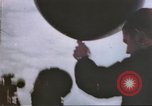
B-25 Mitchell bombers take off one by one from Adak Island, Aleutian Islands, Alaska during the Aleutian Islands Camp.
The Aleutian Islands Campaign of World War II. Two soldiers make a last minute weather observation on Adak Island in the Aleutian Islands, Alaska. Aerial cameras are taken inside a U.S. Army Air Forces B-25 Mitchell bomber. Pilots make a final meeting. A pilot gets inside an aircraft. The aircraft take off one by one.
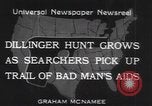
Events revolving around the hunt for bank robber John Dillinger in the United States.
The hunt for bank robber John Dillinger in the United States. Funeral services are held for federal agent W. Carter Baum killed in a battle with bandits. A house in the background. A girl inside the house. A man plows a field using a plow driven by horses. The outlaw's father J. W. Dillinger at Moorsville expresses his view about his son's exploit. Notorious robber Raymond Hamilton behind the bars. (World War II period).
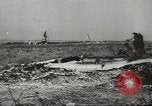
German citizens evacuate from cities and towns being bombed by Allied forces during World War II
Film begins, showing remains of a Boeing B-17F from the U.S. 100th Bombardment Group (BG) with home base at RAF Station Thorpe Abbotts, England, during World War 2. Camera pans over a field of debris containing two of the aircraft's engines and the wreckage of the fuselage and tail. The tail displays the Square D symbol of the 100th BG, plus the letter "T" and some of its tail number: "2303." Camera pans interior wreckage including crew seats and oxygen tanks. It then shows broken wings along with bodies of several crew members wearing parachute harnesses. A different side of the fuselage and tail shows the tail number "230311." This fully identifies it as B-17, number 42-23011. A field grade German officer and another officer examine the wreckage. Views of aircraft wreckage, in a forest, including a Browning M2 .50 caliber machine gun and another aircraft engine. Scene shifts to nearby town, where German women in white are serving meals at an outdoor food kitchen, for local people who are preparing to evacuate. A camper van loaded with family belongings is seen moving in the background. Several women, carrying plates of their food, walk toward tables. Some sit and eat at a table with a German soldier. Women make themselves sandwiches with foods laid out on a butcher block table. Closeup of a large drum of drinking water. local people fill containers from it. German children are seen aboard a bus waving goodbye to their mothers during evacuation for their safety. German children are placed aboard open boats at a port, for transport to safety out of war zone. German women and children board a train during evacuation to safety. Huge piles of their luggage is stacked on the train platform. View of a substantial private home in a residential area. Inside view shows it has been converted into nursery for infants, who are seen in many small cribs. Women sit on the lawn behind a substantial country home, as some small children run toward them from the house.
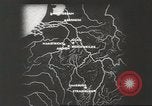
German Army Group Oberrhein undertakes Operation Nordwind, in Alsace, during World War II
German troops are seen in white winter uniforms, during World War 2, with some holding panzerfaust. Narrator mentions combat against Anglo-Canadian forces, and then speaks of preparation for the New Year's offensive. Heinrich Himmler, as commander of Army Group "Oberrhein" had ordered the launch of Operation Nordwind to recapture Strasbourg. Accordingly, On New Year's Eve, 1945,The Germans launch an offensive (Nordwind) into Alsace, attacking the Allied 6th Army Group at multiple points. On January 5, 1945, Army Group Oberrhein begins a support attack by General Otto von dem Bach's XIV SS Corps, the 553d Volksgrenadier Division, reinforced with armor and commando units. They are seen crossing the Rhine river in small boats at Gambsheim, just ten miles north of Strasbourg. Allied aircraft bomb German positions on the West bank of the Rhein (Rhine) River. The German troopers seize high ground West of the Rhein. German troops are seen firing recoilless anti-tank weapons in a field, Views of knocked out British and American tanks. Abandoned German Jagdpanzer IV faces a U.S. Tank Destroyer. German troops are seen advancing into town North of Strasbourg (Herrlisheim, Drusenheim, Offendorf ?). Scenes of destruction in town. Words: "Haus Bewohnt Civil" scrawled on homes to identify them as civilian occupied.
Germany prepares to defend Fortress City of Breslau in Lower Silesia, Germany (now Poland) against Soviets in World War II
The city of Breslau being fortified and prepared to defend against surrounding soviet forces in January, 1945, World War 2. Armed sentries patrolling the city streets. Snow on ground in some places. Poster announces the situation and requests cooperation of all Men, women, and children (over the age of 10). A poster being nailed to a pole, showing a defender with a panzerfaust anti-tank weapon confronting a tank. German soldiers shouldering panzerhaust on patrol in the snow. Closeup of insignia on sleeves on defenders' overcoats reading,"Volkssturm Wehrmacht." Men on defensive barricades. Others hauling material for defenses in wheel barrows. Tram cars being overturned and placed as impediments to invading forces. Closeup of Karl August Hanke, Gauleiter of Silesia, the city's Battle Commander (Kampfkommandant), mingling with other officers, and various groups of defenders. Hatless, he shakes hands with a defender who is dressed in heavy white cold weather coat. A car riding on road laced with tram tracks. view from inside the car of streets, building, and barriers contrived from overturned vehicles. Tram cars being set up as barriers. View from inside a defensive position, of a woman and man walking in the snow. Men setting up boxes of explosives and hooking them up to detonators along railroad tracks on a bridge. Closeups of the boxes and detonators. The charges are ignited and a large destructive explosion results raising dust and smoke. Civilian residents of Breslau, under orders to evacuate, are seen leaving the city with their belongings. Some of the refugees ride in army trucks, others use any means available to transport their belongings, including , wagons, bicycles, carts, and even baby carriages. As they leave, German soldiers including Volkssturm (Peoples' Militia) enter to reinforce the city defenses, Views of the reinforcements, some carrying panzerfaust anti-tank weapons, but most shouldering rifles as they march into the city. Cases of small arms being offloaded from army trucks to supply the reinforcements. A Goliath, SdKfz. 303 remote controlled tracked mine is seen scurrying across the ground as soldiers watch it in operation. A contingent of Volkssturm carrying panzerfaust weapons. City defenders setting up a large artillery field piece. A supply train carrying heavy armor and artillery to the city. A German Hetzer light tank destroyer (JagdPanzer 38) being maneuvered into position with other armor on a dirt road. A line of Panther tanks on a roadway behind supply trucks. Closeup of one with crew members visible. Scene shifts to a dirt airfield where a German Luftwaffe Messerschmitt Bf 109 aircraft is taking off. It is followed by several Focke-Wulf Fw 190 aircraft. Some raise considerable dust during takeoff. Closeup of one passing the camera on takeoff. Next, one is seen nosing over in the soft dirt of the airfield. But the pilot manages to right it again and continue the takeoff. Some Messerschmitt Bf 109 aircraft taking off in the dust. German airmen look up to watch the departing airplanes. Aircraft are barely seen in distance above, possibly engaged in dogfights with Soviet aircraft. Black smoke rising from Soviet bombing or shelling. German Army soldier on the airfield, shouldering a panzerfaust, looks skyward, with a comrade. View of sky shows aircraft engaged above, but barely discernible. White smoke rises from the ground, possibly from a crashed airplane.

At the end of World War II in Europe, President Truman speaks and crowd celebrates in New York Times Square.
A film titled 'The war ends in Europe' shows American people celebrating the end of World War II in Europe following surrender by Germany. A crowd in New York Times Square celebrates Victory in Europe Day (V-E Day). People pray in a church. U.S. President Harry S Truman announces the German surrender.
CRITICALPAST.COM: About Us | Contact Us | FAQs - How to Order | License Agreement | My Account | My Lightboxes | Shopping Cart | Advanced Search | Featured Collections | Website Terms & Conditions | Privacy Policy ©2026 CriticalPast LLC.
License Agreement |
Terms & Conditions |
Privacy Policy
©2026 CriticalPast LLC.