


 Francais
 Deutsch
 Italiano
Refine Your Search
US-Gliders- stock footage and images
- Showing 1879 to 1884 of 21921 results more
more Hide
Hide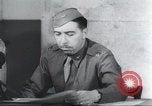
U.S. B-17 crews of 8th Air Force are debriefed by intelligence officer upon return from a mission, during World War II.
U.S. 8th Air Force B-17 crew is debriefed by an intelligence officer immediately after returning from a bombing mission during World War 2. In response to his questions, the crew members describe being hit by enemy fire, damage to their aircraft, and attacks by German Fw-190 and Me-109 fighter aircraft. A gunner tells of shooting down a German plane that flew underneath their B-17. Narrator Richard Cordon seated at a desk speaks to camera in a public service announcement, and appeals to capable American mechanics and men under 50 who are handy with tools to volunteer for service with the Army Air Forces. He reads a notice of the U.S. Army Air Forces dated October 1, 1942, inviting civilian mechanics to service with the Army Air Force. Views of mechanics performing various maintenance duties on parked B-17 bomber aircraft. Mechanics work on a B-17 aircraft with name "Baby Doll" on it. A mechanic works on a propeller of B-17 aircraft with nose art and name "Birmingham Blitzkrieg." A mechanic evaluates a machine gun in side door of a B-17 aircraft named "Shoot, You're Faded." Close-up view of notice from the U.S. Army on its letterhead, appealing for mechanics up to 50 years of age.
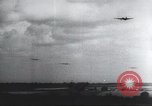
U.S. 8th Air Forces B-17s return to England after bombing Rouen, France during World War II.
U.S. Army Air Forces B-17s of the 8th Air Force, return after the first raid on Rouen, France during World War 2. Several U.S. Army Air Forces B-17 aircraft are seen coming in to land at an airfield in England. Brigadier General Ira Eaker who personally flew the B-17 "Yankee Doodle," to lead this mission, jumps from the aircraft and shakes hands with Major General Carl Spaatz, Commander of the 8th Air Force. (Other crew members of the B-17 "Yankee Doodle" are seen quietly leaving their aircraft.) Later, Eaker, smoking a cigar, is interviewed by a group of civilian and U.S. Army reporters.
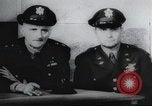
U.S. General Ira Eaker discusses the air raid after bombing Rouen, France during World War II.
Discussion of the first B-17 raid in the European theater (on Rouen, France) during World War II. Major General Carl Spaatz, Commander of the U.S. 8th Air Force, comments about this first such use of American heavy bombers against German targets in World War 2. He notes that this raid was led by Brigadier Ira Eaker, head of U.S. Bomber Command. He invites Eaker to comment on the raid. General Eaker reports that pilots maintained good formations and gunners caused German fighters to back away. He states that the main targets during the air raid were marshalling yards and a Locomotive repair facility. An intelligence officer debriefs two members of a flight crew, following a mission. They answer questions. One of the crew members points out their target on a map, and reports success at hitting their targets..
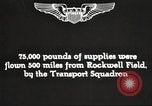
Men unload supplies from U.S. Army Air Corps C-2 aircraft during a training exercise in the United States.
U.S. Army Air Corps 1st Provisional Wing at an annual training in the United States. Men unload supplies from U.S. Army Air Corps C-2 aircraft flown from Rockwell field. Men load supplies from an aircraft into a truck. A U.S. Army Air Corps C-1 aircraft parked beside two C-2 aircraft on a field.
U.S. Army Air Corps B-2 and LB-6 aircraft defend themselves against pursuit planes during training in the United States.
U.S. Army Air Corps 1st Provisional Wing at an annual training in California, United States. Pursuit planes in flight during the annual training as they make passes at U.S. Army Air Corps LB-6s and B-2s in flight. Bombers LB-6and B-2 aircraft use cloud cover to defend themselves. Aircraft in flight.
U.S. Army Air Corpsaircraft in flight as A-3 aircraft lays a smoke screen during a maneuver in San Francisco, California.
U.S. Army Air Corps 1st Provisional Wing at an annual training in San Francisco, California. U.S. Army Air Corps C-3 aircraft on a field. California state police men load motorcycles into the aircraft. A policemen tries to put on a parachute. A pilot helps the policemen to put on the parachute. Policemen board C-2 aircraft and bid goodbye. A girl bids adieu to a pilot. Nearly 200,000 spectators at the Mills Field, San Francisco. U.S. Army Air Services LB-6, B-2, A-3, P-12 aircraft in flight. Spectators look on. A-3 aircraft lays a smoke screen.
CRITICALPAST.COM: About Us | Contact Us | FAQs - How to Order | License Agreement | My Account | My Lightboxes | Shopping Cart | Advanced Search | Featured Collections | Website Terms & Conditions | Privacy Policy ©2026 CriticalPast LLC.
License Agreement |
Terms & Conditions |
Privacy Policy
©2026 CriticalPast LLC.