


 Francais
 Deutsch
 Italiano
Refine Your Search
US-Gliders- stock footage and images
- Showing 18955 to 18960 of 21918 results more
more Hide
Hide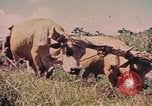
Agricultural activities in Puerto Rico on the eve of World War II
Cattle pulls his plow as a farmer plows his field in Puerto Rico. Man loads sugar cane into a truck. The S.S. Catherine is docked at a passenger terminal. (She makes overnight runs between San Juan, Puerto Rico, and St. Thomas, the U.S. Virgin Islands.) Men are seen moving about on the wharf, where some cargo is sitting. . View of farms. A small tugboat pulls a heavily laden barge in coastal waters. A sign reads 'god bless America'. New cars are seen on the docks. Some are covered with cloth covers. Cars of the era are parked at the curb near a sidewalk. Aerial views from an airplane flying over the coastline. Views of Fort San Felipe del Morro from the air.
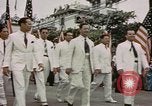
National Youth Administration officials and youth parade past the Capitol Building in San Juan Puerto Rico.
Officials dressed in white business suits, march, flanked by American flags,in a parade for the National Youth Administration, past the Captiol Building in San Juan, Puerto Rico. They are followed by youth in black overalls, shouldering spades. Behind them march girls, carrying a banner reading: "NYA, Caguas Proyecto." A truck comes next, displaying a large poster in its rear reading: "NYA for Puerto Rico, Puerto Rico Leads the way," amd listing various NYA youth projects in Puerto Rico. Youth carrying N.Y.A. banners and American flags come next, followed by more young men carrying spades. Youthful firemen stand beside reels of hoses and a sign reading: "Bomberos de Guayama." An official pins a badge on the lapel of a man being honored. Next, a fireman, and two youth demonstrate by spraying water from their hose along the street. Remainder of the film is a montage of views. Scene shifts to the harbor, where two U.S. Clemson class destroyers are seen. Then boys are seen playing on a beach. A closeup of a young woman. Closeups of several of the youthful firemen previously seen. Several youth with spades, seen from the rear. An American flag wafting in a breeze.
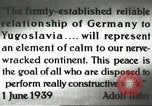
Tripartite Pact signed by Germany, Italy and Japan in Berlin, Germany. Ensuing attacks by Germany and Japan in World War II
This film is a scattering montage of World War 2 scenes from 1939 through 1945. Part of an agreement between Nazi Germany and Yugoslavia is shown in English. It is dated June 1, 1939 and ostensibly signed by Adolf Hitler. Next, German Ju 87, Stuka dive bomber aircraft are shown peeling off from formation, on April 6, 1941, to attack Yugoslavia. Bombs bursting on the ground. Closeup of a Stuka airplane in a dive, making its characteristic whine, and dropping bombs. Bombs exploding just outside some concrete walls. German infantry running along railroad tracks and entering backyard of house in a village. German soldiers observing from overlooking hill; climbing over rubble; and marching along a road toward a village. Animated map showing German invasion areas early in World War II, extending through most of Europe and into Norway, by 1941. Animated map shows further invasions into France, Belgium, low countries, the Balkans, and Eastern front towards the Soviet Union. Map highlights Tokyo, Rome, and Berlin. Delegations walking in hall of Reich Chancellery in Berlin, to sign Tripartite pact, on September 27, 1940. The group is led by by Count Galeazzo Ciano (Italian Foreign Minister, and Mussolini's son-in-law); Joachim von Ribbentrop, Germany's Foreign Minister and Japan’s Ambassador Saburō Kurusu. The diplomats are seen, next, standing near a table as Adolf Hitler enters rendering Nazi salute. He shakes hands with Count Ciano and Ambassador Kurusu. Hitler is seated to watch the proceedings. Von Ribbontrop is seen signing for Germany. Next scenes show German armored units heading East in Operation Barbarossa (June of 1941). A sign identifies the town of Eydtkau (Eydtkuhnen) on the German-Lithuanian border. German armor and artillery moving eastward. German troops destroying international crossing barriers. German troops firing siege guns. Montage with glimpses of German battle scenes showing tanks, guns, rockets in action with attendant explosions, fires, and destruction. Formations of German warplanes in flight, including Junkers Ju-52s that carry troops, including paratroops. View from above of Junkers Ju-87 Stuka dive bombers in formation. Battle of Britain scenes, with view of St. Paul's Cathedral in London, England (which miraculously survived the Blitz). The Tower Bridge in London, seen through a haze following blitzkrieg. German Junkers 87 Stuka dive bombers peeling off from formation to attack. British anti-aircraft searchlights shining beams skyward. Diving bombers illuminated by the lights. Anti-aircraft guns firing. Nighttime scenes showing gunfire flashes, explosions, tracer bullets and fires in London. British fire brigades fighting fires in London buildings as some collapse from the German bombing during the so-called "Blitz." Scene shifts to Pearl Harbor, December 7, 1941, as a Japanese bomb explodes on a U.S. Navy warship. The USS Arizona billowing smoke and listing as it succumbs to Japanese bombing. Another view of the Arizona sinking. Smoke rising from Battleship Row, at Pearl Harbor. Glimpse of postwar Nuremberg trial.
Chief Prosecutor of France Francious De Monthon concludes counts 3 and 4 against Nazi leaders during Nuremberg trial
During Nuremberg trial Chief Prosecutor of France Francious De Monthon concludes counts 3 and 4 and describes from memoranda of Fritz Sauckel Nazi policy of forced labor. Captives used as labor and later on killed by the Nazis.
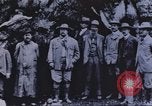
The "Big Blowup" forest fire of 1910 in Elk City Idaho. Firefighters recruited.
History of fire fighting in forests in United States. United States President Theodore Roosevelt standing with several persons, including John Muir and Chief Forester, Gifford Pinchot. Roosevelt on speaker's stand. Picture of Northern District Forester, William B. Greely and his staff, in Missoula, Montana. Scenes from 1910 during period of drought. A ranger checks a rain gauge. Picture of Smoke rising in a forest as a fire breaks out in Montana. Firefighters are recruited and head to Montana on horses and mules. Smoke rises as fire spreads across the forest. Firefighters work with hand tools and axes in attempt to control the fires. August 20, 1910, hurricane force winds create the "Big Blowup" fire storm starting in Elk City Idaho. Destruction in Wallace, Idaho. Scenes of aftermath, showing swaths of destroyed forest. Men in area filled with smoke, felling a large tree using axes. Forest Rangers standing on a mountain peak, scanning the horizon, with field glasses, for signs of fire. A Ranger on horseback. A Ranger approaches a fire, puts his backpack down and starts to clear brush. A fire warden standing on a peak looking for signs of fire.
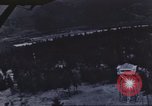
Firefighters parachute into forests from Ford trimotor airplane. Parachute training in Missoula, Montana
Aerial view of a lookout tower in a forest in United States . A Ford trimotor airplane takes off on a grass field. The airplane in flight and dropping supplies to firefighters, by parachute. Scenes of 1939 experimental tests with firefighters parachuting from a Ford trimotor, near Winthrop, Washington. They can be seen leaving the aircraft, chutes opening, and firefighters descending. Scenes from first operational use of parachuting firefighters, on July 12, 1940, when Smoke Jumpers, Rufus Johnson and Earl Cooley parachuted into the Nez Perce forest , in Idaho, where they successfully extinguished a small fire. Rufus Johnson was the first to jump from the airplane, followed immediately by Earl Cooley. Fire fighters being trained at a parachute training center in Missoula, Montana. Men learn to jump and run over wooden planks. An instructor gives directions to trainees on a loudspeaker. (World War II period).
CRITICALPAST.COM: About Us | Contact Us | FAQs - How to Order | License Agreement | My Account | My Lightboxes | Shopping Cart | Advanced Search | Featured Collections | Website Terms & Conditions | Privacy Policy ©2026 CriticalPast LLC.
License Agreement |
Terms & Conditions |
Privacy Policy
©2026 CriticalPast LLC.