


 Francais
 Deutsch
 Italiano
Refine Your Search
US-Gliders- stock footage and images
- Showing 1921 to 1926 of 21921 results more
more Hide
Hide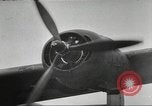
U.S. Army Air Force B-24 Liberator bombers drop bombs over Japanese bases in Kahili during World War II.
U.S. Army Air Force aircraft attack enemy positions on Kahili, Papua, New Guinea during World War II. U.S. 13th Air Force aircraft take off from a runway to attack an enemy base. B-24 Liberator bombers bomb the enemy base. Japanese aircraft in the sky attack U.S. fighter planes. The Japanese aircraft go down in flames. The B-24s drop bomb load over Kahili.
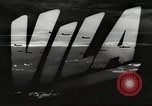
U.S. 13th Air Force bombers drop bombs over Japanese installations on Munda Point, Solomon Islands during World War II.
U.S. Army Air Force aircraft attack enemy installations on Munda Point, Solomon Islands during World War II. U.S. 13th Air Force bombers in flight over Vila in the Solomon Islands. The bombers take off from Guadalcanal to attack Japanese installations on Munda Point in New Georgia. Views of support fighter aircraft taking off to join in this, the largest single raid (total participating aircraft) in the Pacific thus far. U.S. naval guns shell enemy targets on Munda. The bombers release bombs over ground targets. Ships fire salvo from giant artillery guns towards shore targets. Smoke rises from heavy shell fire. The bombers escorted by fighters drop bombs over the targets. Smoke billows up from exploding targets. View of newly formed craters all over Munda Point after smoke clears. Aerial views of a second round of bombing over Munda Point during the same raid.
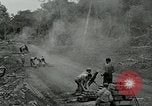
Vapor effects of persistent gas munitions are examined during various U.S. chemical warfare tests in San Jose Island, Panama.
Tests of persistent gas munitions during U.S. chemical warfare tests on San Jose Island, Panama during World War II. Chemical warfare tests shows U.S. troops firing 4.2 inch mortars and 105mm howitzers laying down a mustard gas barrage. Smoke rises from shell fire in the jungle. A technician examines a bombed area in the jungle. Vapor effects of persistent gas munitions are examined. Bodies of captured Japanese soldiers who were in the bombardment area are examined within three hours of the bombardment. U.S. troops without any protective clothing advance through the jungle area 48 hours after the bombardment. The troops fire mortars and howitzers.
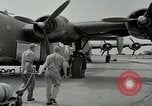
Phosgene and CK gas tests are made by dropping bombs from U.S. 6th Air Force B-24s on San Jose Island, Panama.
Tests of non-persistent gas munitions during U.S. chemical warfare tests on San Jose Island, Panama during World War II. Bombs are loaded on U.S. 6th Air Force B-24 Liberator bombers. The B-24s take off from a runway. A formation of B-24s in the sky. Phosgene and CK gas tests are made by dropping bombs from the B-24s. Results are plotted on maps and studied by U.S. personnel in a room.
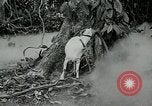
Goats wearing Japanese canisters are used to test the effect of Phosgene and CK gas bombs in San Jose Island, Panama.
Tests of non-persistent gas munitions during U.S. chemical warfare tests on San Jose Island, Panama during World War II. Goats wearing Japanese canisters are used to test the effect of Phosgene and CK bombs. All unprotected goats are killed. A goat is placed in a gas proof dugout. A man wearing protective clothing drags out the dead goat from the dugout. U.S. troops make CK bomb tests and fire mortars. Bombardment at night during the rainy season. A soldier examines the result.
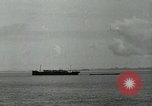
Tests of non-persistent gas on ship targets are carried out by U.S. Army at San Jose Island during World War II.
Tests of non-persistent gas munitions during U.S. chemical warfare tests near San Jose Island, Panama during World War II. Tests of non-persistent gas on ship targets are carried out. A stationary ship in water on which tests are to be carried out. Goats are loaded aboard the ship to represent Japanese personnel. Testing stations are set up at the bow, the stern and on varying heights by U.S. Army personnel. A man works with a gas concentration sampling instrument at a testing station aboard the ship. Goats wearing gas masks fitted with Japanese canisters are placed on the testing station. Bombs are loaded on U.S. 6th Air Force B-24 Liberator bombers at an airfield for carrying out the tests. The bombs are dropped from the B-24s near the test ship. Gas clouds cover the target completely after bursts on water. A man examines protected and unprotected goats killed by gas concentration. Attack on various vessels.
CRITICALPAST.COM: About Us | Contact Us | FAQs - How to Order | License Agreement | My Account | My Lightboxes | Shopping Cart | Advanced Search | Featured Collections | Website Terms & Conditions | Privacy Policy ©2026 CriticalPast LLC.
License Agreement |
Terms & Conditions |
Privacy Policy
©2026 CriticalPast LLC.