


 Francais
 Deutsch
 Italiano
Refine Your Search
US-Gliders- stock footage and images
- Showing 1975 to 1980 of 21924 results more
more Hide
Hide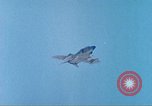
Officials watch U.S. Air Force firepower demonstration at Fort Bragg in North Carolina.
The activities and joint demonstrations by the United States Readiness Command (USREDCOM), Brass Key II at Fort Bragg in North Carolina. People gather in a large number to watch the demonstration. Fire power demonstration by the Air Force units. A U.S. Air Force McDonnell Douglas F-4 Phantom II airplane in flight. Plane fires a television-guided AGN-65 Maverick missile at a target. Officers and guests watch the aircraft demonstrations through binoculars from a reviewing stand. Smoke from explosion on the target area. Demonstration of gunship operations. U.S. Air Force Lockheed AC-130 aircraft in flight. The AC-130 Gunship firing its 20mm cannons its 40mm cannons, and its 105mm howitzer. U.S. Air Force A-7 Corsair II airplanes in flight. Mark 82 low drag 500 pound Laser guided bombs being dropped from the airplanes. Smoke arising from an explosion. McDonnell RF-4C reconnaissance aircraft approaching in sky overhead, and delivering, via small parachute packages, its aerial photographs taken that day.
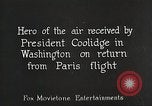
U.S. President Calvin Coolidge presents the Distinguished Flying Cross to Charles Lindbergh in Washington D.C.
American aviator Colonel Charles Lindbergh's flight from New York to Paris. Colonel Lindbergh returns to the United States after completing his flight on June 11. A large crowd gathers in Washington D.C. to greet him. U.S. President Calvin Coolidge arrives at the ceremony to welcome him. President arrives at the podium. Crowd applauding. He addresses the people and speaks about the flight of the aviator. He talks about the history of airplanes and their flight. He states that the airplanes were first used for the purpose of transportation of passengers and for national defense. They had a limited flying radius in the beginning. But now the area has been extended. He states about the historic flights of many U.S. Navy personnels. Then he talks about another historic flight of Lindbergh and bestows the Distinguished Flying Cross upon him. People cheer and applaud as he makes the announcement. Lindbergh arrives at the podium and being greeted by the cheering crowd.
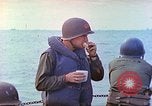
U.S. forces launch amphibious Assault on Iwo Jima in World War II.
U.S. invasion of Iwo Jima during World War 2. A sailor eats a sandwich. U.S. Landing ship Infantry (LSI) No. 1029, firing rockets at the shore of Iwo Jima. Change of scene to aboard ship further from shore. Mount Suribachi visible in background. Other ships closer to shore. A U.S. Destroyer off the shore. A line of armed landing craft approaching Iwo Jima, headed by LCI-717. Views and closeup of USS Brule (APA-66) . Attack transports USS Cape Johnson (AP-172) and USS Fond du Lac (APA-644). the Destroyer Escort, USS Vammen (DE-644). The camouflaged Light Cruiser, USS Vicksburg (DL-86) bombarding the coast of Iwo Jima with 5 inch and 6 inch guns. A landing craft infantry approaching the shore, firing rockets. Large explosions in the water at a distance. USS LCI-65 returning from the shore. (Note: The ship at the 1:07 - 1:18 sec mark is a Pensacola class heavy cruiser and the ship at the 2:11 - 2:40 sec mark is the battleship USS North Carolina BB 55.)
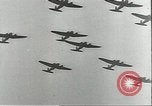
U.S. antiaircraft artillerymen training with M7 director system for controlling antiaircraft batteries, during World War II.
Sequence begins with views of German He-111 bombers in formation,during World War 2. Scene shifts to Squad of U.S. Army antiaircraft artillerymen surrounding a Sperry Gyroscope M7 director system control unit, in a sand-bagged position, as the soldiers train in the United States. View of a single He-111 is inserted. Battery of U.S. 90mm antiaircraft guns is seen firing under guidance of M7 director system. Scene shifts to a German Me-110 aircraft maneuvering evasively through flak bursts from antiaircraft guns, somewhere in Europe, during World War 2. Scene shifts again, back to Narrator describing operator actions in using M7 artillery control unit, as it is shown in images.
U.S. aircraft bombard the city area and the Japanese fleet off the coast of Okinawa, Japan.
A U.S. air attack on Okinawa, Japan during World War II. U.S. aircraft from U.S. Navy ship USS Yorktown (CV-10) attack Okinawa. An aerial view of the air attack. Japanese ships underway at sea. The aircraft in flight over the target area. Aerial and gun camera views as aircraft drop bombs and strafe the Japanese fleet. Smoke rises as the ships explode due to the bombardment. Splashes in the water. The aircraft bombard the city area on the island. Smoke rises due to bombardment in the city.
U.S. troops getting established on Guam during Marianas campaign of World War II
What appear to be a damaged Landing Vehicle Tracked (LVT) and several damaged DUKW amphibious vehicles at the shore of Guam, after invasion by U.S. troops in World War 2. Burned bodies of Japanese soldiers in their fortifications. U.S. troops make their way through mud. U.S. Army Jeeps and trucks move across the scene. View from camera carried in back of a jeep bouncing in muddy ruts. Some building materials seen laid out on ground.
CRITICALPAST.COM: About Us | Contact Us | FAQs - How to Order | License Agreement | My Account | My Lightboxes | Shopping Cart | Advanced Search | Featured Collections | Website Terms & Conditions | Privacy Policy ©2026 CriticalPast LLC.
License Agreement |
Terms & Conditions |
Privacy Policy
©2026 CriticalPast LLC.