


 Francais
 Deutsch
 Italiano
Refine Your Search
US-Gliders- stock footage and images
- Showing 19801 to 19806 of 21919 results more
more Hide
Hide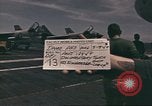
Crew members attach rocket pod to A-4 Skyhawk aboard the carrier USS Ticonderoga (CVA-14) in the Gulf of Tonkin.
USS Ticonderoga (CV-14) in the Gulf of Tonkin. U.S. Navy crew carries a 19-shot rocket pod on a trolley. He opens its front portion and ensures the rockets are properly seated. Crew members attach the rocket under the wing of the A-4 Skyhawk. (Vietnam War period.)
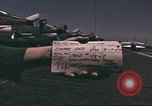
F-8 aircraft and rocket aboard USS Ticonderoga
USS Ticonderoga (CV-14) in the Gulf of Tonkin. U.S. Navy crew chiefs working on F-8 aircraft. Rocket ammunition with explosive projectiles is displayed. (Vietnam War period.)
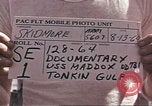
Commander Ogier talks with Captain Herrick and other naval officers observe the sea from USS Maddox in the Gulf of Tonkin.
Reconstruction of activities that took place aboard Destroyer USS Maddox (DD-731) in the Gulf of Tonkin. Lieutenant R. P. Connell and Ensign C. W. Bond stand on the bridge and look out aboard USS Maddox. U.S. Navy officer in the foreground looks through a window with binoculars and looks down through a radar. The lieutenant puts looks through an eyepiece to scan with a radar repeater. Captain J. J. Herrick sits in his chair on the bridge and speaks to Commander Herbert L. Ogier. Captain Herrick reads a message. (Vietnam War period.)
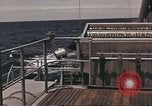
Commander Ogier and Captain Herrick stand on the bridge of USS Maddox and look through binoculars in the Gulf of Tonkin.
Reconstruction of activities that took place aboard Destroyer USS Maddox (DD-731) in the Gulf of Tonkin. Commander Herbert L. Ogier and Captain J. J. Herrick stand on the bridge. They look out through binoculars. Captain Herrick points out to the sea. Commander Herbert L. Ogier stands nearby. A U.S. Navy destroyer in the background. Captain Herrick and Commander Ogier on the bridge. (Vietnam War period.)
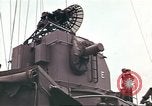
Reconstruction of activities aboard USS Ticonderoga and a SH-3A helicopter rescues Lt jg Albert J. Showers in the Tonkin Gulf.
Reconstruction of activities that took place aboard USS Ticonderoga in the Gulf of Tonkin. A gun director training. A radar dish situated on the top of the gun director. USS Ticonderoga in the sea. Smoke flares in water. A helicopter recovers Lieutenant Junior Grade (jg) Albert J. Showers, VA-56 pilot of A-4A. A U.S. Navy SH-3A helicopter flies over the water and lowers a sling to Lt. jg Showers in water. Lt. jg Showers in a one man raft. The SH-3A hovers and then hoists Lt. jg Showers out of water. A white float, part of a pod from the A-4A aircraft porpoise in water. Roger D. McKeithan scans the horizon with his binocular. L. C. Alexander looks through binocular and talks over his phones then again looks through the binoculars. Lt. jg P.D. Corsett, training gun director, holds the control handles. (Vietnam War period.)
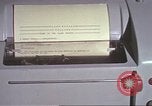
An operator takes a message being typed on a paper on USS Ticonderoga (CVA-14) in the Gulf of Tonkin.
U.S. Navy ship USS Oklahoma City (CLG-5) in the Gulf of Tonkin. A paper with a message being typed on it comes over on a teletype. An operator at the teletype machine waits for the information which comes in over the teletype. (Vietnam War period.)
CRITICALPAST.COM: About Us | Contact Us | FAQs - How to Order | License Agreement | My Account | My Lightboxes | Shopping Cart | Advanced Search | Featured Collections | Website Terms & Conditions | Privacy Policy ©2026 CriticalPast LLC.
License Agreement |
Terms & Conditions |
Privacy Policy
©2026 CriticalPast LLC.