


 Francais
 Deutsch
 Italiano
Refine Your Search
US-Gliders- stock footage and images
- Showing 20761 to 20766 of 21919 results more
more Hide
Hide
Various snow vehicles and demonstration of Weasel showing its various parts and capabilities in the United States (WW2)
Demonstration of the capabilities of the small snow vehicle, Weasel in the United States during World War II. Military personnel skiing on snow covered land and use artillery for military operations. Dogs pull sled. Book is read. Sign on the book 'War Department Specification, Vehicle T-15'. Mules carry troops and equipment. Aerosled, jeep, half track and snow truck being driven on snow covered land. Swamp buggy is driven in water. Model of small snow vehicle called the Weasel. Its height, width and tracks are shown. It shows its parts and describes its capabilities. Various parts include engine, gas tank, Steering, breaks, clutch, accelerator and instrument box.
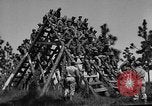
Japanese American recruits climb up and down ladders, jump in and out of foxholes at Camp Shelby in Mississippi.
Opening scene shows U.S. soldiers of Japanese ancestry, in the 442nd Regimental Combat Team, moving en masse over a training obstacle. Views from the side and headon, as the troops come charging down the obstacle. Next, they traverse a deep trench containing some fixed obstacles, and proceed over a berm.View of them descending at a run. The troops charge toward, and taking cover in, trenches and simulated shell holes. A view of them assembled in the grass across from the camera, which is separated from them by part of the obstacle course. Suddenly, an explosion occurs in the obstacle course, close to the camera. (World War II period).
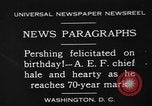
John Joseph Pershing is congratulated on his 70th birthday in Washington DC.
John Joseph Pershing is congratulated on his birthday in Washington DC. John Joseph Pershing (Former General of the U.S. Armies) is congratulated on his 70th birthday. He is greeted by A.E.F. (American Expeditionary Force) chief. He speaks.

Franklin D. Roosevelt arrives on Campobello Island by USS Tuscaloosa for Canada visit.
Franklin D. Roosevelt visits Canada, Campobello Island, Canada. USS Tuscaloosa, cruiser underway at sea, enroute to Campobello Island. U.S. President Franklin D. Roosevelt aboard the Tuscaloosa. He gets into barge along with the Tuscaloosa. The barge lands. President Roosevelt in the barge. A building on the island. The President and officials discuss. He talks with a man and a woman. Birds including hens, cranes and turkeys seen.

Early 1900s car traffic on streets of New York City; car usage in America versus rest of world
Demand of Automobile in the United States. Shows a photograph (ca. 1900) of a policeman ordering a horseless carriage off New York City streets. Picture of men on horseless carriage and on bicycles. Views of traffic of 1910's and 1920's cars and other vehicles on busy, traffic filled streets of New York City, as a police officer directs traffic between the lanes of automobiles. Figure shows that out of 26 million of automobiles, 77% is in the U.S. and 23% in rest of the world.
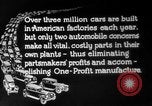
Manufacture of a cast iron engine block in the foundry of the Studebaker automobile plant in South Bend, Indiana
Slates at start of film explain that we are going to be shown manufacturing processes inside an automobile plant. Glimpse of a 250 acre manufacturing plant of Studebaker Automobiles in South Bend, Indiana. Inside, overhead conveyors are seen moving ladles that are to be filled with molten iron from a cupola furnace. Closeup of molten iron being poured into a ladle. The conveyor moves the full ladle back from the furnace and others move ladles into position and they are filled too. Slate describes casting of engine blocks. Men in foundry are seen guiding a large ladle of molten iron to pour some into a smaller ladle. Then two men using handles to guide the small ladle, proceed to pour molten metal from it into some green sand molds of engine blocks. Closeup of the molten iron being poured into the sand mold. After cooling for some time, a crane lowers a device to remove the cope from the drag of the mold. The solid, but still smoking engine block is then lifted out of the mold with a chain hoist.
CRITICALPAST.COM: About Us | Contact Us | FAQs - How to Order | License Agreement | My Account | My Lightboxes | Shopping Cart | Advanced Search | Featured Collections | Website Terms & Conditions | Privacy Policy ©2026 CriticalPast LLC.
License Agreement |
Terms & Conditions |
Privacy Policy
©2026 CriticalPast LLC.