


 Francais
 Deutsch
 Italiano
Refine Your Search
US-Gliders- stock footage and images
- Showing 20923 to 20928 of 21919 results more
more Hide
Hide
Film describing the 100th Infantry Battalion, 442nd Regimental Combat Team, comprising Americans of Japanese ancestry, in World War II.
Film opens showing relatives of fallen American soldiers of Japanese ancestry who made the ultimate sacrifice in the European theater of operations, during World War 2. The dead soldiers were members of the United states 100th Infantry Battalion, 442nd Regimental Combat Team. The relatives are assembled in an auditorium at a military installation in Hawaii, where the 100th Infantry is conducting a ceremony honoring their fallen heroes.Camera pans over some of the relatives. Decorations for valor are presented posthumously to some of the surviving relatives. A widow receives the Silver Star. A father receives the Distinguished Service Cross. A mother receives her son's award. Film shifts to scenes showing artillery batteries of the 100th Infantry in action at numerous battles in the Italian Campaign, including Naples, Cassino, Rapido River, Pisa, Anizo and others during World War 2. A column of 100th Infantry accompanied by armor, are seen entering Livorno, Italy. Members in a jeep are seen passing through area of complete destruction. Others pick their way through rubble, as civilians bass the opposite way,carrying salvaged belongings, Troops of the 100th move cautiously and deploy near barricades to shield from snipers. They escort captured German prisoners. Battle casualties are seen being carried into field hospitals. A medical team performing emergency surgery inside a tent. Wounded and convalescing patients being tended by a woman Army nurse. Others recovering outside tents at the field hospital. A group of 100th infantry troops taking a break. One of their medics is interviewed. Gunners seen with Browning M1917 machine gun. Troops preparing a meal in the field. A soldier presenting paper airplanes to Italian children who fly them. M4 Sherman tank parked on Italian street. Battalion members attending a Roman Catholic mass in the field. Army interviewer asks a Japanese-American Lieutenant why he fights in the U.S. Army. He responds saying "I'm fighting over here for the better things of life, and to preserve the American way of living."
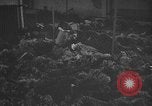
Nazi concentration camp victims, and emaciated Prisoners of war. Massacre in Lublin, Poland
Concentration camp survivors of Bergen-Belsen and Nordhausen in World War II. Some victims lying inside a building and two sitting outside a tent. U.S. soldiers with red crosses on their helmets, place one survivor on a litter. Another survivor is carried to ambulance by other survivors dressed in striped prisoner uniforms. Views of emaciated concentration camp survivors. Scenes of war in Germany. Aircraft drops bombs. Tanks fire guns at buildings in cities. Rescuers carry concentration camp survivors on stretchers. Views of healthy, well-fed local German citizens who live only a few kilometers from a concentration camp, where atrocity victims were starving and suffering. Prisoners of war cooking food over fires at a prison camp. They show their bodies after surviving maltreatment at Nazi camp. Rescued prisoners being provided medical treatment. View of Lublin Castle, Poland. Rooms filled with dead bodies of forced laborers killed by the Nazi German forces. Women weep looking at the dead bodies.
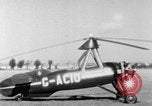
Cierva C30 Autogiro parked at airfield. Autogiro lands on roof of new Post Office Building in Philadelphia, Pennsylvania, USA.
Cierva C30 Autogiro (G-ACIO) built by British A.V. Roe & Co. is seen parked at Air Park, London, England. Several views of the autogiro. Scene shifts to aerial view of the new Federal Post Office building in Philadelphia, Pennsylvania, U.S.A. A Kellett autogiro lands on the building roof, on May 25, 1935,as part of dedication ceremonies,for the new Post Office building. Officials stand on the rooftop watching the landing. The pilot delivers a mail pouch to James A. Farley, the U.S. Postmaster General, thus initiating airmail service between Camden New Jersey and Philadelphia. Aerial views of the Post Office building and surrounding downtown Philadelphia. The autogiro climbing steeply away.
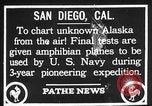
Pilots load tri-lens aerial camera aboard aircraft and Lieutenant Wyatt discusses problems with pilots in San Diego,California.
First test flight of the amphibian aircraft to be used by United States Navy out of San Diego, California, to document unchartered territory in Alaska. An aircraft taxis and takes off from the airfield. Mountains in the background. The aircraft in flight over sea. Ships docked at sea in the background. The wheels of the aircraft fold and the aircraft taxis at sea. Pilots load tri-lens aerial camera aboard an aircraft. Lieutenant B H Wyatt, Commander of the expedition, discusses problems with pilots. The Commander points at a map. Tents in the background.
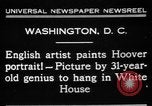
An English artist paints United States President Herbert Hoover's portrait in Washington DC.
An English artist paints a portrait in Washington DC. An English artist paints U.S. President Herbert Clark Hoover's portrait. The artist prepares the portrait to be hung in the White House.
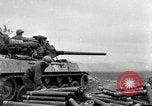
General Buckner visits 7th Infantry Division OP and tours area in the Pacific Theater during Ryukyu Campaign of World War II.
U.S. Army 77th Infantry Division advance in the Pacific Theater during Ryukyu Campaign of World War 2. Soldiers fire American M-18 Hellcat tank against Shuri Line. Mountains in the background. Tanks move through rugged terrain. United States Army Lieutenant General, Simon Bolivar Buckner visits United States Army 77th Infantry Division and tours area. Soldiers moved past damaged United States tank. Soldiers advance toward hillside. They fire into caves as they progress. Explosions rise.
CRITICALPAST.COM: About Us | Contact Us | FAQs - How to Order | License Agreement | My Account | My Lightboxes | Shopping Cart | Advanced Search | Featured Collections | Website Terms & Conditions | Privacy Policy ©2026 CriticalPast LLC.
License Agreement |
Terms & Conditions |
Privacy Policy
©2026 CriticalPast LLC.