


 Francais
 Deutsch
 Italiano
Refine Your Search
US-Gliders- stock footage and images
- Showing 20977 to 20982 of 21919 results more
more Hide
Hide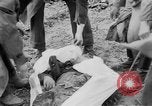
German Civilians wrap dead bodies in shrouds and place them in individual graves during a mass burial in Gardelegen, Germany.
A mass burial in Gardelegen, Germany during World War II, for victims of the Gardelegen massacre. German civilians wrap dead bodies in shrouds and place them in individual graves. They pour dirt in the graves with shovels. Burned barn building in background.. They are burying concentration camp and slave laborer victims of nazi atrocities who died after being locked in the barn that was then set on fire, in Gardelegen, Germany, on April 13, 1945. The atrocity was discovered by the U.S. Army 102nd Infantry Division on April 14, which directed the German civilians to properly bury the victims from April 21-25, 1945.
A dramatization of a fight between a foreman and a superintendent inside a tunnel in New York, United States.
Paper print. Turn of 20th century motion picture. Tunnel workers in New York, United States. A dramatization depicts: a construction foreman and his family seated at a table having a meal. The foreman gets up and leaves. A woman gives a cap to her daughter and kisses her. A superintendent arrives at a window. He meets the foreman's daughter and wife. The foreman watches them and shouts. The woman and the girl weep. Workers work in a tunnel under a river. They bring construction material and pile it. The workers leave the tunnel. The foreman and the superintendent fight. A smoke column rises from a blast. A worker shouts and calls others. The workers come and open chamber gate. A worker shouts for help. Other workers remove stones and rescue the superintendent. They carry the wounded superintendent and beat the foreman. The wounded foreman rests on a bed in his house. His wife opens the door for a doctor. The doctor treats the wounded foreman. The superintendent using crutches to walk comes and asks the foreman to forgive him.
9th Weather Reconnaissance Group members record and transmit information during storm tracking mission in the United States.
Hurricane Hunters track storm in the United States. Scenes of city during hurricane. People wade through water. In Texas:Civil Air Patrol (CAP) Cadets evacuate the victims. Members of the 9th Weather Reconnaissance Group board U.S. Air Force WB-50 Superfortress aircraft at the Kindley Air Force Base (ABF) ,Bermuda on a storm tracking mission. Aircraft takes off and in flight. Aircraft crew at controls as they fly into storm. View of the storm eye. Weather watchers record data and transmit information by wireless key to the Hurricane Weather Center in Miami. A teletype being operated. Woman goes through the damaged house.
Airman Phillip Clark is honored as top trainee by Major General Robert Stillman at Lackland AFB in Texas,United States.
Airman Phillip Clark is honored in Texas,United States. Base Commander Major General Robert Stillman honors Airman Phillip Clark as the top trainee. Fellow airmen march past during parade at the Lackland Air Force Base (AFB). Commander Stillman and Airman Clark on the reviewing stand. Airman Clark gets in the U.S. Air Force T-33 Shooting Star jet trainer aircraft. The aircraft takes off from the Kelly AFB. Airman Clark is greeted as guest of honor at the Rotary luncheon. Clark visits the City Hall. He takes his seat as the honorary mayor of San Antonio,Texas.
A USAF C-123B Provider transport and a C-124A Globemaster II cargo aircraft land in South Carolina.
Reserve airmen of a Recovery Unit in South Carolina. Airman gets in car and drives. Reserve airmen ready the field for use. Reserve airmen and officers of a Recovery Squadron gives a Readiness test at North Field near Columbia,South Carolina. United States Air Force (USAF) C-123B Provider transport aircraft taxis for landing. Reserve airmen check the aircraft and crew for radiation. Wounded men are evacuated by ambulance. Airman operates a radio. USAF C-124A Globemaster II cargo aircraft with modified radome nose lands at airfield. Emergency vehicles drive onto the runway.
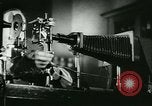
Engineers study the internal structure of the metal casting and find defects at the X-ray laboratory in the United States.
Railroad research and railroad network in the United States. Worker works on springs for smoother rides. He studies and tests metals and parts. Rubber gloves are immersed and water and checked. Worker undergo a goggle test. Engineer checks metals for defects using electric current. Engineers study the internal structure of the metal casting and find defects at the X-ray laboratory. Locomotive moves on track. Animated map depicts: the network of railroads spread over various countries in America.
CRITICALPAST.COM: About Us | Contact Us | FAQs - How to Order | License Agreement | My Account | My Lightboxes | Shopping Cart | Advanced Search | Featured Collections | Website Terms & Conditions | Privacy Policy ©2026 CriticalPast LLC.
License Agreement |
Terms & Conditions |
Privacy Policy
©2026 CriticalPast LLC.