


 Francais
 Deutsch
 Italiano
Refine Your Search
US-Gliders- stock footage and images
- Showing 2095 to 2100 of 21924 results more
more Hide
Hide
U.S. fliers drop bombs near river of Mauna Loa volcano lava to divert it from waterworks in Hawaii, United States.
U.S. fliers bomb Hawaii Mauna Loa volcano to divert lava in Hawaii, United States. Aerial view of diamond formation of three U.S. Army Air Corps Keystone B-3As bomber aircraft and two U.S. Army Air Corps Keystone LB-6A light bombers in flight over Hawaiian mountains. Eruption of Mauna Loa volcano. Lava flowing down its sides. The bombs exploding near river of lava to divert it from waterworks at Hilo, Hawaii. Three B-3As and two LB-6As in flight in line-a- step formation. The bombs exploding near river of flaming lava flowing down the sides of Mauna Loa volcano.

U.S. Army Air Corps crewmen wearing heavy flight clothing and A-12A aircraft flying in formation in Michigan, United States.
U.S. Army Air Corps crewmen at Selfridge Air National Guard Base near Mount Clemens in Michigan, United States. U.S. Army Air Corps crewmen, wearing heavy flight clothing stand near line of U.S. Army Air Corps Martin B-10 bombers parked on a flight line. Two ground crewmen warming engines of A-12A with oil stove. Two pilots putting moccasins on a collie dog. A pilot donning heavy flight clothing. Propeller turning over. Six A-12As in flight in formation. A pilot in the cockpit. A B-10 in flight. The B-10 in flight and a tail of second B-10 in the foreground. The pilot in the cockpit. Two B-10s in flight. A B-10 in flight.
U.S. Women Army Corps march, and woman work in war production factories in World War 2 in the United States.
Contribution of U.S. women in the war effort in the United States during World War 2. U.S. troops fire a camouflaged artillery. Aircraft parked in a line. The aircraft take off one after the other. The aircraft in flight. A woman Marine looks through binoculars. Another Marine stands beside her. A ship underway in the background. The women Marine looks into documents. The members of the U.S. Women Army Corps (WAC) at work. Women war production workers in war production factories and machining factories make tools to help with the war effort. A woman worker operates industrial equipment. American soldiers carrying supplies embark a ship. Animated map shows the location of Berlin and Tokyo. The women walk in a group. A woman speaks to a man at an office. The Women Army Corps (WAC or WACC) march on a street. Buildings in the background. Narrator asks women to join the war effort as war workers or by joining the armed forces. The women march. The troops fire guns. Smoke rises due to explosion. The areas where women are needed.
U.S. Marines fire guns, blow a cave, and captured Japanese troops walk on the Palau Island during the Invasion of Philippines.
U.S. Marines capture Palau Island during World War II. U.S. Marines advance on the Palau Island. The Marines fire guns. Smoke rises in the background. The Marines load guns and fire the gun. Shells kept in the background. The Marines get off from the landing crafts. The marines fire. A Marine sprays liquid fire in a Japanese foxhole. The Japanese troop runs. The U.S. Marines shoot the troops. The dead Japanese troop. The Marines fire and advance. The Marines blow up a cave. The captured Japanese soldiers walk with their hands up.
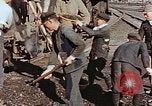
The laborers use wicker baskets and dump the baskets into a coal bunker of the tender, Nagasaki.
The laborers employed in Nagasaki, Japan after the atomic bombings during the end of World War II . A locomotive standing on a siding at Nagasaki railroad yard. A man using shovel to put the coal in a basket. The human chain method as they dump the coal into the tender. The laborers use wicker baskets to pass the coal up to the tender. The coal in the tender. The laborers on a ladder passing coal in the tender. The laborers dump the baskets into a coal bunker of the tender. A man using shovel to put the coal in a basket.
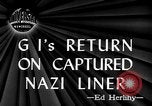
U.S. Marshal James MacKay takes possession of the German liner Europa as it arrives in New York.
U.S. troops on the Nazi German liner Europa arriving in New York harbor after the end of World War II. Europa approaching the New York harbor. U.S. troops seen aboard, on the deck of the ocean liner. A Nazi flag on the ship. The troops stand on the deck. A banner reads 'Hiya Butch'. Captain of the liner is seen. U.S. Marshal James MacKay signs a document and takes possession of the vessel for the United States. The Naval officers stand in a group.
CRITICALPAST.COM: About Us | Contact Us | FAQs - How to Order | License Agreement | My Account | My Lightboxes | Shopping Cart | Advanced Search | Featured Collections | Website Terms & Conditions | Privacy Policy ©2026 CriticalPast LLC.
License Agreement |
Terms & Conditions |
Privacy Policy
©2026 CriticalPast LLC.