


 Francais
 Deutsch
 Italiano
Refine Your Search
US-Gliders- stock footage and images
- Showing 21001 to 21006 of 21919 results more
more Hide
Hide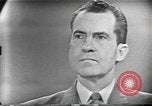
Richard Nixon argues against federal government control over education during a presidential election debate in Chicago.
The first Kennedy-Nixon Presidential Debate in Chicago, Illinois. Charles Warren from Mutual News asks Republican candidate U.S. Vice President Richard M. Nixon about the raising of education standards and the reason for his refusal to vote in favor of increase in salary of teachers in the Senate. Nixon answers and objects the potential cost in controls and states his views against federal government control over education. He talks about the role of the state and local communities towards the education system. Democratic candidate Senator John F Kennedy presents his views on the matter and states that the issue before the Senate was the money given to the state which would then decide whether to spend it for school construction or on teachers' salaries. He objects to the federal government paying teachers' salaries directly. He disagrees with the statement made by Nixon regarding unbalancing of budgets by execution of programs.
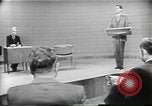
During a presidential election debate in Chicago, Illinois Nixon states that he hopes to control the House and get a majority.
The first Kennedy-Nixon Presidential Debate in Chicago, Illinois. Bob Fleming from ABC News asks Republican candidate U.S. Vice President Richard M. Nixon whether he could work better with Democratic majorities in the House and Senate than Senator Kennedy. Nixon answers and says that he hopes to control the House and to get a majority in the House in the elections. He states that the President cannot control the Senate and the President needs the support of the country and people to get his programs accomplished. He says that whenever a majority of the people are in favor of a program, the House and the Senate respond to it and it does not matter if the House and the Senate in the next session is Democratic or Republican. He disagrees with the reason of a presidential veto by Kennedy. Democratic candidate Senator John F Kennedy presents his views. Kennedy talks about the bill for minimum hourly wage system against which the Republicans voted. He then talks about the federal aid to education bill which failed because the Republicans did not vote for it. He talks about the third bill of medical care for the aged which is tied to Social Security, which is financed out of Social Security funds and it does not put a deficit on the Treasury. Kennedy concludes that these are three programs which are quite moderate and not extreme.
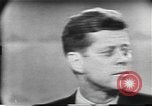
During a presidential election debate in Chicago Kennedy talks about the threats of Communism to the national security.
The first Kennedy-Nixon Presidential Debate in Chicago, Illinois. Charles Warren from Mutual News asks Democratic candidate Senator John F Kennedy about the threats of Communism to the national security of the United States. Kennedy states that matter of Communism should be given great care and attention. He states that the citizens should support the laws passed by the United States and they should sustain the Department of Justice and the Federal Bureau of Investigation (FBI) in its efforts. He further states that the Americans can meet any internal threat but the major threat is external. Republican candidate U.S. Vice President Richard M. Nixon presents his views and states that he agrees with Senator Kennedy's appraisal generally in this respect. He talks about the Cold War. He states that they could also fight Communism at home by moving against those various injustices which exist in their society which the Communists feed upon.
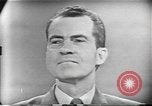
During a presidential election debate in Chicago Richard M. Nixon talks about the reasons for the financing of schools.
The first Kennedy-Nixon Presidential Debate in Chicago, Illinois. Sander Vanocur from NBC News asks Republican candidate U.S. Vice President Richard M. Nixon whether the financing of the schools and hospitals was provided by the Eisenhower Administration or by the local school districts. Nixon answers and states that they only think about the work of the federal government. Instead they should consider the joint effort by the federal, state, local government and individual enterprise. The reason the Eisenhower Administration has supported the funds to build schools, hospitals and highways is because this administration has encouraged individual enterprise. Another reason is the greatest expansion of the private sector of the economy and the overall growth of our country. Democratic candidate Senator John F Kennedy presents his views and states that the reason for the construction of schools is because of the willingness of the local school districts to increase property taxes. And also because the United States is a powerful country. He compares the country's progress with that of their adversaries and hopes an overall progress in the field of education, in health, in buildings, in homes and in economic strength.
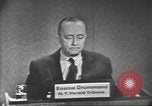
John Kennedy and Nixon debate over the prestige of America prior to the presidential elections in the United States.
Presidential election debate held between Democratic nominee Senator John F. Kennedy and Republican nominee U.S. Vice President Richard Nixon in the United States. New York Herald Tribune newspaper correspondent Roscoe Drummond asks Senator Kennedy that how can American prestige be measured abroad. Senator Kennedy responds stating that America is identified with the cause of freedom and if other countries have to choose between America and a Communist country, they would choose America. He further speaks that there are many indications that prestige of the United States is not as high as it once was. Kennedy summarizes some of these indications and relates to it by mentioning the example of Sputnik space program by the Soviet Union in 1957 (during the Space Race). Kennedy speaks about the economic development of the Soviet Union. He says the Soviet Union will be ahead of any other country scientifically and militarily by 1970. He mentions votes by different countries in the United Nations dealing with Red China. He says that Guinea and Ghana, two independent countries now are supporting Soviet foreign policy at the UN. NBC correspondent Bill Shadel asks Richard Nixon to speak on the topic. Vice President Nixon responds by speaking about the economic development of the Soviet Union. He speaks that the Soviet Union is a very primitive economy and that the United States is well ahead economically. He says that if the United States is going to maintain its strength and its prestige, they must not only be strong militarily and economically but must be firm diplomatically also. Bill Shadel says that an entire hour was devoted to answering questions from the reporters. He says that each candidate was questioned in turn and each had the opportunity to comment on the answer of his opponent. Shadel says that the reporters were free to ask any question on any subject, neither candidate was given any advance information on any question that would be asked. He says that the fourth debate is scheduled for Friday, October twenty-first.
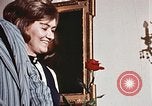
Julie Nixon Eisenhower speaks to Goodwill Worker of the Year Mrs. James Klotz in the White House Library in Washington DC.
Goodwill Worker of the Year Mrs. James Klotz in the White House Library in Washington DC, United States. Mr. James Klotz stands. He gives a rose to Julie Nixon Eisenhower, the daughter of U.S. President Richard Nixon. Julie then greets Mrs. Klotz and talks to Mr. Klotz. Julie poses for pictures with two men.
CRITICALPAST.COM: About Us | Contact Us | FAQs - How to Order | License Agreement | My Account | My Lightboxes | Shopping Cart | Advanced Search | Featured Collections | Website Terms & Conditions | Privacy Policy ©2026 CriticalPast LLC.
License Agreement |
Terms & Conditions |
Privacy Policy
©2026 CriticalPast LLC.