


 Francais
 Deutsch
 Italiano
Refine Your Search
US-Gliders- stock footage and images
- Showing 21427 to 21432 of 21920 results more
more Hide
Hide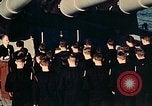
A chaplain addresses sailors during church services held aboard a ship underway at sea in the United States.
A film on the life of sailors aboard U.S. Navy ships in the United States. Church services aboard a ship on a Sunday morning. A navy chaplain addresses sailors during a sermon. The chaplain talks to a patient in bed. He meets and gives guidance to other sailors. Cooks prepare dinner in a kitchen aboard the ship. A cook takes a roasted turkey from a table. The sailors seated at a table eat Sunday dinner. A sailor eating a roasted turkey leg.

USAFE precision flying demonstration team, the "Skyblazers" perform. Various aircraft involved in crashes in Europe
A documentary titled: 'No Sweat' on accidents of USAFE (United States Air Force in Europe ) aircraft. USAFE precision flying demonstration team, the Skyblazers, perform a formation takeoff in their F-86 F Sabre aircraft. They maneuver in close formation. The airplanes leave smoke trails behind. View of an airplane diving into the ground and crashing. Views of crashed U.S. Air Force aircraft in Europe, involving a variety of airplanes, including F-86, T-33, C-119, C-47, and numerous other aircraft, some completely destroyed so as to be unrecognizable.
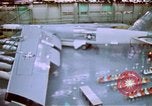
Boeing and Air Force officials gather and review progress on the B-52 Stratofortress H model at Wichita Plant in Kansas, United States.
The coverage of the Boeing 1960 Progress Report covering the development and production of U.S. Air Force B-52 Stratofortress G and H models. Interior of Boeing Wichita Plant in Kansas, United States. A high altitude view of the plant. Officials gather in the plant. The CTCI follows the CDI. The officials discuss. They scrutinize the changes in the H model of the aircraft. The model of the aircraft. A man makes a sketch and experiments for the model of the aircraft. Engineers wearing boeing lab coats conduct tests.
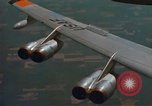
A B-52 H aircraft with turbo fan engines in flight overhead in Kansas, United States.
The coverage of the Boeing 1960 Progress Report covering the development and production of U.S. Air Force B-52 Stratofortress G and H models. A B-52 H model in flight over an air field in Kansas, United States. It is equipped with a turbo fan engine. The aircraft taxis on a runway and takes off. The airplane in flight overhead. Aerial view of the flight. Average Pacific range improvement of the aircraft due to turbo fan engines.
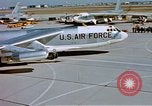
Demonstration of release of a GAM-77A Hound Dog missile from a B-52 H aircraft in flight in Kansas, United States.
The coverage of the Boeing 1960 Progress Report covering the development and production of U.S. Air Force B-52 Stratofortress G and H models. A B-52 H aircraft parked at an airfield in Kansas, United States. The airplane is equipped with a GAM-77A Hound Dog missile. The aircraft takes off from the airfield. The missile is released from the aircraft.
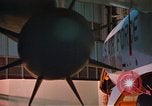
Men work on a GAM-87A Skybolt ballistic missile at Wichita Plant in Kansas, United States.
The coverage of the Boeing 1960 Progress Report covering the development and production of U.S. Air Force B-52 Stratofortress G and H models. Interior of Wichita Plant in Kansas, United States. Development of a GAM-87A Skybolt ballistic missile. The missile in the plant. Men stand nearby and work on the missile. The missile on a trailer. A B-52 aircraft in flight. The aircraft is equipped with the missile.
CRITICALPAST.COM: About Us | Contact Us | FAQs - How to Order | License Agreement | My Account | My Lightboxes | Shopping Cart | Advanced Search | Featured Collections | Website Terms & Conditions | Privacy Policy ©2026 CriticalPast LLC.
License Agreement |
Terms & Conditions |
Privacy Policy
©2026 CriticalPast LLC.