


 Francais
 Deutsch
 Italiano
Refine Your Search
US-Gliders- stock footage and images
- Showing 21685 to 21690 of 21920 results more
more Hide
Hide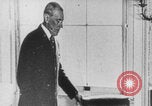
President Woodrow Wilson in office, United States troops leave for Europe (WWI)
United States President Woodrow Wilson at his office in the White House after the entrance of the United States into World War 1. President Wilson holding a telephone on top of his filing cabinet. President Wilson signing documents from his desk. A little girl waves the flag of the United States as US troops (American Expeditionary Forces or AEF) mobilize to leave for Europe. Men holding baskets during a parade as flowers are thrown before them. Crowds watch as American Expeditionary Forces march in a parade. Men and women wave good-bye at soldiers leaving for Europe. A government official with a senior military official watch the deployment of soldiers to Europe.
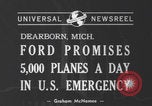
Ford executives inspect military planes as company promises to meet war demands for aircraft (WW2)
Ford executives meet with a U.S. military official as the company promises to build 5000 aircraft per day to meet war production demands in World War 2. Ford executives inspect planes. Charles “Charlie” Sorensen, Ford executive responsible for Ford’s defense contracts, speaks with United States military officer and inspects a Curtiss P-40 (possibly an XP-40) fighter. Edsel Ford, Charlie Sorensen and an officer inspect the fighter’s cockpit. Henry Ford, wearing a straw boater, observes the meeting. Propeller of the P-40 fighter plane. Henry Ford listening to a discussion. Military aircraft in flight over mountains as seen from an aircraft. Spectators watch and take photographs. View of aircraft in flight. Cockpit POV view of a group of bombers in flight. Aerial view of three United States Army bombers (likely Boeing Y1B-17 ) in flight. A Boeing Y1B-17 flying. A group of United States Army Boeing Y1B-17 bombers in flight.

Spectators watch eagerly as horse Bimelech and jockey Fred A Smith win the 1940 Belmont Stakes at Belmont Park
940 Belmont Stakes at Belmont Park, New York (2150 Hempstead Turnpike, Elmont, NY 11003, United States). Huge crowds watch the Belmont Stakes horse race. Two horses trotting before the race. A man uses binoculars and another man pointing during the race. Horses come out of the starting gates to run on a turf track. Spectators eagerly watch the race. A man chews gum while fashionable women behind him watch the horse race. A horse named Bimelech and ridden by jockey Fred A Smith wins the 1940 Belmont Stakes.
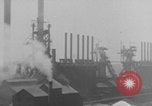
President of Lukens Steel Company, Robert W. Wolcott, speaks about the importance of scrap metal in the wartime steel industry (WW2)
Smokestacks in a steel factory in the United States during World War 2. Robert W. Wolcott, the President of the Lukens Steel Company in Coatesville, Pennsylvania (the oldest steel mill in commission within the United States), and also chairman of the American Industry Salvage Committee, speaks about the importance of scrap metal in steel production for the war efforts in World War 2. Robert W. Wolcott speaks to two men inside his office. Wolcott’s office is decorated with patriotic posters on the use of scrap for war production (“Half the Metal in every ship, every tank, every gun is SCRAP!”). Behind Robert W. Wolcott is a sign saying “American Industries Salvage Committee”. “This decline in scrap must be checked. Steel, scrap must flow to the mill. This is becoming a serious situation. And it is a definite challenge to industry” concludes Robert W. Wolcott.
Major General Lucius D. Clay speaks of importance of scrap metal for war production (WW2)
Exterior view of the Pentagon building in Washington DC. Entrance facade of The Pentagon. Inside the Pentagon, sign says “Director of Materiel Army Service Forces Major General Lucius D. Clay”. Major General Lucius D. Clay, Director of Materiel speaks about the importance of steel in the production of US war materiel for World War 2. A secretary writes down his speech. “However our contribution to the collection of scrap can in no way meet the demand. We must depend on our home front, to exert its best effort, to collect the huge tonnage of scrap. The steel industry must have the scrap if our arms services are to obtain the high quality of steel needed for invasion. The collection of steel scrap is a vital part of our war supply program” Major General Lucius D. Clay says as he concludes his speech.
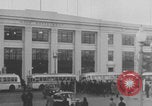
Rear Admiral Edward L. Cochrane speaks about United States Navy shipbuilding steel needs during WW2.
View of the Navy Department building, also known as the Main Navy and Munition Buildings (now demolished and turned into Constitution Gardens. Constitution Ave. NW, Washington, DC 20024, United States). Sign says “Bureau of Ships”. Rear Admiral Edward L. Cochrane speaks about the United States Navy’s shipbuilding and maintenance program during World War 2 and great needs for steel. To underscore his point, he notes that, "A single salvo of the main battery guns of such a ship as the South Dakota, for example, will take 10 tons of finished steel." He goes on to say, “Our job in the Navy until the war is over is using steel to build and to fight. We must continue to rely on the Homefront efforts to collect the big tonnage of heavy industrial scrap which is needed to make a fine quality steel in huge quantities which we need in the Navy” concludes Rear Admiral Edward L. Cochrane.
CRITICALPAST.COM: About Us | Contact Us | FAQs - How to Order | License Agreement | My Account | My Lightboxes | Shopping Cart | Advanced Search | Featured Collections | Website Terms & Conditions | Privacy Policy ©2026 CriticalPast LLC.
License Agreement |
Terms & Conditions |
Privacy Policy
©2026 CriticalPast LLC.