


 Francais
 Deutsch
 Italiano
Refine Your Search
US-Gliders- stock footage and images
- Showing 217 to 222 of 21920 results more
more Hide
Hide
Formation of transport planes fly overhead at RAF Newbury (WW2)
Allied transport aircraft fly overhead at RAF Newbury in Berkshire, England during World War II. The transport planes release gliders. A Waco CG-4 Hadrian military glider bank as it lands on the airfield. Various military planes parked in the background. A formation of transport planes fly overhead. A British Airspeed AS.51 Horsa military transport glider. C-47 Skytrain transport plane tows a glider during takeoff.
Scenes showing some of the earliest aircraft in the first decade of human heavier-than-air flight
Mankind's earliest attempts at achieving heavier-than-air flight, and footage of early and historic flight and aircraft. Animated film clip showing imaginary rocket in flight. View from an airplane taking off with other aircraft and terminal buildings seen outside. A caption reading "We can fly." Views from airplane windows of scenes below, including a town, bodies of water, Alpine lodges, and snow-covered mountains. (Views are from a Ju52 passenger plane, the corrugated wings, of which are seen.) Some views are out of the small round port window of the airplane. Sequence shifts to film reenactment of Otto Lilienthal setting up one of his early ornithopter-like gliders (looks like early hang glider), and running downhill to launch it (circa 1895). A still photo of Lilienthal aloft in one of his gliders. View of German Karl Jatho's airplane, circa 1903. The American Wright brothers airplane being started and taking off. The Wright Flyer airplane in flight. The Voisin-Farman I airplane in flight. it was built by Frenchman Gabriel Voisin and flown by aviator Henri Farman in 1907. Danish inventor-engineer,Jacob Christian Hansen-Ellehammer, in his airplane, 1906. Louis Bleriot inspects his airplane, circa 1909. A pilot (not Bleriot) sits cockpit of a Bleriot airplane with engine running. He taxis and takes off.A biplane built by Gabriel Voisin in flight, circa 1909. A light monoplane built by German aviator,Hans Grade,takes off, flies a while, and lands again,at an air show in 1909. The pilot crawls out of the airplane.Photograph of The Etrich Taube (AKA Rumpler Taube) monoplane,in flight. It was designed in 1909 by Igo Etrich of Austria-Hungary, and first flown in 1910.
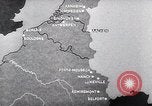
German forces fire on British aircraft and paratroopers in Battle of Arnhem during World War 2
German newsreel shows a map with Arnhem and Nijmegen and other nearby cities in Holland region. British aircraft flying overhead during Operation Market Garden (British 1st Airborne Division) as German troops fire at them from the ground during World War II. Sky is filled with Allied aircraft and parachuting British troops. British planes, gliders, and parachutes descend and some aircraft explode on impact after being hit by German rifle, machine gun, and artillery fire. German soldiers view wreckage and some burning British aircraft through binoculars and up close. British Horsa Invasion gliders burning on an open field. Scattered Allied equipment, dead bodies and gliders are seen. A group of British prisoners of war is seen gathered together on a roadside.
A Stuttgart monoplane and a Gotha biplane aircraft take off from the Wasserkuppe hill in Germany.
Gliders in flight at a contest at the Wasserkuppe hill in Germany. A Stuttgart monoplane glider with sled type landing gear takes off, in flight and lands. A monoplane glider takes off and in flight. A biplane tilts up on its nose and lands upside down during an attempt to take off. A Gotha biplane in an unsteady flight immediately after take off.
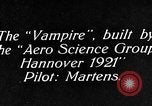
A Vampire plane and an Espenlaub biplane take off from the Wasserkuppe hill in Germany.
Gliders in flight at a contest at the Wasserkuppe hill in Germany. A group of men stand in front of a bulletin board. Two men enclose a civilian pilot in the cockpit of a monoplane. A Vampire plane being assisted in taking off. It is in flight. A group of men with a large number of spectators in the background. An old automobile carrying the fuselage of an early glider is followed by a horse drawn carriage carrying the wing of the early glider. A monoplane being launched and in flight. An Espenlaub biplane in flight.
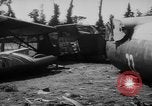
General Dwight D Eisenhower reviews a march of paratroopers after their return from Normandy.
Scenes following the D-Day Allied invasion of Normandy, France during World War II. Demolished gliders, paratroopers in a protective hole dug by them. Drop zone areas with wrecked gliders. Pathfinder's failure to light proper drop areas resulted in damaged gliders. C-47 aircraft in flight. Paratroopers in a parade as General Eisenhower and other officers review the parade. They salute as colors and troops move past them.
CRITICALPAST.COM: About Us | Contact Us | FAQs - How to Order | License Agreement | My Account | My Lightboxes | Shopping Cart | Advanced Search | Featured Collections | Website Terms & Conditions | Privacy Policy ©2026 CriticalPast LLC.
License Agreement |
Terms & Conditions |
Privacy Policy
©2026 CriticalPast LLC.