


 Francais
 Deutsch
 Italiano
Refine Your Search
US-Gliders- stock footage and images
- Showing 2389 to 2394 of 21924 results more
more Hide
Hide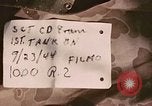
U.S. Marines of the 1st Marine Division make repairs during lull in combat on Peleliu Island in World War II
During a lull in fighting, on Peleliu, during World War 2, a U.S. marine, with two others in an improvised tent shelter, hands out mail to buddies. Their tent frame is made from broken tree limbs. Three mess kit cups hang on the top frame limb. Marines stand in a line with their mess cups to dip beverage from a large pot. Marines walk along the airfield while others ride on a landing vehicle tracked (LVT). Those on the LVT get down and walk with the rest. Partial remains of roofed structure protects some supplies and equipment. Others sit out on the ground. An M4A2 tank, of the 1st Marine Tank Battalion, sits in the background. Marines work on equipment, in the shade of the roofed shed. One uses a welding torch to make repairs. Outside the shed, marines work on M4 tanks and an LVT.
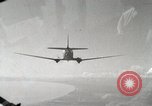
U.S. Army aircraft operations at Angaur Island, Palau, during World War 2
Rear view of a U.S. C-47 transport aircraft, as viewed from a trailing aircraft. Aerial view airstrip and ships offshore at Angaur Island, Palau. A C-47 lands at airfield. A flight of three U.S. P-38 lightning fighter aircraft, in formation, breaks for landing. A P-38 shown landing.
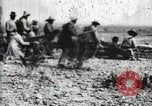
Federal soldiers fire at Rebels in Ojinaga, Mexico. and U.S. Punitive Expedition forces collect captured guns and ammo
Federal soldiers fire at Rebels in Ojinaga, Mexico. General Mercado and General Castro look through binoculars. Dead Rebels on ground. Federal soldiers and U.S. Army Punitive Expedition forces collect rifles and other captured equipment. U.S. Army Major McNamee, in charge of Fort Presidio, examines captured guns and ammunition.
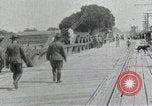
Release of U.S. 10th Cavalry prisoners at the International Bridge in El Paso, Texas
United States General James Franklin Bell and a motor cycle squadron go to the International Bridge to meet U.S. prisoners from the 10th Cavalry "Buffalo Soldiers" held by Mexico. The prisoners stand in line at Carrizal. They had been released by Mexican Constituionalist Army leader Venustiano Carranza Garza 10 days after the battle between U.S. forces and Mexican federal soldiers at Carrizal. Officer gives instruction to prisoners.
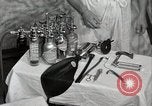
1st U.S.Marine Corps Medical Battalion surgeon attends to wounded U.S. Marine in tent, Bougainville, Papua New Guinea.
Physician of the 1st United States Marine Corps Medical Battalion performs surgery on a wounded U.S. Marine in a tent at Bougainville, Papua New Guinea, within the Solomon Islands archipelago. Surgeon prepares instruments for operation. Patient is given anesthesia via inhalation. His back shows large cut swabbed with antiseptic. The patient is given intravenous injection. Surgeon performs a thoracotomy incision on patient's chest to remove shrapnel from his thoracic cavity. The lung is visible in the wound as a retractor is placed to expose the inside of the chest. The surgeon removes the shrapnel and places it on piece of cloth. Surgeon reapproximates the ribs using wire suture. Chest tube is inserted. Doctors dress the wound with gauze. Attending medical staff wipe face of patient and doctor with clean cloths. X-Ray of the patient shows pieces of shrapnel in his chest.
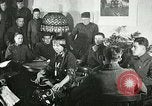
U.S. soldiers watching the performance of Tsianina Redfeather (a.k.a. Tsianina Blackstone), during World War I .
Tsianina Redfeather (also known as Tsianina Blackstone), a famous Creek-Cherokee Native American Indian mezzo-soprano, plays the Hawaiian guitar and sings for U.S. soldiers in YMCA- sponsored entertainment for the troops in a canteen, 1917-1918, during World War 1. (Historic note: While sailing to Europe in 1918 as a member of the American Expeditionary Forces, her vessel, the HMS Carmania, was struck by a torpedo. She continued the journey, entertained thousands of troops, and received a commendation for her service. Her interest in entertaining the troops, according to her autobiography, rested in the fact that so many American Indian soldiers were fighting overseas-- around 17,000. After her return to the U.S. her career continued to escalate. This clip perhaps represents the only surviving footage of this truly remarkable individual.)
CRITICALPAST.COM: About Us | Contact Us | FAQs - How to Order | License Agreement | My Account | My Lightboxes | Shopping Cart | Advanced Search | Featured Collections | Website Terms & Conditions | Privacy Policy ©2026 CriticalPast LLC.
License Agreement |
Terms & Conditions |
Privacy Policy
©2026 CriticalPast LLC.