


 Francais
 Deutsch
 Italiano
Refine Your Search
US-Gliders- stock footage and images
- Showing 19 to 24 of 21920 results more
more Hide
Hide
French volunteers leave on a U.S. Army truck, anti-glider poles placed by Germans near Mont-Saint-Michel (WW2)
A French soldier (with an anchor symbol on his helmet) talks with a French civilian. A United States Army truck with soldiers and French volunteers move away from a damaged bridge. A vehicle drives on a damaged bridge. Poles planted to the ground by Germans to prevent glider landings of the Allies near Mont-Saint-Michel (Mont Saint-Michel 50170, France).
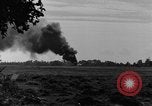
Wrecked CG-4 Haig glider, Horsa glider, Martin B-26 Marauder aircraft and other aircraft on a field in France.
Wrecked gliders and aircraft on a field in France during World War II. Smoke comes out from a burning U.S. Army Air Force Martin B-26 Marauder aircraft in the background. The B-26 burns and thick smoke rises. A U.S. soldier near a 50 caliber anti aircraft gun at an emplacement in the foreground. The wrecked gliders. The invasion marks on the gliders. A wrecked Horsa glider and invasion markings on it. The name on one glider reads 'Spook' . U.S. soldiers at an gun emplacement and wrecked gliders in a field. Many glider obstacles. A wrecked CG-4 Haig glider and invasion markings on it. Trees in the background. Wrecked gliders in the foreground. An abandoned German tank. Glider obstacles near a tree. A crushed silver U.S. Army Air Force Lockheed P-38 Lightning. Personnel examine the P-38. Trees in the background. Wrecked gliders Horsa and CG-4 on the field. Invasion markings on the gliders.
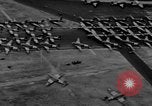
British and American C-47 tow planes and gliders during Allied invasion of Normandy in World War II
Aerial view of many USAAF Troop Carrier Command C-47 aircraft,together with gliders, parked on a field in England. The aircraft and gliders are all painted in D-Day stripes. Views on ground of C-47s taking off towing gliders behind. Formation of C-47s and gliders overhead. Views from an aircraft in a formation. Below, the Portland Bill lighthouse & directional beacon (code-named Flatbush) is seen as the formation departs the English coast. (Note: film view of Portland Bill light is reversed. Roundabout should appear to right of the lighthouse.) Closeup of a glider in the formation. View from a ship, in the English Channel, as an airplane crashes and explodes on the French coast. Aerial view of landing craft on the Normandy beach, as the formation passes overhead. View of French fields flooded by the Germans. Aerial view of parachutes from U.S. Army paratroopers who had dropped into France the night before (June 5th), but no sign of the troops themselves. Masses of gliders on the ground. View inside a glider as it cuts loose from its C-47 tow plane. View from ground as gliders cut loose and maneuver for landing. View of a glider that crashed into a German Headquarters building, and view of another landing in water. Allied gliders destroyed (some burning) and damaged by German gunfire and passive defenses (15 foot poles planted closely in landing zones). A German artillery piece concealed at the edge of a landing zone. American troops, from the gliders, marching into Saint Marcouf, France. Montage of Allied advances and gunfire. Road sign pointing to Sainte Marie-du Mont and Carentan. U.S. troops moving through French town of Sainte Marie-du Monte. U.S. troops riding in a captured German Ketenkrad tracked motorcycle.
American soldiers and medics working to rescue soldiers trapped under a wrecked glider in Holland.
U.S. 101st Airborne Division invades Holland, Netherlands during World War 2 Operation Market Garden. United States Army Air Force C-47 Skytrains and gliders in flight overhead. Aerial view of flooded lands in Holland. The gliders come in for a landing on a field. A glider tips forward hard and crashes while landing. U.S. Army soldiers and medics work to free men from the wreckage. A soldier chops a part of the glider to rescue a soldier trapped underneath. An injured man crawls out as the rescuers lift up a nose section of glider with name "Jessie" written on front. A jeep is unloaded from a glider.
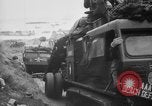
Allied paratroopers in gliders continue airborne assault in daytime, on D-day, after initial airborne troop drop the night before, in World War II
Allied invasion of Normandy, France during World War 2. Allied trucks and equipment move up from beachhead after D-Day. Half-tracks, armed with antiaircraft guns, move up from the beachhead. Back in England, gliders are readied for mission. A long line of Paratrooper medics wearing Red Cross Arm bands, board gliders. View from airplane flying over an airfield filled with C-47 tow planes, and gliders, all painted with invasion stripes. Closeup of Sergeant with British 6th Airborne Division showing Pegasus insignia on his sleeve. British paratroopers boarding a Hamilcar glider. U.S. paratroopers boarding gliders. View from above of Allied gliders being towed across the English Channel View from a ship in the invasion convoy, of tow planes and gliders overhead. View, from aircraft overhead, of invasion flotilla below. Distant view of Allied aircraft shot down by German antiaircraft fire, near the coast of Normandy and exploding in flames upon impact. View from the air of areas flooded by the Germans as a defense measure. Parachutes and gliders on the ground from earlier sorties. Gliders in this wave cut loose from tow planes and maneuver independently. Glimpses of Allied fighter planes moving fast and high above the scene. A glider splashing down in one of the flooded fields. Other fields, studded by the Germans, with poles 12-to 15 feet tall as defense against gliders. Gliders landing. Paratroopers leaving a Horsa glider, after landing.
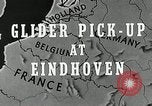
Gliders are retrieved by 9th Troop Carrier Command C-47s in Eindhoven, Netherlands (WW2)
Gliders are retrieved by TCC C-47s in Eindhoven, Netherlands during World War II. Animated map of Eindhoven. Gliders at Eindhoven, Netherlands. Men are in operation to overhaul the plane. 9th Troop Carrier Command C-47 lands. General P.L. Williams inspects the military operation. Men prepare for picking up gliders. Gliders are towed and ends of the ropes are tied to gliders and C-47's. A man gives signal for take off of C-47. Men use the gliders pick up device. Glider is ready for pick up. C-47 pick the glider up and flies with glider.
CRITICALPAST.COM: About Us | Contact Us | FAQs - How to Order | License Agreement | My Account | My Lightboxes | Shopping Cart | Advanced Search | Featured Collections | Website Terms & Conditions | Privacy Policy ©2026 CriticalPast LLC.
License Agreement |
Terms & Conditions |
Privacy Policy
©2026 CriticalPast LLC.