


 Francais
 Deutsch
 Italiano
Refine Your Search
US-Gliders- stock footage and images
- Showing 2701 to 2706 of 21924 results more
more Hide
Hide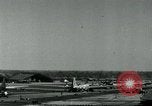
B-29 bombers of the 7th Bombardment Group of the U.S. Army Air Force fly after bombing targets in Burma during World War 2
China-Burma-India Theater during the World War II. Bombing on targets by the 7th Bombardment Group of the U.S. Army Air Force. Smoke rises high due to a explosion. A number of B-29 bombers of the U.S. Army Air Force flying in a formation.
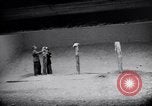
Soldiers of Allied army at a firing squad chamber used by the Nazi forces, during World War II in France (the Balard shooting range).
Soldiers of Allied army at a firing squad chamber used by the Nazi forces, during World War II in France (the Balard shooting range in Issy-les-Moulineaux). The stakes where people were tied prior to their execution. The soldiers imitate the execution practices used by the Germans. Pieces of clothes and a rosary of those who were executed by Nazi forces.
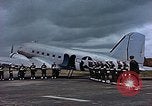
U.S. General Hoyt S. Vandenberg, Commander of the 9th Air Force greets officers of the Free French Air Force at end of World War II
A U.S. Army Air Corps honor guard stands around a C-47 transport plane, at an airport in Torgau, Germany at end of World War 2. Glimpse from behind of officers assembling on the ramp near the airplane. Closeup of the Ninth Air Force logo and the name, "Suzanne,"below the pilot's window on the aircraft. A staff car arrives and several U.S. Army Air Corps officers step from the car, including Lieutenant General Hoyt S. Vandenberg, Commander of the 9th Air Force and Major General Otto P Weyland, who would succeed him as 9th Air Force Commander. They join officers of the Free French Air Force at an area of the airfield ramp beside a destroyed hangar. They shake hands and talk with Free French Air Force officers, wearing black caps. The one in Leather jacket is General Martial Henri Valin Commander of Free French Air Force. Closeup of General Valin and General Vandenberg conversing. All stand at attention and salute colors or band plays National Anthems (unseen) General Vandenberg leaves walking toward the camera and boards his aircraft, as those behind shake hands and say good byes. A brass band plays and then the honor guard marches away from the aircraft. The right engine starts and then the left. An unidentified Air Corps Brigadier General waves goodby as the C-47 taxis out for takeoff.
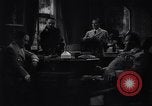
Tactics used by the Nazis to prove and sustain their theory of racial supremacy.
U.S. Army training film depicts racial theories used by the German Nazi party. Clip includes mix of actual footage and actor portrayals. Actors portraying Nazi leaders Adolf Hitler, Hermann Goring and others at their office. Next scene is authentic footage of book burning by Nazi soldiers. Actor portraying prisoner in jail cell. Actual view of people in Germany migrating with their belongings. Several views of University students crossing a bridge over River Lahn, and buildings of Philipps University of Marburg in Marburg Germany during the late 1930s or early 1940s. View of news commentator speaking at microphone of BBC radio. Cover page of an edition of The New York Times as example of media banned in Nazi Germany. Actual footage of Goebbels speaking and addressing a group. Footage of champion African American boxer Joe Louis fighting in the boxing ring. His fights were banned to be seen in Germany. View of scientist Albert Einstein walking in a garden area outdoors and then on a footpath toward what appears to be Nassau Hall of Princeton University in New Jersey, USA. Remainder of clip shows dramatized scenes with actors, as follows: Catholic priest and a judge express fear from hatred spread by Nazis and oppose Nazi theories. They were put into concentration camp. A teacher in class disapproves Nazi theory of racial supremacy. Nazi soldiers arrest him. (World War II period).

French officers examine facilities used by Gestapo during Nazi occupation of France in World War II
Views of Nazi facilities that had been used by the Gestapo to torture and kill prisoners during the German occupation of Paris, France, in World War 2. A long low tunnel is seen (that had been a rifle range for the Ministry of Aviation). French soldiers and Partisans examine wooden stakes and hand prints of victims on the walls. Closeup of the uniformed French officers examining the wooden stakes where prisoners were executed by firing squads. Numerous bullet holes and damage is evident in the stakes. A blindfold and rosary are found on one stake. In another area, the officers examine wooden coffins ready for use. In the courtyard, a large excavation is shown where numerous bodies were dug up. Wooden boxes are seen that contained bodies.
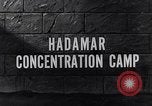
Major Herman Bolker of the U.S. military and his subordinates visit atrocities at Hadamar concentration camp after World War II.
Hadamar concentration camp in Germany visited after World War II. Major Herman Bolker and his sub-ordinates step out of a U.S. military truck and move into the camp. Disease-stricken, weak and starved prisoners at the camp. Guards dig a common grave and pull out corpses of the victims of this concentration camp. Doctors and priests at the place. Guards make notes about the dead. Chief physician of the camp, Adolf Wahlmann, with head nurse, Karl Willig, are interrogated by Major Walker. He shows a bottle of morphine, as morphine injection was commonly used to murder the inmates. Soldiers arrest Wahlmann.
CRITICALPAST.COM: About Us | Contact Us | FAQs - How to Order | License Agreement | My Account | My Lightboxes | Shopping Cart | Advanced Search | Featured Collections | Website Terms & Conditions | Privacy Policy ©2026 CriticalPast LLC.
License Agreement |
Terms & Conditions |
Privacy Policy
©2026 CriticalPast LLC.