


 Francais
 Deutsch
 Italiano
Refine Your Search
US-Gliders- stock footage and images
- Showing 3031 to 3036 of 21924 results more
more Hide
Hide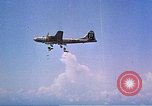
U.S. defeats Japan in Pacific through air power in World War II; multiple views of American combat aircraft in action in World War 2
From "The Last Bomb": The defeat of Japan through American airpower in World War 2. Mix of actual combat footage and a small amount of vintage, dramatized, pilot in cockpit footage. A single B-29 from the 39th Bomb Group (stationed at North Field Guam) drops clusters of incendiary and fragmentation bombs over Japan. Bombs away view of large number of bombs falling toward Japan. A formation of B-29s from the 498th Bomb Group, Isley Field, Saipan, in flight during a daytime bombing mission over Japan. Explosions and smoke rise from targets in Japan, including two Japanese aircraft plants and an airdrome as part of U.S. tactical plan 574. Color, low aerial view of massive bomb damage over Tokyo following U.S. air attacks of March 1945. Escorting P-51s from Iwo Jima engage defending Japanese fighter aircraft in dogfights. Aerial gun camera footage of Japanese airplanes being hit, exploding, bursting into flames, and falling from sky to crash. Later, P-51s conduct strafing attacks against Japanese ground targets, including: lines of communication; railroads; marshaling yards; factories; airfields; ships; and harbors. Color gun camera footage shows these strafing attacks. P-51s returning to land at Iwo Jima and performing celebratory rolls over the field. Crippled B-29s making emergency landings on Iwo Jima. A B-29 from 500th Bomb Group with an engine shutdown. A B-29 from the 29th Bomb Group. Bad weather over runway at Iwo Jima forces a P-51 pilot to bail out over the field. A B-29 from the 6th Bomb Group ditches in water near beach on Iwo Jima. A B-29 crashes and bursts into flames during landing at Iwo Jima (all crew escapes.) Firefighters douse the flames with foam. Formation of B-29s from 39th Bomb Group returning to Guam after bombing mission over Japan. A B-29 crashing on landing and bursting into flames. Sole surviving crew member being carried on stretcher, as firemen and rescue teams work at scene. Formations of B-29s from 498th Bomb Group and 9th Bomb Group, in flight. Good color view from B-29 of the atomic bombing of Nagasaki on August 9, 1945, which brought about the capitulation of Japan and end of World War 2. Large mushroom cloud rising into the air following atomic bomb explosion at Nagasaki.
Marines and U.S. seventh division recapture Seoul during Korean War, Seoul in Korea.
Focuses on Korean War (1950-1953). Marines and U.S. seventh division advance in Seoul under enemy fire. U.S. troops combat enemy in streets of Seoul. Troops take cover behind sand sacks. Troops fire rifles. Tanks advance through heavy smoke in streets. Smoke arises from explosions. Soldiers relax after five days battle with enemy. Soldier talks into radio. Soldier holds a paper cutting. Headlines read 'Marines enter Seoul, Fight Reds In Streets'.
U.S. 11th Airborne units arrive at Ashiya Air Base in Japan and Kimpo Airdrome in Korea for attack on Seoul, Korea.
Focuses on Korean War (1950-1953). U.S. 11th Airborne units arrive at Ashiya Air Base to carry out Seoul operations in Korea. Soldiers unload equipment from truck at air base. Sign on building reads 'Ashiya Air Base, Base Operations'. Paratroopers board planes. Plane takes off from runway. Road sign reads 'Kimpo Airdrome Stop Military Police Check Point'. Plane taxis at Kimpo air base in Korea. Men disembark from plane. Wounded soldiers on stretcher taken into plane. Boats are carried out of cargo planes at air base. Air University Commanding General George C Kenney, and Commanding General of Far East Forces (former commander of U.S. forces) Carl Spaatz, arrive at Kimpo air base for inspection. Captured IL-10 plane parked in the background in hangar. Men manning Grumman F7F Tigercat aircraft. F7Fs in flight line.
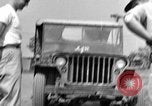
U.S. 10th Air Jungle Rescue Detachment performs Rescue mission behind Japanese lines in Burma during World War 2
10th Air Jungle Rescue Detachment mission in Burma, during World War Two. U.S. Airmen talk in front of jeep bearing Letters "AJR" on its windshield.. They examine a map. Ground crew pull props through on B-25 Mitchell bomber and clean gun turret canopies. View of pilots inside cockpit of B-25 in flight over jungle. A jungle rescue team discusses mission in front of a Sikorsky YR-4B helicopter parked at field. Pilot, Lieutenant Carter Harmon, climbs into cockpit of the helicopter. Ground crew seen pulling props through on a B-25. Views from inside a B-25 flying over jungle. The object of rescue is is seen. (TSgt Ed "Murphy" Hladovcak of the 1st Air Commandos, piloting a Stinson L-1 Vigilant with three wounded British soldiers on board, had been forced down behind Japanese lines, several miles from Mawlu, Burma.) Two B-25s are seen parked on a rough field. A white tent is nearby and many Burmese people are seen. Airmen are seen around a B-25. Brief view of happy airmen inside a vehicle. (Note: This is probably the first use of a helicopter for a combat rescue. )
U.S. Army Inverted Stinson L-5 plane, is turned right side up, by soldiers on field in Italy, during World War II
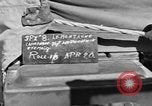
A crashed U.S. Army Stinson L-5 Sentinel airplane, serial number 42-98969, upside down on a field in Italy, during World War 2. Pilot lying on ground checks his hand. Soldiers around flipped plane. The inverted plane is righted and set on its landing gear by soldiers using ropes. (Note: Opening slate, naming Lt. Montagne, refers to Lt. Ed Montagne, 196th Signal Photo Co, .who reportedly went on to produce the TV Series McHale's Navy during the 1960s.)
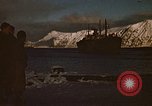
Large transport and supply ship docks at U.S. military base, in cold climate. Sailors disembark and go to billets.
Large ship approaches pier at U.S. military base. Snow capped mountains in the background. The ship docks and sailors with sea bags disembark. Trucks loaded with sailors and their sea bags pull away. Sailors with sea bags walk into barracks. Notice on building shows hours for serving "chow." Men enter the building for a meal. U.S. Navy clock shows past 1800 hours with sweep second hand moving.
CRITICALPAST.COM: About Us | Contact Us | FAQs - How to Order | License Agreement | My Account | My Lightboxes | Shopping Cart | Advanced Search | Featured Collections | Website Terms & Conditions | Privacy Policy ©2026 CriticalPast LLC.
License Agreement |
Terms & Conditions |
Privacy Policy
©2026 CriticalPast LLC.