


 Francais
 Deutsch
 Italiano
Refine Your Search
US-Gliders- stock footage and images
- Showing 3181 to 3186 of 21927 results more
more Hide
Hide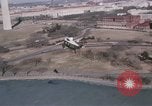
A U.S. Marine One helicopter arrives and lands in the South Lawn of the White House and takes off in Washington DC.
The White House, the residence of the President of the United States, and the area near it in Washington DC. A U.S. Marine One helicopter flies and crosses the Potomac River and the Washington Monument. The U.S. Capitol and other federal and other buildings as seen from the flying Marine One. The helicopter approaches the South Lawn of the White House and makes a landing on the helipad. The Marine One takes off again and flies back again on the same aerial path.
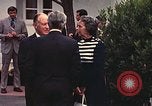
Soviet Premiere Leonid Brezhnev signs an agreement with U.S. President Nixon in San Clemente, California during his visit.
Soviet Premiere Leonid Brezhnev on a visit to the United States and meets U.S. President Richard Nixon in San Clemente, California. Secretary Rogers and his wife greet and welcome the dignitaries in the lawn of the Western White House. The dignitaries line up as President Nixon and Brezhnev arrive. They sit on chairs and sign an agreement. They stand and shake hands while other dignitaries applaud. President Nixon walks to a microphone and addresses the gathering. He expresses his satisfaction towards US-Soviet relations.
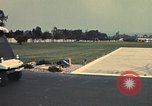
Soviet Premier Leonid Brezhnev and U.S. President Nixon are greeted by Apollo astronauts in San Clemente.
Soviet Premiere Leonid Brezhnev visits the United States. Brezhnev and U.S. President Nixon arrive at a helicopter pad in a golf court. U.S. helicopters in the background. The leaders meet Apollo astronauts. The astronauts present plaques to both the leaders. Brezhnev and Nixon move to board a helicopter. The helicopter takes off for El Toro.
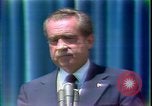
In San Clemente, California U.S. President Richard Nixon talks about the Watergate scandal and the Cambodian bombings.
U.S. President Richard Nixon talks about his officials' role in informing the prosecutors during the Watergate Scandal in San Clemente, California. A journalist seeks an explanation from the President as to why, after being informed by his officials about the White House staff's involvement in criminal activities, had he not given this information directly to the prosecutor rather than allowing his staff to conduct their own investigations. The President explains that he was under the impression that both the people responsible for communication with the prosecutor, White House Counsel John Wesley Dean and the President's Assistant for Domestic Affairs John Ehrlichman, were keeping the prosecutor informed. Another journalist asks the President whether he felt he owned an apology to American citizens with regard to the Cambodian bombing. The President states that he does not feel that way since the bombed area in Cambodia was occupied by North Vietnam Communists and was being used for attacking and killing American soldiers. The President felt that his countrymen would be thankful to him for taking the necessary action in order to save the lives of American soldiers. (Vietnam War period).
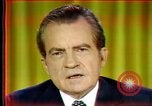
U.S. President Richard Nixon's speech on the Watergate scandal in Washington DC.
U.S. President Richard Nixon addresses U.S. citizens on the Watergate scandal in Washington, DC. The President questions upon the occurrence of the Watergate scandal and whom should one blame. He finds 1972 as the year of crucially important decisions, of intense negotiations and of new directions in achieving goals for bringing peace to United States. He states that the Presidency stands before politics. He has limited his appearances in campaigns. He believes that the culprits must bear the liability and pay the penalty. He finds it cowardly to blame his sub-ordinates, to whom he had delegated the responsibility, for the improper actions that took place within his campaign organization. Instead he accepts all the charges as he believes that the man at the top of an organization is the one who is responsible for all. The President takes a pledge to ensure a fair justice in the Watergate scandal.
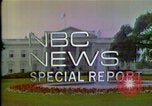
U.S. President Richard Nixon addresses American citizens on the nation's economy in Washington DC.
U.S. President Nixon addresses the American citizens on the nation's economy in Washington DC. The White House. The President in his office. He talks about the 3 subjects of public interest- jobs, income and cost of living. He briefly discusses the nation's problems and their causes. He introduces a program which deals with these problems. The first step involves the recognition of causes. There exists a transition between the peacetime economy and a wartime economy. Labors and the businessmen prefer the peacetime economy. He states that his government takes the responsibility to cut down the expenditure in order to strongly restrain the current economy. They have also decreased the Federal spendings. He talks about his actions against the inflation. They include- appointing the National Committee on Productivity to check how well the resources are being used, instructing the Counsel of Economic Advisor to prepare a periodic inflation alert and establishing a purchasing and review board to review all the government actions. The President briefly talks about the actions he will take and those which he would not take. He states that at this time the Congress and the President should co-operate each other on common welfare programs. He requests the Congress to help him by passing the legislation related with peoples' jobs and cost of living and to act on the one which have already been submitted by him. He asks the Congress to join him on the way of cutting down the government spendings. He also talks about the significant happenings taking place in the American economy. The President believes that in the next 5 years American consumer will be able to buy 20% more than what he does today. The White House in Washington DC.
CRITICALPAST.COM: About Us | Contact Us | FAQs - How to Order | License Agreement | My Account | My Lightboxes | Shopping Cart | Advanced Search | Featured Collections | Website Terms & Conditions | Privacy Policy ©2026 CriticalPast LLC.
License Agreement |
Terms & Conditions |
Privacy Policy
©2026 CriticalPast LLC.