


 Francais
 Deutsch
 Italiano
Refine Your Search
US-Gliders- stock footage and images
- Showing 3253 to 3258 of 21927 results more
more Hide
Hide
Chinese workers use primitive tools to construct an aerodrome in china
"China's manpower carves aerodrome from wilderness" Chinese workers use primitive tools to construct an aerodrome in China. A worker breaks a rock and mixes it with mud to prepare cement like material used in construction. 300 men pull a massive roller for leveling the ground. American aircrafts take off from the aerodrome.
Barometer described among scientific instruments used for weather forecasting in United States
Scientific instruments used for weather forecast at a weather bureau in United States. A man uses a barometer to record atmospheric pressure.
Early means of communication used in case of a forest fire in United States.
Early developments in North American forest fire detection and communication Various methods of communication used to send information during a forest fire. Smoke rises from forest and a Ranger, carrying a spade, climbs a hill in the area. Circa 1920 picture of a man with a carrier pigeon used to send information in case of forest fire. Rangers with shovels working around smoking underbrush. Another man with a hand mirror for reflecting the suns rays and sending a signal to others. A man speaks over a telephone. Man in a room as he speaks over a wireless handset.
Chinese laborers use primitive tools to construct an airfield for United States B-29 aircraft in China during World War II.
Chinese laborers build an airfield in Western China during World War II. Nearly 70,000 Chinese laborers walk to an airfield construction site. Men, women and children carry primitive tools as they walk towards the airfield site. Laborers work with primitive tools as they construct an airfield for United States Army Air Forces B-29 Super fortresses. Laborers break stones with hammers. A treadmill being used too mix water and sand. Laborers eat chow for lunch. A 10 ton roller being hauled over the runway as men pull it. A B-29 aircraft in flight. Another B-29 aircraft taxis along and takes off. Chinese laborers build an airfield in Western China during World War II. Nearly 70,000 Chinese laborers walk to an airfield construction site. Men, women and children carry primitive tools as they walk towards the airfield site. Laborers work with primitive tools as they construct an airfield for United States Army Air Forces B-29 Super fortresses. Laborers break stones with hammers. A treadmill being used too mix water and sand. Laborers eat chow for lunch. A 10 ton roller being hauled over the runway as men pull it. A B-29 aircraft in flight. Another B-29 aircraft taxis along and takes off.
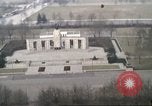
U.S. soldiers patrol the West Berlin border and look into East Berlin through binoculars in Germany.
Aerial view of monuments and buildings in West Berlin including the Victory Column (Siegessäule Großer Stern, 10557 Berlin, Germany) and the war damaged Kaiser Wilhelm Memorial Church (Breitscheidplatz, 10789 Berlin, Germany). Street view of cars and buildings near Kurfürstendamm. View of the Brandenburg Gate obstructed by the Berlin Wall. U.S. Army soldiers patrol the West Berlin border in Germany. American soldiers of Berlin Brigade in a Jeep as they move past Charlie Checkpoint. The jeep moves along the Berlin wall as soldiers patrol the borders of West Berlin. Point of view (POV) shot from jeep as it passes immediately beside the Berlin Wall. Soldiers get out of the jeep and climb up an observation tower. They view East Germany through binoculars. Views of Berlin Wall and barricades and obstacles in the "death strip" area beyond the wall. The U.S. Army soldiers carry M-60 machine guns. They reenter the jeep and continue their patrol. Views of graffiti painted on the Berlin Wall. A sign, "You are leaving the American Sector" in Checkpoint Charlie.
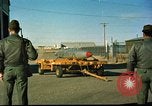
The mechanism of working of a nuclear device and the devices that ensure safety of nuclear weapons in the U.S.
Safe use of nuclear weapons by the United States Air Force. A nuclear bomb on a trailer. a C-119 aircraft takes off in background. An animation shows the nuclear material used in weapons. Fissionable material is surrounded by a layer of high explosives.. Detonators being fired simultaneously at the edges of the high explosives causes implosion that exerts pressure on the fissionable material, causing it to compress into a critical mass that results in nuclear explosion. In an event in which the high explosive, itself, is accidentally ignited, it will burn unevenly, and not provide the uniform circumferential pressure needed to cause the core of nuclear material to compress into a critical mass, even though it may be broken up and scattered.. Various safety features of a nuclear weapon. A battery which provides current, armed switch which controls the flow of current. Thermo fuses which ensure protection against fire. Various mechanical devices like safety pins and wires with seals also ensure safety of nuclear weapons and prevent untimely detonation.
CRITICALPAST.COM: About Us | Contact Us | FAQs - How to Order | License Agreement | My Account | My Lightboxes | Shopping Cart | Advanced Search | Featured Collections | Website Terms & Conditions | Privacy Policy ©2026 CriticalPast LLC.
License Agreement |
Terms & Conditions |
Privacy Policy
©2026 CriticalPast LLC.