


 Francais
 Deutsch
 Italiano
Refine Your Search
US-Gliders- stock footage and images
- Showing 3571 to 3576 of 21928 results more
more Hide
Hide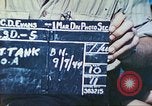
U.S. Marines of 1st Tank Battalion en route to Peleliu on the USS Gunston Hall (LSD-5) in World War II
U.S. Marines of the 1st Tank Battalion aboard the USS Gunston Hall (LSD-5) headed toward Peleliu in the Palau Islands during World War 2. Marines work on their M4A2 Sherman tanks aboard ship. They use tar and tape to seal places on the tanks as they prepare them for amphibious assault.They clean a hatch on one. A Marine points out water proofing points on tank. A slate reads "motor trouble" on September 12th. Another reads: "Passing Army Convoy." Then a long line of ships is seen on the horizon in the distance.
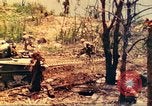
United States Army tanks support U.S. Marines, at Horseshoe Valley in Peleliu Island, Palau during World War 2
U.S. Army tanks of 1st. Platoon, A Company, 710th Tank Battalion operating in support of Marine Corps infantry at Horseshoe Valley in Peleliu Island, Palau on October 8th 1944. Tanks are receiving fire from hidden Japanese 37mm guns up on the hills. Damaged trees in the area. United States Marines with tanks patrol on the island. U.S. tanks equipped with flamethrowers fire at Japanese positions. Marines on alert positions watch from behind bushes.
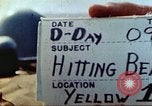
U.S. 4th Marine Division engaged in the Battle of Iwo Jima during World War II
U.S. 4th Marine Division during the Battle of Iwo Jima in World War 2. Views from Landing craft arriving at Yellow 1 Beach during U.S. amphibious assault on Iwo Jima. A sherman tank at the water's edge. The next day, two marines tend to a wounded out of sight below a bluff. One is seen holding a container of blood plasma above his head as they administer emergency treatment. A sherman flailing (crab) mine-clearing tank equipped for deep wading moves across the beach. Closeups of marines hunkered down on the beach, taking cover near armor, as they attempt to move inland. Marines and equipment covering the beachhead. Close offshore, an explosion sends water into the air. LSM-216 is seen maneuvering close to shore, attempting to bring ashore "C" Company tanks to Yellow Beach II. Marines setting a smoke screen of dense white smoke.

Reenactment shows early 20th century U.S. research in gas turbines that contributed to development of turbojet airplane engine
Views of Cornell University where mechanical engineer, Stanford Moss, conducted research into gas turbines as part of his doctoral thesis work in 1903. Dr. Moss later joined the staff of General Electric Company. During World War I Dr. Moss is called to Washington DC to discuss, with the National Advisory Committee on Aeronautics (NACA), development of a turbo supercharger for airplane engines. View of a biplane with turbo supercharger mounted on top of radial engine. Animated diagram illustrating workings of a turbo supercharger. Using a supercharged engine, the U.S. Army Air Services established an altitude record of 36 thousand feet. (The pilot, flying without supplemental oxygen, passes out and doesn't regain consciousness until the airplane has fallen about 30 thousand feet.)
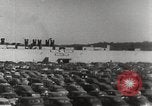
The new (circa 1951) GE jet engine plant at Lockland, Ohio. Engines being assembled. Various aircraft using GE engines
Views of the new (1951) GE jet engine assembly plant at Lockland Ohio. Animated description and U.S. map showing numerous suppliers across the country that contribute parts for the jet engines assembled at the GE Lockland plant.Views inside the plant, with engines being assembled. GE staff members, including chief engineer, Donald F. Warner, are seen in the plant. Various U.S. jet warplanes taking off, including: Hughes XF-91; North American F-86D Sabrejet ; Martin XB-51; North American B-45 Tornado; Boeing B-47 Stratojet bomber; and Convair B-36.
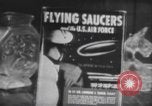
Television broadcast shows a U.S. Air Force officer being interviewed about Unidentified Flying Object in the United States.
Television broadcast shows the controversies regarding UFO (Unidentified Flying Object) in the United States. Book headlined 'Flying Saucers and the United States Air Force'. U.S. Air Force official in an interview says that the U.S. Air Force is not hiding anything from the people. Foreign Technology Division at Wright Patterson Air Base in Ohio. Articles from outer space displayed on the table.
CRITICALPAST.COM: About Us | Contact Us | FAQs - How to Order | License Agreement | My Account | My Lightboxes | Shopping Cart | Advanced Search | Featured Collections | Website Terms & Conditions | Privacy Policy ©2026 CriticalPast LLC.
License Agreement |
Terms & Conditions |
Privacy Policy
©2026 CriticalPast LLC.