


 Francais
 Deutsch
 Italiano
Refine Your Search
US-Gliders- stock footage and images
- Showing 3811 to 3816 of 21928 results more
more Hide
Hide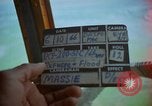
U.S. Army Special Forces camp at Thuong Thoi, Kien Tuong Province, Vietnam during floods.
U.S. Army Special Forces camp at Thuong Thoi, (Detachment A-432) in Kien Tuong Province, Mekong Delta region of Vietnam during floods. Aerial view of a flooded region. Several huts and buildings surrounded by water. Aerial view of U.S. Army Special Forces Camp. Buildings arranged in two lines with a cluster of buildings in the center. Special Forces soldiers load a UH-1D Iroquois helicopter with supplies. View from inside the helicopter as its door is being closed. Pilot in white helmet standing near the door. View from outside, of right side of the helicopter with flooded river in background. American soldier in bathing suit and a Vietnamese soldier in fatigues, help civilian refugees from flood, out of their small boat. More aerial views of the flooded Mekong Delta. (Vietnam War)
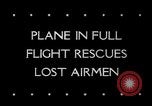
A U.S. Army aircraft on an airfield during an experiment of a rescue operation for stranded airmen in the United States.
Testing of an aircraft rescue operation in the United States. Several airmen on an airfield during an experiment of an aircraft rescue operation for stranded airmen. A U.S. Army aircraft airlifts a sack from an airfield while in flight. A sheep being harnessed by a few men for a live test. The tied up sheep on the ground beside a small fence on the airfield. The U.S. Army aircraft in a low flight airlifts the sheep and flies away. The aircraft parked on the airfield with its door open. A few men take the safe sheep out from the aircraft and untie the ropes around it. A few men tying a pilot for a human rescue experiment. The man placed on the airfield beside a small fence. The aircraft in low flight airlifts the man. The aircraft in flight with the man hanging in a sling. The man is pulled into the aircraft. The aircraft lands on the airfield and the rescued man gets off the aircraft.
U.S. President Eisenhower briefs press about his 2 1/2 week trip to nine countries during a press conference in Washington DC
U.S. President Dwight Eisenhower's 175th press conference in Washington DC, United States. Several correspondents from different nations arrive for the President's 175th press conference. Men prepare cameras mounted on tripod stands at the back of a hall. President Eisenhower with an official walks past the newsmen seated in the hall. The President makes an announcement of his two and a half weeks' trip starting from December 4, 1959. The newsmen taking notes. The President says that he would be visiting nine countries and would be making brief informal visits to Rome, Ankara, Karachi, Kabul and would be in New Delhi for the inauguration of the American Exhibit at the World Agricultural Fair on December 11. He says he will visit Tehran and Athens on his way to Paris for the Western Summit meeting. He gives details of the 3 main days. December 4 - when they would be developing legislative program for the coming year, December 11 - the beginning of the World Agricultural Fair, and December 19 - when he would be in Paris for a meeting. A newsman asks the President the purpose of this extensive visit. The President states the importance and need of being the first U.S. President to make an extensive visit to a strategic continent like Asia. He expresses his interest in visiting India and millions of people who are struggling to raise their standard of living. He says that he will visit Pakistan, Afghanistan, Iran and other nations on the way. The President further says that he hopes to build in that region of Asia and in many other parts, a better understanding of the United States. A correspondent asks the President whether Mrs. Eisenhower and his family members would be joining him for the visit. The President says that some of his family members would be joining him but may be not his wife.
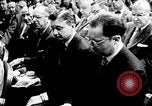
U.S. President Dwight Eisenhower answers a query on the spirit of Camp David during a press conference in Washington DC.
U.S. President Dwight Eisenhower's 175th press conference in Washington DC, United States. One of the pressmen asks the President that in the discussions about a date for an East-West summit conference with General Secretary of the Communist Party of the Soviet Union Mr. Nikita Khrushchev the point arises to preserve the momentum at the end. The Russians talk about the need to preserve the spirit of Camp David. He asks the President what he would like to maintain -- the spirit of Camp David or the momentum. The President says that he has heard of the expression the spirit of Camp David but he does not know what it means. He says that whenever he and Mr. Khrushchev spoke, they spoke in principle and in generality more. There was an agreement when they spoke about problems which the ministers will very likely take up. The President says he thinks that the spirit of Camp David must mean that they can talk together without being mutually abusive. About momentum, he says that that was a word used in discussions on development of foreign relations and agreements. If momentum is kept up it helps not to be rushing into things without being fully prepared.
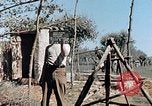
U.S. Army soldiers set up radio equipment in jeeps on a farmyard in Italy during the Italian Campaign of World War II.
The U.S. Army in Italy during the Italian Campaign of World War II. A small building in a farmyard. U.S. Army jeeps and trucks moving on a road in the background. Jeeps, trucks and trailers loaded with soldiers move on a path in front of a small building in the yard. A rake in the foreground. Several soldiers beside army jeeps in front of a shed. The soldiers setting up radio equipment in the jeeps.
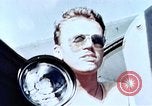
U.S. Major Hunziker with other offices on Ramatuelle airfield in France during World War II.
U.S. Army soldiers in France during World War II. A United States Army Air Force B-25 Mitchell crew member blinking a code. View of part of an aircraft. A few soldiers in the interiors of the aircraft. The crew members looking out of windows. The pilot of the aircraft. U.S. Major Hunziker talking with other officers standing beside a B-25 Mitchell on Ramatuelle airfield. The aircraft takes off. A truck moving on the airfield. The officers standing and talking on an operations tower on the airfield.
CRITICALPAST.COM: About Us | Contact Us | FAQs - How to Order | License Agreement | My Account | My Lightboxes | Shopping Cart | Advanced Search | Featured Collections | Website Terms & Conditions | Privacy Policy ©2026 CriticalPast LLC.
License Agreement |
Terms & Conditions |
Privacy Policy
©2026 CriticalPast LLC.