


 Francais
 Deutsch
 Italiano
Refine Your Search
US-Gliders- stock footage and images
- Showing 3841 to 3846 of 21928 results more
more Hide
Hide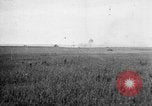
German shells explode on U.S. lines on the Western Front during the Aisne-Marne Offensive of World War I.
The Aisne-Marne Offensive on the Western Front during World War I. German shells explode on U.S. lines. Smoke rises from an explosion in the background. Dead German soldiers and equipment lying on a field. U.S. soldiers look at German equipment lying on the ground.
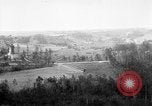
Smoke rises from German shells exploding on U.S. lines on the Western Front during the Aisne-Marne Offensive of World War I.
The Aisne-Marne Offensive on the Western Front during World War I. German shells explode on U.S. lines. Damaged buildings. U.S. soldiers standing outside a building. Smoke rises from a building.
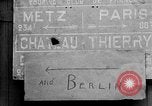
U.S. soldiers salvage materials from damaged church in Château-Thierry, France during WWI, and pause to sing and play piano
The Battle of Château-Thierry in Château-Thierry, France during World War I. A wooded area. A few dead German soldiers lying on the ground. A statue of Jesus Christ in a damaged church. U.S. soldiers salvage materials from the church. They uncover and dust off part of the altar. A soldier sits at a piano amidst the rubble and plays while several U.S. soldiers gathered around sing.

U.S. Navy aircraft from the USS Wasp engage Japanese aircraft and strafe ground installations in World War II
Aerial view of the U.S. Navy Aircraft carrier, USS Wasp (CV-18) painted in camouflage Measure 33, Design 10a paint, underway in Manila Bay, during World War 2. Close view of an F6F Hellcat of Navy Squadron VF-14 taking off from the Wasp, followed by a TBF/TBM Avenger of VT-14. Formation of TBFs passing overhead and then over coast of Japanese-held territory. A Japanese airplane with smoke streaming behind. A Japanese airplane being attacked from behind and hit by gunfire (probably from an F6F). View from U.S. Navy aircraft strafing Japanese ground targets.
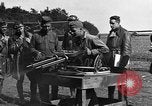
U.S. soldiers fire a double Lewis machine gun on a test bench before mounting it into an aircraft in Colombey-les-Belles, France.
Activities of U.S. 96th Aero Squadron at the First Air Depot in Colombey-les-Belles, France during World War I. U.S. soldiers check out and fire a double Lewis machine gun on a test bench before mounting it into an aircraft.
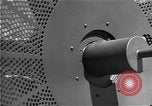
U.S. Army Anti-aircraft batteries respond to threat from unknown aircraft sighted near Alaska and the Eastern seaboard.
U.S. Army Air Defense elements respond to threats from an unidentified (possibly hostile) aircraft detected, near Alaska and over the Eastern Seaboard of the United States. Closeup of a rotating radar antenna. High altitude contrails (vapor condensation trails) seen overhead. Two U.S. Army technicians tracking aircraft and making notes in an anti-aircraft operations center. Two soldiers in a control center at positions labeled "Intelligence Teller" and "AAA Opns Off" respectively. A Lieutenant joins them and directs one to push an alert button. Soldiers respond from their barracks and take up positions at a large tracking map table. They move markers to positions corresponding to incoming reports. A Colonel joins the Lieutenant, already at the control center, and takes up a position labeled, "Deputy Defense CO," (Deputy Defense Commanding Officer). In the background, reports can be heard coming into the control center about five aircraft at 18 thousand feet. Two soldiers plot information on vertical plexiglass display, showing radial lines and distances. . A sign above the boards reads, "Early Warning Op." More reports in the background refer to three aircraft. The Lieutenant has now moved to the position of "AAA Opns Off." View of a soldier markiing grease pencil entries of aircraft sighting reports, on a plexiglass display, at his work station. More views of information being reflected by soldiers moving markers on the map plotting table and the large vertical display. Closeup of the aircraft position markers being moved on the plotting table. A Battery Attack light flashes on another display. The Lieutenant wearing a headset, announces to all units the change of readiness condition to "battle attack." (He also states, "this is not an exercise," and adds "alert all batteries.") An alarm bell rings at an aircraft battery. Soldiers are awakened in their quarters and scramble to their respective guns in a 120 mm Gun M1 anti-aircraft battery. Each gun crew reports being ready, as they raise their gun barrels. More views of aircraft positions being plotted. One appears to reflect a threat to New York City. Computers record data necessary to aim anti-aircraft batteries. Range and azimuth data being displayed. Gunners load shells and propellant charges into their weapons. Gunners looking up and awaiting further instructions. View of all battery guns pointed skywards. Apartment houses in the background. Changing firing and wind azimuth plus fuze information being displayed. A radar antenna turning at the battery location. Narrator states that the aircraft near Alaska has disappeared over the Pacific and the Eastern Seaboard sightings turn out to be commercial aircraft forced off course by strong winds. View of a Lockheed Constellation flying through some clouds, and then landing at an airfield. Alert lights go out in the Anti-aircraft control center, returning to normal status. View of soldiers manning their positions in the center begin wrapping up their activities. One lights a pipe.
CRITICALPAST.COM: About Us | Contact Us | FAQs - How to Order | License Agreement | My Account | My Lightboxes | Shopping Cart | Advanced Search | Featured Collections | Website Terms & Conditions | Privacy Policy ©2026 CriticalPast LLC.
License Agreement |
Terms & Conditions |
Privacy Policy
©2026 CriticalPast LLC.