


 Francais
 Deutsch
 Italiano
Refine Your Search
US-Gliders- stock footage and images
- Showing 4591 to 4596 of 21929 results more
more Hide
Hide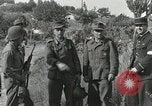
French officer and U.S. soldiers capture two German prisoners near Aix-en-Provence France
French officer speaks to several U.S. Army 3rd Division, 30th Infantry Regiment soldiers in area of Aix-en-Provence France during World War 2. They have captured two German soldiers. Close-up views of the faces of the captured German prisoners of war, taken by the 163rd Signal Photo Company. The group walks on a dirt road and passes through an area of trees and a field.
C-46 Commando and C-119 Flying Boxcar airplanes drops U.S. Army paratroopers in Korea.
187th Airborne Regimental Combat Team paratroopers land on plowed field in Korea, during Korean War. The U.S. Army paratroopers jump from C-119 Flying Boxcar , and C-46 Commando airplanes. Soldier unfastens his parachute harness on the ground.

Gas turbine engine used in vehicles to avoid air pollution in United States.
View of a busy traffic scene with automobiles and a passenger bus emitting air pollution in the United States. Highways filled with bumper to bumper traffic jam. Smog pollution over busy roadway. Automobile engineers and environmental protection Agency Researchers work to find pollution free power system. View of the test steam engine. Diagram depicts the functioning of gas turbine engines for vehicles. Truck with gas turbine engine dives on road. Gas turbine engine is used in boats and heavy machinery equipment. View of Continental Trailways passenger bus on road.
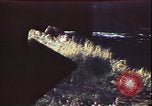
Robert Parson, designer of 4X4 Parson's Cube demonstrates its use for various purposes.
Robert Parson, designer of 4X4 Parson's Cube demonstrates its use. The Parson's Cube is made of seven parts which combines to make arrangements for eating, studying, entertaining and sleeping.
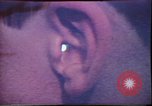
Infra code device used to improve deaf peoples hearing and speech skills.
Infra code technique for assisting the deaf and hearing impaired. During an early training, the amplifier is held by a boy and headset blocks from unwanted vibrations. The instructor speaks into device and the boy replies on hearing. Woman instructor places hand in front of her mouth to prevent the boy from lip reading, and the boy is still successful as he repeats a word spoken by the instructor after he hears it . A woman Janet Marson, who is 85% deaf, is shown. She leads a normal and active life as a laboratory technician. She gets into her early 1970's red Volkswagen Beetle and drives the car. She is shown in a laboratory where she works, conversing with a colleague as she weighs a test mouse on a scale, and as she answers a telephone call and takes notes during the call. She can hear impulses from 60 feet away. Board on door reads 'Infra Code Center for Hearing and Speech'. Using the Infra Code device, men and children improve their hearing and speech skills.

Aerial views of the U.S. Army complex at Cu Chi, Vietnam, during the Vietnam War
Views from an aircraft circling counterclockwise over the large area occupied by elements of the U.S. 25th Infantry Division at Cu Chi, Vietnam. Among the sites seen at the camp are: the C-123 airstrip; CH-47 areas; 1/8 ARTY (1st Battalion, 8th Field Artillery Regiment); 2/77 ARTY; 1/6 ARTY; 3/13 ARTY; 2/27 Infantry; 65th and 554th Engineer Battalions; 125th and 36th Signal Battalions; 12th Medical Evacuation and 25th Medical Battalions; 3/4 Cavalry, 2nd Battalion, 14th Infantry (Golden Dragons) and others.
CRITICALPAST.COM: About Us | Contact Us | FAQs - How to Order | License Agreement | My Account | My Lightboxes | Shopping Cart | Advanced Search | Featured Collections | Website Terms & Conditions | Privacy Policy ©2026 CriticalPast LLC.
License Agreement |
Terms & Conditions |
Privacy Policy
©2026 CriticalPast LLC.