


 Francais
 Deutsch
 Italiano
Refine Your Search
US-Gliders- stock footage and images
- Showing 4765 to 4770 of 21929 results more
more Hide
Hide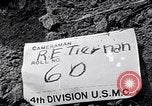
U.S. Marines clearing pockets of Japanese resistance along a ridge in final days of the battle for Iwo Jima in world War II
U.S. marines ot the 9th Marine Regiment, operating from the 4th Marine Division's zone of action, during later phase of the battle for Iwo Jima in World War 2. (Their mission is to sweep the last hostile troops from the ridge in the southeast corner of the 3rd Marine Division's zone of operation.) They move cautiously along extremely rough terrain on the ridge, to flush out any remaining pockets of Japanese resistance. A marine carefully scouts an area of large boulders and potential Japanese hiding places. Another marine is seen silhouetted atop the ridgeline. A marine hurries down from the ridge after placing a demolition charge. He hunkers down with several other marines sheltered just below the ridge as the demolition charge explodes raising brown smoke followed by white smoke. The marines then stand and cautiously approach the ridge.
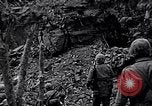
U.S. Marines seek out remaining Japanese defenders in final days of battle for Iwo Jima in World War II
Several U.S. marines approach possible Japanese defensive position at a cave during final days of the battle for Iwo Jima in World War 2. Debris on the ground, including a tin can and Japanese rocket (or mortar shell) with fins. Japanese war supplies outside a destroyed fortification. A marine cautiously approaches the entrance of a Japanese cave fortification, and then walks away. Several marines below a ridgeline. One throws wire, from a spool, upward to the top of the ridge, to connect a demolition charge. Later the charge ignites with a huge explosion, destroying part of the ridge.
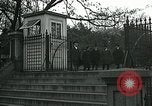
U.S. President Woodrow Wilson watches Armistice parade from side gate to the White house grounds
Armistice parade in Washington,DC, marking end of World War1. President Woodrow Wilson, and several officials, stand near guard shack at gateway to West Wing of the White House, where they watch a parade celebrating the armistice. An army officer on horseback rides past, saluting, followed by several others saluting. Behind them comes a marching military brass band. They are followed by another military band on horseback, leading a small contingent of mounted soldiers and two trucks pulling artillery caissons and field pieces. In succession, the following are seen: an army band; a navy band; a color guard; a contingent of sailors marching with presented arms,in salute; Yeoman (F) women in the U.S. Navy Reserve; and a team of horses pulling a float full of young women in white displaying flags of the World War 1 Allied nations. Marching beside the float are a representative from each of those nations, in uniform, carrying their respective national colors. The last group seen parading are women of the Knights of Columbus, dressed in flowing long-sleeved dresses, and caps. Many of them wear their hair long. A brief glimpse of President Wilson, walking back to the White House, conversing with Attorney General,Thomas Watt Gregory. (World War I; World War 1; WWI; WW1)
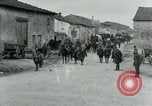
U.S. 128th Field Artillery troops enter village of Courouvre France
U.S. 128th Field Artillery troops enter Courouvre in France. Soldiers walk on path of a village. Huts besides road. Guns and ammunition are carried in horse-drawn wagons. (World War I; World War 1; WWI; WW1)
Several soldiers of U.S. 128th Field Artillery enter town on motorcycles,Courouvre, France.
Several U.S.128th Field Artillery soldiers enter Courouvre, France on motorcycles, over a dirt road. One of the motorcycles has a sidecar. (World War I; World War 1; WWI; WW1)
U.S. 139th infantry Regiment encamped during the Meuse-Argonne offensive of World War I
U.S. 139th infantry Regiment troops encamped in France, during the Meuse-Argonne offensive of World War 1. Camp fires are burning in background. The area is covered by a large set of camouflage tarpaulins. Soldiers are seen emerging from under the tarps. Forests surround the camp. (WWI. WW1.)
CRITICALPAST.COM: About Us | Contact Us | FAQs - How to Order | License Agreement | My Account | My Lightboxes | Shopping Cart | Advanced Search | Featured Collections | Website Terms & Conditions | Privacy Policy ©2026 CriticalPast LLC.
License Agreement |
Terms & Conditions |
Privacy Policy
©2026 CriticalPast LLC.