


 Francais
 Deutsch
 Italiano
Refine Your Search
US-Gliders- stock footage and images
- Showing 559 to 564 of 21920 results more
more Hide
Hide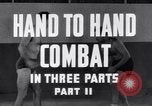
Sailors of the U.S. Navy demonstrate chancery against low frontal attack, arm drag and leg pick up during training in the U.S.
A U.S. Navy Training demonstrates the methods of chancery against low frontal attack, arm drag and the leg pick as part of training in hand to hand combat, United States. Two sailors show chancery against low frontal attack. One of the sailors attacks the other from front. The other sailor puts one of his arms beneath the shoulder of the attacker, passes his other arm beneath the attacker's neck to lock it and delivers a kick to the opponent. Next they demonstrate the Arm drag. The second sailor uses one of his arms to hold the wrist and secures the elbow of the opponent with his other arm. He stamps on the foot of the attacker and drags at his arms which cause both to fall. Now they demonstrate Leg pick up. The second sailor grasps both the legs of the attacker just above his knees, raises him, holds him and drops him on the floor. (World War II period).
U.S. President Roosevelt inspects and addresses the U.S. troops stationed in Tehran, Iran during the World War II.
U.S. President Franklin D. Roosevelt reviews U.S. troops in Tehran, Iran. President Roosevelt is driven towards the military camp in an open military jeep. The troops parade in front of the President. The soldiers stand at attention for the inspection. The President addresses the assembled garrison.
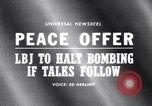
U.S. President Lyndon B Johnson talks about Hanoi's refusal to peace talks offer by the U.S.
U.S. President Lyndon B Johnson speaks at the National Legislative Conference in San Antonio. He talks about the U.S. proposal for peace in Vietnam. He expresses the desire to negotiate with the Democratic Republic of Vietnam Ho Chi Minh and other Chiefs of States. He is prepared to send Secretary Rush to meet Vietnamese officials. Conference attendees seated during the speech. He states Hanoi's refusal of the peace offer, as a result of which the war in Vietnam continues.
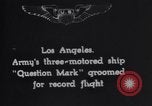
Airplane flight endurance record set by U.S. Army Air Service Fokker trimotor aircraft using inflight refueling
The U.S. Army Air Service modified Atlantic-Fokker C-2A, named the 'Question Mark,' taxis and takes off. Refueling operation between the Question Mark and a Douglas C-1 aircraft. Question Mark in flight over the coast of California. A U.S. Army Air Service Douglas C-1refueling plane, with hose trailing below it, flies above the Question Mark. Crew member can be seen disconnecting the 3 inch fuel hose and throwing it off the Question Mark. After being aloft continuously for 6 days, the Question Mark landed at Metropolitan Airport, Van Nuys, California on January 7, 1929. Staff Sergeant Roy W. Hooe, Lieutenant Elwood R.(Pete) Quesada, Lieutenant Harry A. Halverson, Captain Ira C. Eaker and Major Carl A. Spatz, stand beside their airplane. (Spatz later changed spelling of his name to Spaatz.)
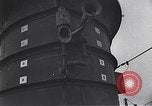
U.S. Naval officers on deck of U.S. submarine tied up with others at deck in Pacific.
U.S. Naval officers on deck of U.S. submarine tied up with others at deck in Pacific. Conning tower with Japanese Flags painted on side. Sailors scraping hull of submarine. Sailors grouped about deck gun. One sailor holding dog mascot. Entire submarine complement at rail. Painting hull of submarine. Sailors cleaning deck gun.
Scenes of warfare using American technology, including submarines, aircraft bombing of London, atomic bomb use in Japan
Training regarding relief and rebuilding works in Germany and Japan by United States Army, after World War II. Narrator discussing adoption of American inventions during the war that were used against America and allies. Sketch of an early American submarine design, followed by view of German U-boats operating under sea, firing torpedoes and target ship is destroyed. Footage of Wright brothers with an early Wright Brothers airplane invention, as they prepare it for a flight. This is followed by a view of London burning after aerial blitz raids by German aircraft during World War 2. View of atomic bomb explosion over Japanese city of Nagasaki and mushroom cloud seen from the air. Also view of Trinity blast in New Mexico - the first U.S. atomic test. The atomic cloud rises high and vast in the sky. Narrator warning against the perils of a third world war.
CRITICALPAST.COM: About Us | Contact Us | FAQs - How to Order | License Agreement | My Account | My Lightboxes | Shopping Cart | Advanced Search | Featured Collections | Website Terms & Conditions | Privacy Policy ©2026 CriticalPast LLC.
License Agreement |
Terms & Conditions |
Privacy Policy
©2026 CriticalPast LLC.