


 Francais
 Deutsch
 Italiano
Refine Your Search
Ubon AirForce Base Thailand 1967 stock footage and images
- Showing 2539 to 2544 of 5487 results more
more Hide
Hide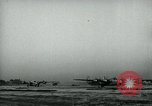
B-24 bombers of the U.S. Air Force take off for bombardment of enemy positions, at China-Burma-India Theater in World War II.
U.S. Army Air Force at a base in China-Burma-India Theater during the World War II. B-24 bombers of the U.S. Army Air Force take off a runway at their base in India during WWII. A number of planes take off as ground staff watches. Each plane has a unique identification number. Bomb dropped at enemy position. Planes among the clouds.
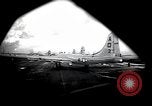
B-29 bombers of 73rd bombardment wing of U.S. Air Force on a mission to Truk, Caroline Islands, during World War II.
73rd bombardment wing of the 20th Air Force of the United States Army Air Force at Isley Field Base in Saipan, Mariana Islands during World War II. B-29 bombers at the hardstands at Isley Field base. Bombers take off for a mission to Truk, Caroline Islands under Japanese rule. Pilot and crew members inside a B-29 cockpit. Other bombers seen flying above the clouds. Crew member keeps a watch for enemy airplanes from the top of canopy. Another crew member keeps a watch on other bombers of the group.
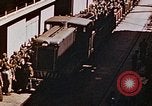
United States Marine Corps prepare for raid on Japanese island of Iwo Jima, in the Pacific Theater of World War II.
United States Marine Corps at their base, prepare for raid on Japanese island of Iwo Jima, in the Pacific Theater of World War II. At the base flat cars loaded with troops move towards cargo ships. Marines unload from flat cars onto pier. A R5D plane flying in sky. Marines going up the gangway to transport. Marines hold sea bags and move out. Marines carrying sea bags walk out of pier warehouse and climb up the gangway.
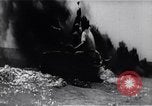
Aid from United States Air Force and soldiers to exile guerrillas and their surrender during Bay of Pigs invasion in Cuba.
Bay of Pigs invasion to overthrow the government of Fidel Castro in Cuba, by armed Cuban exiles. Exile leaders of Cuba at their base. Cuban warships on alert in sea. United States Air Plane and crew carries aid to the exile guerrillas. A United States soldiers with exile guerrillas in jungle. Captured exile soldiers guarded by riflemen. U.S. flag at exile base. Cuban soldiers and their commanders. Fidel Castro addresses his soldiers. Tanks during the battle. Surrendered guerrillas with hands raised.
WW2 German defensive preparations on French coast; Allied invasion scenes; Allied bombing over Germany
Slave laborers digging during the construction of the Atlantic Wall in World War II. German engineers oversee the construction. Men working around a large gun turret. Nazi German fortifications, bunkers, and artillery posts along coasts facing the Atlantic Ocean in Europe. The 380 mm gun at the Todt Battery near Cape Gris-Nez, Pas de Calais, France. 40.6 cm SK C/34 gun “Battery Lindemann” (German unit MKB 6 / MAA 244) as part of the Dover Strait coastal guns. German emplacements and troops marching along Normandy in France. A German soldier uses binoculars to watch the English Channel. Adolf Hitler and a Nazi German general. Adolf Hitler greets Benito Mussolini as the latter exits a plane in Vichy France. Allied leaders Winston Churchill, Franklin Roosevelt, Joseph Stalin, and General George C. Marshall at the Tehran Conference in 1943 during World War 2. Armies from various European countries march and prepare themselves for war against Germany. Supreme Commander General Eisenhower and other Allied generals during a meeting. Fleet of ships in sea ready to land in Normandy on D-Day. Navy and coastal command aircraft drop bombs on Nazi German submarines. Anti-aircraft guns fire at Nazi bombers. Docks damaged by German bombing receive aid from Allied countries. Cranes and hooks lower relief supplies, medicines and warfare material at dock. Warships loaded with artillery and warplanes lowered in ships by hoists. A locomotive train is being lowered from a ship. A military band plays music in a dock. Soldiers move towards the ships. British and Royal Canadian and Australian bombers at their base take off for bombing on Nazi bases at night. A soldier directs a bomber taxiing in runway. Aerial views of British bomber aircraft bombing targets in Germany at night, with immense explosions.
The Cuban Missile Crisis. The Limited Nuclear Test Ban Treaty.
October, 1962, U.S. Air Force U-2 reconnaissance aircraft, tail number 56-6707, of the Strategic Air Command (SAC) 4080th Strategic Reconnaissance Wing, lands at Laughlin Air Force Base, Texas. View of Photographic evidence, brought back by the U-2, showing Soviet missiles being set up in Cuba. President John F. kennedy broadcasts to the nation about the crisis on October 22, 1962, announcing measures being taken by the USA to address the situation. A B-58 Hustler bomber landing. Airmen removing camera from nose of a reconnaissance aircraft. Air Force Sergeant, photo interpreter, reading wet film in a base laboratory. U.S. Naval officers and sailors in Command Center viewing large wall map of the world. U.S. Air Force SAC B-52 bombers taking off. View of United Nations Headquarters building in New York City. On October 25, 1962, U.S. Ambassador to the UN, Adlai Stevenson, confronts Soviet Ambassador Valerian Alexandrovich Zorin about missiles in Cuba.He looks at Zorin, and says,"Don't wait for the translation, yes, or no." Zorin smiles as the room fills with laughter. He then responds. View of a Soviet ship bound for Cuba being monitored by a U.S. aircraft overhead. Pilot in cockpit of the aircraft. View from U.S. aircraft flying low past a Soviet ship. Crew in cockpit of the aircraft. Soviet ships turning away. Helicopter flying over sandy beach area of Hyannis Port, Massachusetts. The helicopter parked and Undersecretary of State, Averell Harriman, steps from the helicopter and is later seen with President Kennedy, and Secretary of State, Dean Rusk, at the President's Weekend White House. Harriman reports on the successful negotiation of a limited nuclear test ban treaty. Glimpse of Moscow. U.S. Secretary of State, Dean Rusk, Soviet Foreign Minister,Andrei Gromyko, and British Foreign secretary, Alexander Douglas-Home, are seen signing the document for their respective nations, August 5, 1963.
CRITICALPAST.COM: About Us | Contact Us | FAQs - How to Order | License Agreement | My Account | My Lightboxes | Shopping Cart | Advanced Search | Featured Collections | Website Terms & Conditions | Privacy Policy ©2026 CriticalPast LLC.
License Agreement |
Terms & Conditions |
Privacy Policy
©2026 CriticalPast LLC.