


 Francais
 Deutsch
 Italiano
Refine Your Search
Ubon AirForce Base Thailand 1967 stock footage and images
- Showing 2611 to 2616 of 5487 results more
more Hide
Hide
U.S. airmen mount Mark MK-82 bombs on a USAF F-4C fighter-bomber during chemical warfare defense training at George AFB.
A film covers chemical warfare defense training received by U.S. airmen at George Air Force Base in California, United States. Airmen in special clothing mount Mark MK-82 bombs on a U.S. Air Forces F-4C fighter-bomber parked at the air base.
U.S. airmen hose down the area around a F-4C aircraft during chemical warfare defense training at George AFB in California.
A film covers chemical warfare defense training received by U.S. airmen at George Air Force Base in California, United States. Airmen in special clothing hose down the area around a U.S. Air Force F-4C fighter-bomber parked at the air base. USAF (United States Air Force) insignia of 'Disaster Response Force'. The airmen scrub the parts of the aircraft.

U.S. airmen use a chemical test kit during chemical warfare defense training at George AFB in California.
A film covers chemical warfare defense training received by U.S. airmen at George Air Force Base in California, United States. A U.S. Air Force F-4C fighter-bomber parked at the air base. A van moves past. The airmen use a chemical test kit. They carry the kit inside a building. They walk out of building with the chemical test kit. An airman helps another man to put bandage on his hand.
Formations of Japanese bombers over the island of Oahu and Pearl Harbor in Honolulu, Hawaii during World War II.
A film dramatizes the Japanese attack on Pearl Harbor in Honolulu, Hawaii during World War II. A Pvt. (Private) soldier operates the controls on a panel at an aircraft warning station at Pearl Harbor. He calls up an information center and informs a U.S. Army Lieutenant that he has detected a line of unidentified aircraft approaching the island of Oahu. The Aloha Tower in Honolulu. Airmen around U.S. aircraft parked at a U.S. air base look at formations of Japanese aircraft in the sky. Exterior of a building in Washington DC. A door sign reads 'Secretary of State'. Formation of Japanese aircraft over clouds and island of Oahu. The aircraft over Waikiki Beach. They drop first load of bombs at Hickam Field which borders Pearl Harbor. Air base installations at Hickam Field burn.
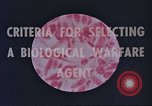
The criteria for selecting a biological warfare agent in the United States, and views of laboratory work on biological warfare.
A training film based on medical defense against chemical warfare and biological warfare in the United States. The criteria for selecting a biological warfare agent includes infectivity, pathogenicity, persistency, casualty effectiveness, possibility of artificial transmission, immunization and therapy and availability. Shows how an ideal BW (biological warfare) agent affects exposed personnel. Pathogenicity tests in laboratory shows a laboratory worker giving intraperitoneal injection of botulism to a mouse. A one ounce bottle contains 250 million lethal of a toxin. A technician in a government laboratory works. The technician drops one of the bottle containing viruses. Taking the usual precautions he washes his hands. A training film based on medical defense against biological warfare in the United States. The criteria for selecting a biological warfare agent includes infectivity, pathogenicity, persistency, casualty effectiveness, possibility of artificial transmission, immunization and therapy and availability. Shows how an ideal BW (biological warfare) agent affects exposed personnel. Pathogenicity tests in laboratory shows a doctor giving intraperitoneal injection to a mouse. A one ounce bottle contains 250 million lethal of a toxin. A technician in a government laboratory works. The technician drops one of the bottle containing viruses. Taking the usual precautions he washes his hands.
Various Chemical Companies of the United States Army during World War II.
A film based on chemical warfare arsenals in the United States and various Chemical Companies of the U.S. Army during World War II. U.S. Army officers walk out of a building at the Edgewood Arsenal in Maryland. Training for U.S. Army officers and enlisted men in the Chemical Warfare Service schools at the Edgewood Arsenal. An explosion as a part of a test. An instructor puts on a gas mask. Officers attend classes. U.S. Army officers enter a chemical warfare board and stand around an officer seated holding a chemical warfare equipment to be sent for future developments. A flame thrower is tested by men. Men work in a Training Aid Station at the Edgewood Arsenal. Personnel supervise making of film strips at the Training Aid Station. U.S. Army Chemical Battalion soldiers march along a road. Gun crews fire mortars. Chemical Air Operations Companies assigned to the U.S. Army Air Force work at an air base. A Smoke Generator Company and a Chemical Field Processing Company. Use of smoke screens in World War II by the U.S.
CRITICALPAST.COM: About Us | Contact Us | FAQs - How to Order | License Agreement | My Account | My Lightboxes | Shopping Cart | Advanced Search | Featured Collections | Website Terms & Conditions | Privacy Policy ©2026 CriticalPast LLC.
License Agreement |
Terms & Conditions |
Privacy Policy
©2026 CriticalPast LLC.