


 Francais
 Deutsch
 Italiano
Refine Your Search
Ubon AirForce Base Thailand 1967 stock footage and images
- Showing 2707 to 2712 of 5487 results more
more Hide
Hide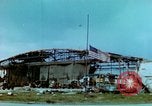
USAAF P-47s operating on a German airfield near end of World War II
View of a wrecked hangar on airfield in Germany, just before the end of World War 2. American flag at half mast in front of the hangar. A U.S. military jeep with a red flag passes the hangar. Several USAAF P-47 Thunderbolts parked at the base including one nicknamed 'Malicious Mary.' Several P-47s land at the airfield.
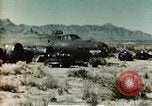
U.S. Army Air Forces B-17 crash-landed in desert near Biggs Army Air Field, El Paso, Texas, during World War II
A USAAF B-17F is seen where it crash-landed in the desert near Biggs Army Air Field, El Paso, Texas, on February 18, 1943, in World War 2. The film was shot some time later when salvage operations are underway including removal of engines. As the camera pans around the plane, a bent propeller is seen in the sand. The tail number 25326 is seen, identifying it as Boeing B-17F Flying Fortress, 42-5326, of the 351st Bombardment Group, 511th Bomb Squadron, with home base at Biggs Field. The camera focuses on the plane's empennage.

Bomb wrecked buildings and airplanes in North Africa.
Bomb wrecked buildings in North Africa. Damaged and destroyed planes at an air base. Military trucks in the background. A U.S. Army soldier observes a wrecked plane. Soldiers inspect the wrecked tail section of a plane. A soldier's helmet lies amidst the debris. (World War II period).
U.S. Army Air Force Douglas C-47 Skytrain transport planes in flight over North Africa (WW2)
U.S. Army Air Force Douglas C-47 Skytrain transport planes in flight over North Africa during World War II. Aerial view of the landscape from the aircraft. Two Skytrains fly next to each other. View of the air base. Several planes parked on the air strip.

Austro-Hungarian soldiers pose with Krupp 77mm artillery field pieces during World War 1
Austro-Hungarian soldiers pose with a 77mm Krupp field gun, model 1914, on display in a public square. Several curious civilians take note of them. Another view of the soldiers posing with two such guns, as several civilians walk nearby. In background, across the Danube River (based on information in the film opening slate) are significant large buildings of a major city. Several officers come to stand in front of one of the guns, as a soldier brings a 77mm shell out for all to see. Another soldier also displays a shell up for the camera. Scene shifts back to the initial location and soldiers standing by their gun.
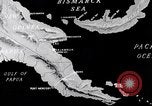
Soldiers pack supplies and parachutes at an Australian Parachute Packing Depot in Papua New Guinea.
March 1943: A map shows Salamaua in Papua New Guinea. An aircraft drops supplies with parachutes over hills. An Australian parachute packing depot. Soldiers pack parachutes on tables in rows. Stacked Australian parachutes to deliver rations, American parachutes used for Ammunition, and 24 foot parachutes for regulation. White parachutes used for medical supplies, blue ones used for rations and red used for ammunition supplies. Aerial view of Goodview, an area of conflict. A soldier radios the requirements to base. Another soldier delivers the plan to the depot. Soldiers pack mortar ammunition. The fuses and sheets are packed together in boxes. Soldiers put boxes into sacks, tie the sacks and attach parachutes. Soldiers pack canned meat: lay straw in big cans, put small cans into those, seal the big cans, secure them with a wiring machine, and attach parachutes. Sacks of rice are put into copper sacks, their mouths tied. Soldiers pack rations including onions, bacon and potatoes for delivery. Supplies are loaded onto trucks and transferred to the aerodrome. (World War II period).
CRITICALPAST.COM: About Us | Contact Us | FAQs - How to Order | License Agreement | My Account | My Lightboxes | Shopping Cart | Advanced Search | Featured Collections | Website Terms & Conditions | Privacy Policy ©2026 CriticalPast LLC.
License Agreement |
Terms & Conditions |
Privacy Policy
©2026 CriticalPast LLC.