


 Francais
 Deutsch
 Italiano
Refine Your Search
Ubon AirForce Base Thailand 1967 stock footage and images
- Showing 3289 to 3294 of 5487 results more
more Hide
Hide
Attack on Pearl Harbor by Japanese, and President Roosevelt asks for war declaration on Japan in 'date of infamy' speech.
United States Government film entitled "The World At War" dealing with World War 2. Film opens showing Japanese warplanes in formation above a Japanese military installation. Slate reads: "Pearl Harbor December 7, 1941. An airfield is seen filled with parked U.S. Army Air Forces B-17 bombers. Two Boeing XB-17 (Model 299) bombers are parked next to each other on the ramp. Derricks and ships are shown at the Pearl Harbor naval base. A formation of Japanese Mitsubishi G3M bombers is seen in flight. They are seen overhead as bombs explode on the U.S. Navy Air Station at Ford Island destroying hangars and aircraft. Next, is shown the famous image of the USS Arizona burning, listing, and sinking, after being bombed. Film continues, panning over post-air raid views of destruction. On December 8, 1941, U.S. President Franklin D. Roosevelt, addresses the Congress, delivering his declaration of war message. He calls December 7, 1941 "a date which will live in infamy." Roosevelt recounts that the United States was at peace with japan and in conversation with its government and Emperor, in the interest of maintaining peace.in the Pacific. even at the time of the attack. Japanese ambassador and his colleagues seen visiting State Department offices to meet with U.S. Secretary of State prior and even during the initial attack operations by Japan.Roosevelt recounts that the United States was still in conversation with Japan even at the time of the attack. Japanese ambassador and his colleagues seen visiting State Department offices to meet with U.S. Secretary of State prior and even during the initial attack operations by Japan. Photographers take pictures of the visiting Japanese delegation. President Roosevelt asks Congress to affirm that a state of War exists between the United States and the Japanese Empire.
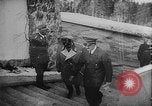
Events leading to World War II in Europe and German attack on Poland in 1939
Adolf Hitler and Hermann Goering walk together up the steps of Hitler's Berghof residence in Berchtesgaden, Bavaria, Germany. Inside the two walk about and converse. Views of them in several different rooms of the building. Hitler and Goering silhouetted against the large windows in one room, containing a long table and a world globe. Change of scene showing Nazi foreign minister, Joachim von Ribbentrop, being greeted by Soviet Union Minister of Foreign affairs, Vyacheslav Molotov, in Moscow, Russia, where they negotiated a Nazi–Soviet non-aggression pact (also called the Molotov–Ribbentrop Pact) in August 1939. Von Ribbentrop is seen seated with Soviet negotiators. Various newspapers reflect mixed world wide views. Some question whether war or peace is ahead. Another notes that the Reichstag supports the diplomatic initiative. Another suggests that England and France must decide. One headline says Chamberlain will want war. Next, Polish forces are seen on parade being reviewed by General Władysław Bortnowski. Among forces parading are mounted cavalry, marching infantry, a formation of PZL P.11 fighter planes, Tk-3 tankettes (Tankietka), 120 mm wz. field guns, CP7 Ursus artillery tractors pulling wagons, antiaircraft guns mounted on trucks, and army trucks carrying soldiers. Scene shifts to German airmen loading bombs on aircraft; arming machine guns; refueling; and testing functionality of aircraft elements, such as turrets. Pilot in cockpit as engines start on a Dornier Do 17 bomber. Ground crew pull chocks and aircraft taxis out. A Heinkel He 111 bomber taxiing. Two of them take off. A Do 17 takes off, followed by more He 111s. Closeup of one flying low over the camera on takeoff. A mixed formation of German aircraft aloft, including several fighters flying top cover; nine Dornier Do 17s; and other bombers. Aerial closeup of a Do 17 seen from adjacent wingman. Closeup of several He 111s in formation. Closeup of gunner in turret. View from above of three camouflaged Do 17s flying far below. Closeup of pilot in cockpit of He 111 with wingman off to left side. More views of Do 17s flying over patchwork of farmlands. Gunner preparing in his turret. Clouds from antiaircraft fire seen from plane cockpit. Bombs falling and exploding on city below. Succession of bomb craters in a line across a flat area of land. View from aircraft of damaged Polish aircraft on an airfield. Scenes of devastation on the ground including destroyed buildings and Polish aircraft. Waves of German Junkers Ju 87 (Stuka) dive bombers taking off; in formation; and peeling off to dive on targets. View from cockpit of one, through rotating propeller, as it dives to bomb a railroad marshaling yard, and view back as it pulls out, showing clouds of smoke rising in its wake. Several German officers peruse damage at rail site. Destroyed Bridge and shipyard. The German battleship, Schleswig-Holstein bombarding the Polish base at Danzig's Westerplatte on September 1st, 1939. German artillery firing in Poland. Formation of Do 17 bombers overhead. Damaged and abandoned wooden wagons at side of road traveled by Polish civilians evacuating in a horse-drawn wagon and herding their cattle to safety. Destroyed Polish artillery and equipment and horses during German invasion. Men dig graves and bury dead Polish soldiers. Vies from air of bombed out part of Warsaw. Polish citizens gathered in places seeking assistance. German forces on parade in Warsaw, including German soldiers goosestepping. Closeups of Adolf Hitler reviewing them.

Gilded age scenes 1890s; Baseball's Orange 'Y' team and the 'Bears' play a reunion game in 1940 in Newark
Clip opens with Gilded Age scenes near the turn of the century in the United States, circa late 1890s. Busy sidewalk scene in a city with men and women in suits, dresses, and hats of the era walking and in conversation. Wealthy people moving about. Group of women ascends steps toward a building. Reunion game of baseball between old men formerly from the Orange 'Y' team and the 'Bears' in Newark, New Jersey. Elderly players pose for a photograph in front of a team banner that says 1885. Elderly baseball players play on a field as fans young and old in the stands watch the game. Young spectators cheer a play by the senior citizen players. A player hits a grounder and another player comes in from 3rd base toward what looks to be a slide at home plate, but he ends up sitting down on the plate.
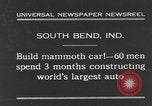
A mammoth Studebaker "Giant Car" roadster is seen in South Bend, Indiana.
In South Bend, Indiana, views of a "Giant Car" Studebaker roadster built by a group of 60 craftsmen working under Studebaker's Paul Auman. This giant scale version 1931 model 80 Studebaker Four Season Roadster was used in the film "Wild Flowers." The Giant Car is 41 feet long with a wheel base of 325 inches. It is 13 1/2 feet high, 15 feet wide, and weighed 5 1/2 tons. Men drive up beside the giant President roadster in a normal vehicle. Some use a rope ladder to climb up into the giant car and others climb up the wheel fender and then onto the hood. A boy is shown trying unsuccessfully to climb up a giant wheel of the car (each wire wheel was 6 feet 8 inches in diameter and weighed 600 pounds). The boy's small pedal car is seen beside the Giant Car tire. A police officer in a motorcycle rides up beside the giant car. He places a board-style 'Police Ticket' on the running board and then climbs up onto the running board to present the ticket to a woman who is behind the wheel of the giant roadster.
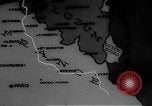
Canadian troops in action around the town of Albert, in West Flanders, Belgium during World War I
Canadian troops in West Flanders, Belgium near Ypres and Albert during World War 1. An animated map shows the region and the Somme River. Canadian troops hunkered down in grass and shrubs on a hill overlooking flat terrain. Shells exploding on horizon in background. A large contingent of Canadian troops marching downhill with left-shouldered arms. Senior officers walk out of a courtyard gate. Next, General Sir Sam Hughes, Canadian Minister of Militia and Defence, is seen shaking hands with several officers. Scene shifts, after he greets only two, and shows Canadian troops marching in platoons along a dusty road. Next, Canadian soldiers are seen moving supplies by horse-drawn wagons along a tree-lined road leading into a town. Final scenes show the war-damaged Albert Basilica. The camera pans upward, along its tower, to the Golden Virgin statue at its top, which is leaning precariously to one side, almost falling off its base. (The statue became the subject of British superstition that the war would end when the statue fell. But British artillery, itself, knocked it down while targeting the tower to prevent its use by the Germans as an observation post, during the 1918 Spring offensive)
Combat fatigued U.S. soldiers are interviewed and sent for treatment in the Training and Rehabilitation Center, Italy.
Psychiatric procedures for United States soldiers in combat areas during World War 2 suffering stress following trauma of battle. Battle scenes: Strong and courageous soldiers sent for fight. They attack enemy and fire rifles from hidden places. Smoke rises. They face danger in battle day after day. View of wounded, burned and dead soldiers in battle. Strongest soldiers of the army maneuver over field. Soldiers seated facing the stress of combat and become psychiatric casualties. Chart depicts fighting front and its three levels: division, army and base. Soldiers are sent to battalion aid station and back to clearing stations for treatment. Medical van brings the wounded soldiers and psychiatric casualties to battalion aid station. One officer checks the ID card of soldiers. ID card reads: '1st battalion, 168 infantry regiment, yes incurred in Italy'. Chart shows training and rehabilitation center (T& R center) near clearing station. Soldiers reach to training and rehabilitation center. A Sign of 'Training and Rehabilitation Center'. Combat fatigue cases are reconditioned by battle training. A psychiatrist interviews a soldier suffering from reactive depression and asks about troubles and feelings faced by him when he got wounded. After interview soldiers are send to clearing center. Soldier enters into tent at camp. They take rest, make social contacts with other soldiers, write letter, get shaved and eat food. Two days later, soldier is re-interviewed about improvement after relaxation in training center. He shows improvement and is encouraged. Recovered soldiers fill the artillery outside the tent near training center. (Modern equivalent - PTSD or post traumatic stress disorder treatment)
CRITICALPAST.COM: About Us | Contact Us | FAQs - How to Order | License Agreement | My Account | My Lightboxes | Shopping Cart | Advanced Search | Featured Collections | Website Terms & Conditions | Privacy Policy ©2026 CriticalPast LLC.
License Agreement |
Terms & Conditions |
Privacy Policy
©2026 CriticalPast LLC.