


 Francais
 Deutsch
 Italiano
Refine Your Search
Ubon AirForce Base Thailand 1967 stock footage and images
- Showing 3337 to 3342 of 5487 results more
more Hide
Hide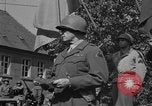
U.S. 9th Armored Division ceremony in Weiden, Bavaria, marking the end of World War II in Europe
Scene opens with closeup of Major General John W. Leonard, Commanding General of the U.S. 9th Armored Division, addressing his troops at the Schlörplatz in Weiden, Bavaria. He has assembled them to hear the news of Germany's surrender, ending World War 2, in Europe. A color Guard stands behind him. Upon hearing the news, the troops raise their arms and cheer, and partially break formation to converse with each other. They resume their formation and listen, as General Leonard continues to speak. Closeup of him reading from some notes. Scene shifts slightly, showing Leonard and the color guard in front of the Gustav von Schlör monument with famous old oak trees behind it. Next, the troops are viewed from the front, as they stand at Parade Rest with buildings near the square behind them. General Leonard walks down from the makeshift podium and passes in front of the assembled soldiers, and shakes hands with his Chief of Staff, Colonel Walter Burnside. Closeups of them shaking hands and conversing. Scene shifts to a unit Chaplain, giving a prayer of thanks for the end of hostilities. General Leonard and Colonel Burnside walk away from the gathering, as the color guard furls the colors. Suddenly an officer walks up on the grass and retrieves something from the base of the Schlör monument and quickly walks back into the square. A Captain has the color guard unfurl the colors again, which include the stars and stripes flanked by the Division colors and the General's two star flag. Next the entire assemblage poses as they are photographed from a high point some yards away. The view shows the color guard standing on grass in front of the Schlör monument with the massive oaks behind, surrounded by assembled troops, including some in a tank. Scene shifts to rear of the assembly, showing troops in armored vehicles at the back of troops in formation. Some armor is moving along a road behind the assembly. Another long shot of the assembled troops is followed by a closeup of them being called to attention. General Leonard walks into the center of the assembly, followed by several officers. They salute the colors and General Leonard converses with the Division Chaplain, who then steps into the grass in front of the color guard, where he removes his helmet, raises his arm, and gives a benediction as all bow their heads. (Note: Armored vehicles seen in this film include M4 Sherman and M36 Tank Destroyer.)
Adolf Hitler addresses the Reichs Arbeit Dienst (National Labor Service) at the Nazi rally grounds in Nuremberg
German Chancellor Adolf Hitler speaks at a rally of the National Labor Service (Reichs Arbeit Dienst) in Nuremberg, Germany. The RAD flag flutters from flagpole. It depicts a shovel with two wheat sheaves at its base. Several flag poles are seen topped by the RAD symbol with swastika embossed on the shovel . State Secretary of Labor Service, Konstantin Hierl, in RAD uniform, introduces the RAD members drawn up in military formation. He salutes Hitler, who proceeds to address the RAD members, who all hold shovels. Several RAD individuals call out their home provinces. Drummers play. The RAD members recite an oath of allegiance, and then march and sing.
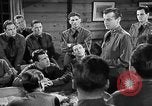
An officer explains different types of platoon formations and its usage and advantages (WW2)
The advantages of the different Platoon formations during World War II. The U.S. Army Sergeants stand around a desk. A Rifle Squad officer talks about the formal formations of the Platoon. He first explains the Platoon Column Formation which is useful at night and during low visibility. Secondly he speaks about the Platoon in Line of Squad Column in which the center is the Base Squad and is useful only when the location of the enemy squad is known. A Sergeant asks a questions and the officer answers. Next is the Platoon in Squad Column formation with center squad back this formation is most useful and widely used. It provides Rifle Squad support and allow use of covered approach terrain further movement in Platoon Column. A Sergeant asks question about the number of squad to be used in the formation. The officer answers. Another sergeant questions him about maintaining contact with security measure. The officer explains this answer with the help of a example.

Ruins of Reich Chancellery following Russian attack on Berlin, and overview of Nazi plan for domination in World War 2
Korean dubbed documentary about Russian attack on Berlin, Germany near end of World War 2. Exterior and interior views of ruins of Hitler's Reich Chancellery building in Berlin following attack by Soviet forces in Battle of Berlin. Bomb damage seen on exterior of Chancellery, view of sign at entrance. Damage and destruction inside the Reich Chancellery building. An animated map showing Hitler's plan of conquest. Quotes from Fuhrer Hitler are printed below each arrow. At 3:38 there is a catapult takeoff and brief flight view of a German Luftwaffe Blohm & Voss BV 138 Seedrache flying boat (Sea Dragon, also known as Der Fliegende Holzschuh or "flying clog" based on the side-view shape of its fuselage) used for maritime reconnaissance. View of German parachutists jumping from a plane and landing on snow covered terrain.
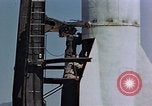
Workers make firing preparations on a German V-2 rocket at the White Sands Proving Ground, New Mexico.
A German V-2 rocket is launched and tested at the White Sands Proving Ground, New Mexico. Preparations for firing shows a couple of workers standing on a platform near the base of the V-2 missile. They make the final preparations. A view from inside a control block house shows V-2 in the firing position. Workmen on ladders work on the warhead section of the V-2.
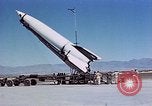
A German V-2 rocket is raised into firing position from top of a special elevating trailer at the White Sands Proving Ground.
A German V-2 rocket is launched and tested at the White Sands Proving Ground, New Mexico. The V-2 is raised into firing position from top of a special elevating trailer or carryall machinery. The warhead of the V-2 rocket. Final firing preparations shows workers standing on a platform at the base of the rocket.
CRITICALPAST.COM: About Us | Contact Us | FAQs - How to Order | License Agreement | My Account | My Lightboxes | Shopping Cart | Advanced Search | Featured Collections | Website Terms & Conditions | Privacy Policy ©2026 CriticalPast LLC.
License Agreement |
Terms & Conditions |
Privacy Policy
©2026 CriticalPast LLC.