


 Francais
 Deutsch
 Italiano
Refine Your Search
Ubon AirForce Base Thailand 1967 stock footage and images
- Showing 3511 to 3516 of 5487 results more
more Hide
Hide
Georgy Zhukov inspects troops during unveiling of Soviet War Memorial and Russian Revolution anniversary celebrations in Berlin, Germany.
Unveiling of new Soviet War Memorial (Tiergarten) in Berlin Germany, during Russian Revolution anniversary celebrations (28th anniversary), in Berlin, Germany, soon after the end of World War II. Marshal of the Soviet Union Georgy Konstantinovich Zhukov inspects British, French, American and Russian units. Trees in the background. Zhukov and United States Army Major General James Maurice Gavin in a grandstand. A Russian officer speaks from the grandstand in front of the Soviet War Memorial (then also called Russian Victory Monument by Allied forces) on Charlottenburger-Chaussee. A Russian Army band plays. A statue of a Russian soldier atop the Victory Monument. Russian troops parade after unveiling of the Memorial. Honor company of United States Army 82nd Airborne Division marches past. Allied troops seen marching in formation on nearby streets of Berlin. Major General Gavin shakes hands with Soviet leader Marshal Zhukov. Officers place wreaths at the Soviet War Memorial. Russian artillery fires salute. Photographers take photographs. The officers salute in front of the War Memorial. Wreaths placed at the base of the Memorial.

Red Devil paratroopers of British 1st Airborne Division, drop into Holland to outflank the German Siegfried Line in World War II
At start, the film shows a formation of American C-47 transport aircraft with paratroopers starting to jump from them during World War 2. Viewed moments later from the ground, the sky is filled with trooper' open chutes, descending. An animated map shows Netherlands, Belgium, Luxembourg, and Germany. It shows location of the Allied paratroopers drop in Holland, intended to spearhead a drive around the Main River into Germany. The map then shows German forces encircling the paratroopers and the Second British Army heading North to the rescue. Next, a huge number of American Soldiers are seen assembled out of doors in England. Closeup of General Dwight D. Eisenhower speaking in a microphone to the assembly. Closeups of soldiers including some who are American Army Air Corps pilots, and other aircrew members, mostly Lieutenants. Senior Paratrooper officers stand at attention in front of formation of troopers with American flag beside them.(Narrator says these were the men who made up the "lost division," heroes who fought alone for seven terrible days.) General Eisenhower makes his way between close ranks of the paratroopers. He is followed by Brigadier General and a Colonel. Lieutenant General Lewis H Bereton also makes his way through the ranks. Scene shifts to a base in England where many British Airspeed AS.51 Horsa gliders are seen with paratroopers heading across the airfield to board. American C-47 aircraft are seen in the background. All aircraft are painted with D-Day stripes. Several British and American paratroop officers review a map together. At a tent camp, A military policeman and two U.S. paratroopers checking their weapons and ammunition. Some troopers sharpen their knives. A trooper is issued Dutch and German money. A British and and American trooper in camouflaged helmets, pose before a glider with a huge British roundel on its side. British paratroopers boarding a Horsa glider, named "Gertie." A Horsa glider moving as it is towed by a British Whitley twin-engine bomber. View from side of runway as the bomber takes off with its towed glider behind. (Narrator comments: "Destination, Holland.") Formations of tow planes and gliders in flight. View of pilot in cockpit of a Whitley bomber. Formations of fighter aircraft in flight overhead. View from inside an aircraft as paratroopers exit through a side door. Sky filled with paratroopers in chutes descending. (Note: This Allied thrust into Holland to launch a drive around the German Siegfried Line was known as the Allied joint American-British "Operation Market Garden," which took place 17 to 25 September 1944, the 7 days referred to by the film Narrator. )
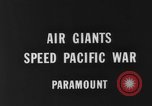
Manufacture and deployment of Boeing B-29 Super Fortress bombers during World War II
Film beginning shows a line of Indian women carrying large wooden bowls on their heads as they walk past a line of Boeing B-29 Super Fortress bombers parked on an airfield ramp in India during World War 2. A B-29 bomber descends and lands on the airfield runway. Scene shifts to the Boeing factory at Wichita, Kansas, where most of the aircraft were manufactured during World War 2. (They were also made by Bell Aircraft Company in Atlanta (Marietta), Georgia, and by the Glenn L. Martin Company in Omaha, Nebraska.) In the Wichita plant, a large room filled with B-29s under construction is seen. A line of women uses hand power tools to finish aircraft parts. A large section of a B-29, including landing gear and tires, moves by overhead crane to be mated with another section in an assembly operation. Men manually push a landing gear with tires installed, along a floor. Workers walk along underneath an assembled B-29 as it is towed out of the factory. Tail view of a B-29 with engines running. View of man working on a B-29 tail rudder. Wing flaps being lowered in function check. Scene shifts, again, this time to China, where a line of B-29s is seen on a ramp at a secret base. A jeep drives under the left wing of a parked B-29, guarded by an armed Chinese sentry. Chinese laborers work with hand tools to make a ditch to drain water from the airfield ramp. Chinese workers unload and roll 55 gallon drums of gasoline for aircraft fueling. A Chinese name (Ding How!)painted on the fuselage of a B-29. Major General Claire Chennault shakes hands with some of a B-29s crew as they prepare to depart on a bombing mission. A Chinese soldier gives the crew a "thumbs up" sendoff. The B-29 takes off on the mission. a group of airmen sit atop a B-29 to watch the takeoffs. Camera focuses on another takeoff and then shows a B-29 aloft, glinting in sunlight and then cruising above clouds. Glimpse of B-29 flying over snow covered mountains (possibly in Japan).
Allied paratroopers board planes, bombers and ships fire Nazi targets in Normandy, France during D-Day Invasion (WW2)
Allied forces raid the coast of Normandy in France on the D-Day invasion during World War II. United States Army paratroopers board transport planes and gliders to land on enemy areas. Infantry soldiers prepare to reach for aid of paratroopers. Armada of Allied warships, boats and landing crafts sail in sea to reach the coast. Guns on ships fire shells at the coast. Fired empty shells on the ships. Allied bombers raid Nazi air bases and headquarters in Normandy. Nazi German warships in a canal destroyed by Allied bombers.
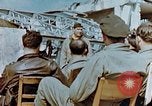
Lt. Col. conducts outdoor briefing for fighter pilots at partially destroyed airfield in Germany near end of World War II.
Lieutenant Colonel conducts outdoor briefing for pilots of the 353rd Fighter Squadron, 354th Fighter Group, at a partially bombed out German airfield, near the end of the Second World War in Europe. Among the pilots seen is Lieutenant B.W. Carr, who was credited with destroying 23 Nazi aircraft. The briefing officer refers to a map suspended at rear of a military vehicle. Wrecked air base buildings in the background and what appears to be a damaged bridge in the distance. Pilots stand as briefing ends and walk past several Squadron P-51D aircraft. Lt. Carr, wearing a holstered sidearm, walks toward his airplane (not seen).
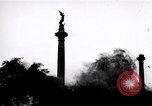
Bolshevik mobs destroy symbols of the Romanovs, in Petrograd, Russia, during the Russian Revolution
The October, 1917 revolution in Russia, during World War 1. Opening scene shows an explosion at the base of a tall column topped by a winged figure with outstretched arms. The column and statue teeter and then fall in a crash to the ground. Within the same scenes another similar collumn stands, but any statue it contained is gone. Next, a Bolshevik rioter is seen on a ladder, prying a large bas relief statue of Romanov double eagle from face of a building. It falls and breaks into many pieces on the ground.
CRITICALPAST.COM: About Us | Contact Us | FAQs - How to Order | License Agreement | My Account | My Lightboxes | Shopping Cart | Advanced Search | Featured Collections | Website Terms & Conditions | Privacy Policy ©2026 CriticalPast LLC.
License Agreement |
Terms & Conditions |
Privacy Policy
©2026 CriticalPast LLC.