


 Francais
 Deutsch
 Italiano
Refine Your Search
Ubon AirForce Base Thailand 1967 stock footage and images
- Showing 3721 to 3726 of 5487 results more
more Hide
Hide
Ethiopia's Emperor Haile Selassie is greeted by officials as he arrives in Yugoslavia.
Ethiopia's Emperor Haile Selassie arrives in Yugoslavia. An airplane parked at an air base. Emperor Selassie comes out of the airplane. Officials gather at the airport to greet him. An official shakes hands with him. Selassie reviews troops. He sits in a Rolls-Royce Phantom IV Hooper-bodied State Landaulette car. His motorcade passes on the streets and he stands in the moving car and waves to people gathered along the sides of the street. Buildings along the sides of the street.
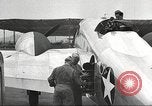
Camera crew members aboard airplanes in flight for the purpose of aerial photography in Culver City, California (WW2)
World War II activities of the First Motion Picture Unit of the United States Army Air Forces in Culver City, California. Airplanes parked at an air base. Camera equipment being loaded into United States Army Air Force Beechcraft AT-11 Kansan and a United States Army Air Force ( USAAF ) A-20 Havoc aircraft for aerial photography. Men in the cockpit of an airplane. A large formation of A-20s in flight. USAAF Curtiss P-40 aircraft in flight. The engine of a USAAF C-47 Skytrain stops and starts. A PT-17 aircraft flying at low altitude over airfields. A USAAF BT-13 Valiant performs an aileron roll. A USAAF Martin B-26C Marauder drops a large life raft and the BT-13 Valiant spins down. The U.S. flag atop a flag pole. Unit personnel at a retreat ceremony in a part of the main building.
U.S. service personnel watch movies in various parts of the world during World War II
Audiences of U.S. servicemen and women watching Hollywood movies in a regular base theaters and outdoors in jungle combat settings, during World War 2. Views of the faces of audience members and their reactions as they watch movies on screen. Soldiers leaving a large elaborate movie theater after seeing a movie. Lieutenant General Brehon Burke Somervell, U.S. Army Chief of Logistics, expressing the Army's appreciation to the motion picture industry as he accepts the 10 thousandth Hollywood movie for exhibition to troops overseas. General Somervell mentions visiting troops in Australia, India, China, and Africa and comments on the way movies boost their morale.
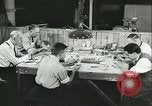
WPA workers build a massive scale model of New York City; also WPA art, library, and theater programs
Works Progress Administration (WPA) projects in New York City during the Great Depression. Skilled architects, draftsmen, and artists work for the WPA on a massive scale model of New York City, built in cooperation with New York University (this model predates the famous Panorama of New York City model built for the 1964 World's Fair). An artist is seen leaning over part of the model painting one of its features, which include detailed roads, bridges, buildings, and waterways. A hand lifts a building and measures its base with a ruler. Cartographic Survey WPA workers are seen creating a relief map of Staten Island for educational use. Men and women artists, including sculptors, are seen creating new sculptures funded by WPA. A man carves a bust in an art studio or class. Another man carves a relief stone commemorating Dewitt Clinton. A man stands in a Free Library and looks at books. Two women on a park bench look at books from the WPA Free Library holdings. A skilled artist is seen laying out and buildings stained glass windows for the United States Military Academy at Westpoint in New York. Stained glass panels depicting George Washington and soldiers are seen. A series of the George Washington stained glass windows is seen in place, with the artist applying final touches. Men work on the Federal Theater Project. Billboard signs advertising various WPA funded theatre productions in 1936 are shown, including Jefferson Davis, The World's Greatest Circus, Taking the Air, The Mikado, Macbeth, All American Minstrels, Battle Hymn, and Horse Eats Hat.
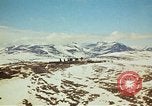
Defense Early Warning radar sites (DEW Line), White Alice communications systems, and North American Air Defense (NORAD)
Aerial views of Dew Line air defense radar installations in the Northern part of North America. Ground views of a man dressed in furs riding a dog sled. View from the sled of the dog team pulling it. The man and dog team moving in the snow past black microwave antennas of the "White Alice" Alaskan Communications system. Aerial view of a White Alice complex containing huge red and white checkered microwave antennas. Oil tanks and other facilities at the site. Scene shifts to closeup of receiving and relaying antennas of the White Alice system. View of a Dew Line radar site. Narrator explains how the Dew Line stations work in concert with the White Alice system. Closeup of radar antenna rotating and fade to a radar screen where a target is being painted by a sweeping beam. Operator at the radar screen picks up phone to inform NORAD (North American Air Defense Command). View of the NORAD Headquarters Building at Ent Air Force Base, Colorado Springs, Colorado, with mountain in background and flags of the U.S. and Canada flying from flag poles in front of the building. View inside the command and control area of the headquarters. A large tracking board on which radar information is depicted. view of a radar station complex on land and one out at sea. A Lockheed EC-121 radar picket aircraft in flight and a radar picket ship at sea.
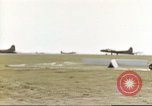
Airplanes and crew members of the U.S. AAF stationed at RAF Polebrook, England, during World War II
Scenes from filming of "Combat America," at RAF Polebrook, Northamptonshire, England, during World War 2. B-17s parked on the airfield. U.S. Airmen standing near and on balcony of the Base Operations control tower building. Interior of Quonset Hut barrack. An airman reading. Four U.S. Army Air Force Officers posing in Class A uniform with blouse and hat.
CRITICALPAST.COM: About Us | Contact Us | FAQs - How to Order | License Agreement | My Account | My Lightboxes | Shopping Cart | Advanced Search | Featured Collections | Website Terms & Conditions | Privacy Policy ©2026 CriticalPast LLC.
License Agreement |
Terms & Conditions |
Privacy Policy
©2026 CriticalPast LLC.