


 Francais
 Deutsch
 Italiano
Refine Your Search
United States 1982 stock footage and images
- Showing 9451 to 9456 of 26493 results more
more Hide
Hide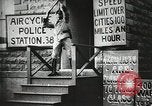
A dramatization depicts: civilians point at the sky and look through binoculars at an aerial contraption in the United States.
Paper print. Early motion picture from turn of 20th century depicting fictional early flight. Humorous Dramatization. Policeman at Aircycle Police station scans sky through spy glass or telescope. Sign reads: "Aircycle Police Station number 38." Another sign reads: "Speed limit over cities 100 miles per hour." Air contraptions being built by two men. Sailors on a ship beat a large fish on deck. Citizens and policemen running and pointing skyward and looking through telescopes. In the air, a man appears riding a bicycle airplane. A man and woman prepare to board a balloon airship. A man flies by flapping large wings like an ornithopter. A man walking on the sidewalk is disturbed by rush of air from the balloon airship. Photographers rush to an observer to photograph the sights.The observer-reporter has a very very long nose.
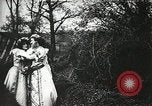
A dramatization depicts: guards stop a man as he takes a princess along with him from a palace in the United States.
Paper print. Motion picture made at turn of 20th century. Dramatization. A palace in 18th century Europe. A dramatization depicts: women stand in a garden. A maid at the service of a princess in the palace. A man comes and takes the princess along. Guards stop him.Fighting ensues.
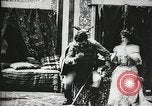
Dramatization depicts: couple seated on a sofa exchange rings and people gather in a restaurant in the United States.
Paper print. Early American motion picture.Dramatization depicts: couple in costume of European nobility seated on a sofa. They talk and exchange rings. Guards walk through streets. Buildings in the background. People seated at table in a restaurant drink tea. Woman reads a letter. Two maids interact.
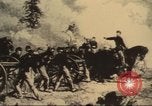
Union soldiers print the first issue of Stars and Stripes newspaper during the Civil War in the United States.
The history of the Stars and Stripes newspaper. Union soldiers print the first issue of Star and Stripes newspaper in a captured press in the U.S. on 9th November,1861 during the Civil War. World War I scenes show soldiers disembarking from a ship and advancing on a battlefield. Commanding Chief of the American Expeditionary Force John J. Pershing writes for the newspaper. Soldiers greet the Chief and wish him luck. After the end of World War I newspaper publication is ceased. During World War II the newspaper publication starts in London, England in 1942. Publication of the Pacific Stars and Stripes newspaper after the end of hostilities in Europe. Headlines in various editions of the Stars and Stripes.
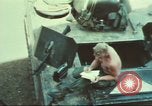
News report and informational programs are broadcast to a large majority of servicemen in the United States.
American servicemen are kept informed by American Forces Radio and Television Station facilities. A soldier listens to a radio and writes a letter. Another soldier in southeast Asia looks at a post with directional arrows showing distances thousands of miles away to cities like Seattle, San Francisco, and Denver. He sits on a bench and listens to the radio. Aerial view of the broadcasting station part of the American Forces Radio and Television Station. Power is supplied by portable generators housed in wooden shacks. View of radio studios, control rooms and administrative blocks. A man serving as Disc Jockey or DJ operates a control panel and a phonograph turntable to play a record. He turns dials on the control panel and works on a program schedule. View of a reel to reel tape machine running. News report and informational programs are broadcast to a large majority of servicemen. Military cooks working in a kitchen to prepare food. Army soldier standing at washroom sink and shaving, while listening to a portable radio. Two Army soldiers, one white and one African American, playing pool or billiards while listening to a portable radio. Soldiers on a rest break during a patrol in the Vietnam War listen to a radio.
A political broadcast shows youth of America prior to the presidential election of 1968 in the United States.
A political broadcast based on American youth promotes Republican nominee Richard Nixon prior to the 1968 Presidential Election. Still images show young people on a dance floor, studying, as soldiers, in laboratories and as engineers, doctors, scientists and construction workers.
CRITICALPAST.COM: About Us | Contact Us | FAQs - How to Order | License Agreement | My Account | My Lightboxes | Shopping Cart | Advanced Search | Featured Collections | Website Terms & Conditions | Privacy Policy ©2026 CriticalPast LLC.
License Agreement |
Terms & Conditions |
Privacy Policy
©2026 CriticalPast LLC.