


 Francais
 Deutsch
 Italiano
Refine Your Search
United States 1982 stock footage and images
- Showing 9751 to 9756 of 26493 results more
more Hide
Hide
Indian PM, Gandhi receives honor by city officials and addresses members of the city and Indian community in Los Angeles.
Prime Minister (PM) of India, Indira Gandhi visits United States for better understanding and friendship between the two countries . Animated map shows: Indira Gandhi and her party leaves New York and arrives in Los Angeles (LA). Exterior of Los Angeles City Hall. On 3rd August, Tuesday, she goes to the City Hall and receives honor by city officials. Cameramen record and take photos. Mayor of Los Angeles, Thomas J. "Tom" Bradley presents her a gift from the City Council. Indira Gandhi delivers a speech and says that she came to America for friendship and better understanding. City officials applaud after her speech. At Century Plaza hotel,she meets Dr. Jonas Edward Salk, the American biologist, who developed polio vaccination. Dr. John Herbert, co-chairman of Indo-US circumvent, & education & culture. She meets prominent women of LA, members of the city and members of the Indian community. She addresses in Hindi that Indians are doing well here and hope, they contribute towards the successes to India also.
Indian Prime Minister, Indira Gandhi, on a visit to Hawaii, presents a baby elephant as a gift to children of Honolulu.
Goodwill trip to America by Indian Prime Minister, Indira Gandhi. Animated map portrays long flight from Los Angeles, California, to Honolulu, Hawaii. Hawaiian hula dancers performing on grass at the Honolulu zoo. View from beach of colorful sail boats, swimmers, sun bathing, and surfers enjoying the beach and beautiful weather in Hawaii. A traditional long canoe is seen being paddling past the beachfront. As hula dancers finish, elephant handler (mahout), Kirpa Swami, brings forward a baby elephant, named Mari, that Mrs. Gandhi is presenting as a gift to the children of Honolulu. Spokesperson Eileen Anderson, acknowledges the gift, before a large crowd of spectators. Prime Minister Gandhi, at the microphone, explains that the elephant is a symbol of strength, of hard work, and in India, of good fortune, or good luck. Kirpa Swami brings Mari across the grass, accompanied by elephant handlers, Gwen Yoshimura and Larry Zolton. As Mari swings her trunk, Mrs. Gandhi says, "she is saluting you all." Scene shifts to the airport, where the Prime Minister's Air India passenger airplane is parked on the runway tarmac, displaying an American flag in the pilot's window. Prime Minister Gandhi speaks at the steps to the aircraft, extending the good wishes of the people of India to the people of the United States. She turns and waves from the top of the steps.
United States Navy sailors fill up water in barrels at the Tunis Port in North Africa.
Various U.S. Navy ships and vessels at the Tunis Port in North Africa. U.S. Navy sailors on pier on shore transfer water from one barrel to the other. Sailors stand beside ships and equipment as they shift barrels. Man uses a hose to fill water into a can. A fire extinguisher lying next to the can. (World War II period).
United States soldiers tend to wounded personnel aboard ships during the invasion of Normandy.
American patrol craft and many small boats in rough waters during the Invasion of Normandy. LCI-85, no weight on, listing to starboard. An American Attack Transport (APA) with a Landing Craft Utility (LCU) along its starboard quarter. LCI-492 moving at about 10 knots. Starboard beam view of a transport ship with smaller craft alongside. Troops aboard transport with packs on, ready for disembarkation. Soldiers administer first aid to a wounded man covered with a blanket on deck of transport. Transport at anchor, small gun boat speeds by in foreground. A Landing Craft Vehicle Personnel (LCVP) alongside ship. Soldiers on deck of camera ship look down over landing craft. Soldier on stern of a Landing Craft Infantry (LCI). Soldier on deck of LCI, letting go of lines, LCVP alongside. Soldiers on deck of the LCI, tending to a wounded soldier, LCVP alongside. A wounded soldier lying on deck, covered over with a blanket. Soldiers on LCI preparing to lift another wounded soldier from landing craft. A wounded soldier in landing craft, another lying on a stretcher in hold of landing craft. Wounded personnel on deck of camera ship. Wounded soldier on a stretcher, being lowered to main deck, from an upper deck. Blood and parts of the human body scattered around on deck. Small camera case covered with blood and fleshy parts of the human body. LCU loaded with troops heading for beach area. Other ships are scattered in background. LCU-199 loaded down with troops, heading for the beach. (World War II period).
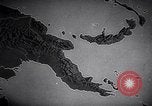
United States B-25 bombers, B-24 bombers, and P-38 fighters attack Japanese positions in Papua New Guinea.
August 1943: Animated map depicts Allied ground advances, 5th AAF air fleet stations, Japanese opposition base at Rabaul as well as Japanese positions and network in Papua New Guinea. Map depicting strategic Japanese positions of Wewak and Boram. 5th AAF soldiers decide to raid the two posts. 17 August 1943: USAAF B-25 Mitchell bombers and P-38 Lightning fighters attack the Japanese post of Wewak. Heavy bombardment by the American bombers. Smoke and explosion from the bombardment. Aerial view of the Japanese airplanes parked on the airstrip. 20 August 1943: USAAF B-24 Liberatoor bombers and P-38 Lightning fighters attack the Japanese position at Boram. Imperial Japanese Navy Air Service Mitsubishi Zeros attack the B-24s, P-38s intervene. Bombs dropped on the target. Smoke and explosion from the bombardment. (World War II period).
United States Marines in trucks at the Hungnam port.
5th and 7th Regiments of the U.S. First Marine Division in Hungnam, North Korea, during the Korean War. A transport near the Hungnam pier. Empty trucks moving in dock area. Tracks running through dock. A military truck with a boat on trolley. Soldiers in some trucks. The shore, ships standing in harbor. During evacuation of Hungnam.
CRITICALPAST.COM: About Us | Contact Us | FAQs - How to Order | License Agreement | My Account | My Lightboxes | Shopping Cart | Advanced Search | Featured Collections | Website Terms & Conditions | Privacy Policy ©2026 CriticalPast LLC.
License Agreement |
Terms & Conditions |
Privacy Policy
©2026 CriticalPast LLC.