


 Francais
 Deutsch
 Italiano
Refine Your Search
United States 1982 stock footage and images
- Showing 10765 to 10770 of 26493 results more
more Hide
Hide
People in scenes of anger and tension; gathering of the Association for Mental Health, Anxiety and Tension
View of spinning world globe. Faces of serious and brooding people in various parts of the world. Close-up views of faces of serious looking men. View of a crowd of people in France listening to a speaker on the street. The faces of people listening to the speaker. Next view shows what appears to be French police in the streets chasing a protest crowd and making it disperse. Next brief scene shows a crowd of people and police in China surrounding what appears to be a European man and pushing him along through a curtain-flanked doorway. A person holding a motion picture camera is among the jostling crowd. Insignia of the United Nations and flags of the member nations around the insignia. View of the UN headquarters (405 E 45th St, New York, NY 10017, United States) in New York City. Traffic on the road. A flag of the United States on a building. A banner reads "Association for Mental Health, First Annual Forum on Anxiety and Tension." A man speaks into a microphone. Mrs. Eleanor Roosevelt, widow of United States President Franklin D. Roosevelt, is seen at the podium addressing the association. Members of the association sit on chairs. The scene changes to a quiet, tree-lined street in a town or suburb. A car parked on the road. A man rests in a backyard garden on a hammock. Contrasting scene shows a man come rushing and running out of his house, hastily putting on his suit jacket. He stops, remembers something and goes back in again, then comes out before getting in his 1950s sedan car and rushing away. In next scene the man in shirt and tie is seen rushing through his lunch at a restaurant, conducting business while eating and smoking a cigarette. View of a angry taxicab driver as he looks out his car window and shouts at stopped traffic. He steps from the car and shouts about traffic delays. Another man works with a pneumatic jack hammer. A man seated on a chair in his living room holds his head as his wife yells at him and berates her husband. She is seen shaking a finger at him and scolding him. View of his fingers tapping anxiously on the arm of the chair and finally make a fist. More scenes of the angry woman wagging her finger at the man in anger. A pair of white swans in mirror-like water. A white Polar bear in a hot cage at a zoo. A man looks at the tired bear and the man also rubs his own face, looking tired. A young boy pulls at the trousers of the man who is looking at the bear, to get his attention.
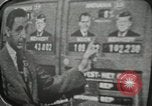
Presidential Election results show Kennedy in the lead and Nixon delivers a speech pledging his support to Kennedy in the U.S.
The 1960 Presidential Election in the United States. A television broadcast showing Presidential candidate John F. Kennedy's lead in the Presidential Election. A correspondent recording figures on a sheet of paper. The returns in a tabulating machine checked by Kennedy's press secretary. The interiors of the press headquarters of the Democratic Presidential candidate in Massachusetts. Men and women viewing a television. The television commentator announces that Republican Presidential Richard Nixon is about to make a statement. A clock showing 3.20 AM. Richard Nixon with his wife Pat Nixon in California, standing behind a podium in front of a tally board which shows Presidential Election summary. Nixon waves at the crowd. His speech being broad casted on television. Richard Nixon talks about the importance of how elections work in the United States, that they are hard fought, but once the decision is made we united behind the man who is elected, and he says that if Kennedy goes on to win the election and becomes the President of the United States then Kennedy will have his whole hearted support. The crowd cheering and applauding. Nixon waving at the crowd. Men and women going out of a building. Vacant chairs in the Republican Party headquarters. A tally board showing figures of the election results. A few men and women in the headquarters.
Contribution of African American soldiers during the Spanish American War and World War I.
A film about the role of African American soldiers during various wars in the United States. A dramatization shows a black soldier during the Spanish American War. He also talks about his role in Cuba and the construction of the Panama Canal. Footage of the Panama Canal being constructed and ships underway in the canal. United States Army forces including black soldiers boarding troop transport ships bound for Europe during World War 1. A railroad train carries African American soldiers to France during World War I. African American soldier units under General Pershing march in formation with an Army band in France during World War 1. African American soldiers work and fight against the Germans, including the 813th Pioneer Regiment near Marseilles, the 332nd Labor Battalion, and the 808th Pioneer Regiment near Verdun. African American soldiers racing for front lines including the soldiers with the 8th Illinois and the 372nd regiment and the 371st, and the 369th Infantry Regiment (sometimes called the "Harlem Hellfighters") in the Argonne. View from behind soldier as he fires a machine gun, and United States Army infantry firing artillery. African American soldiers of the 369th regiment "Harlem Hellfighters" being decorated and receiving the French Croix de Guerre for their heroic actions in World War I. The African American soldiers march at a parade in New York City following World War I and are greeted by throngs of enthusiastic African American civilians attending the parade. View of Henry Johnson being congratulated by civilians after he and Needham Roberts performed with exceptional heroism and received the Croix de Guerre. Close up view of the Croix de Guerre medal on a uniform. Graves of African American soldiers who lost their lives during World War I at Arlington National Cemetery in Virginia. View of the All-Wars Memorial to Colored Soldiers and Sailors in Logan Square in Philadelphia (Logan Square, SE corner 20th Street & Benjamin Franklin Parkway, Philadelphia, Pennsylvania). View of a stone memorial erected in the Meuse-Argonne region, north of Sechault, as a tribute to the efforts of the African American soldiers of the 371st Infantry Regiment who fought and died there on April 21, 1918 during World War 1.
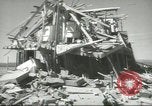
Soldiers assess damage from atomic explosive test shot,"Apple Two," during U.S. Army exercise Desert Rock 6.
Views of various structures and objects after being exposed to atomic explosive test shot "Apple 2" during U.S. Army Exercise Desert Rock VI. A wooden frame house splintered by the blast. A low concrete structure, relatively intact. An overturned Army vehicle. An unsheltered low-wing monoplane, number NG 489851, with skin stripped from its horizontal stabilizer and wing tips. A P-47 aircraft appearing relatively intact. A badly damaged two-wheel trailer. A relatively unscathed auxiliary power unit on a stabilized trailer. Vehicles reduced to rubble. Radar unit and accompanying truck and power unit, seemingly OK, but dish antenna may be damaged. Three soldiers stand around an M2HB heavy machine gun knocked from its stand. A B-29 bomber sits on a ramp with a sign in front of it warning of radiation. A ground crewman sprays the bomber down with a pressure hose to decontaminate it by washing off radioactive particles. A soldier rides a jeep out to check radiation readings on a vehicle that had been exposed. Troops walk back from ground zero and undergo personal cleaning with brooms and checks by geiger counters. A soldier being checked, including his boots. Soldiers sweeping dust from M48 tanks used in the exercise. A soldier being "interviewed" by another, about means of coping with atomic weapons on the battlefield. A formation of soldiers marching, led by one carrying a Corps of Engineers Guidon with the number 14 on it. [Note: According to the U.S. Department of State, Office of the Historian, from February 18 to May 15, 1955, the United States conducted Operation Teapot, a nuclear test series at Yucca Flat and Frenchman Flat on the Nevada Test Site in the continental United States. During the test period 14 nuclear shots and 1 non-nuclear shot were detonated. Several thousand scientific, military (army, air force, navy, marines), and civilian contract personnel participated in the organization, planning, and execution of the test series. Military exercises undertaken during and following the shots took place under the name Desert Rock 6.]
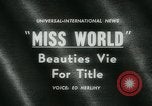
Rose Marie Franklin of the United Kingdom is crowned Miss World 1961 in London, England
Contestants of China, Germany, France, Italy, United Kingdom and United States walk on the ramp during the 1961 Miss World pageant at the Lyceum Ballroom (Lyceum Theatre, 21 Wellington St, London WC2E 7RQ, United Kingdom) in London, United Kingdom. Miss World 1961 1st Runner-up Grace Li Shiu-ying (Republic of China) on stage. Miss World 1961 judges such as Bob Hope, Richard Todd, John Spencer-Churchill, Kathleen Manners, the Duchess of Rutland, and Countess Ethel Beatty, sit behind table. Large audience cheers the participants. Miss United Kingdom Rose Marie Franklin wins the competition and is crowned by Hollywood star Bob Hope. Winner and runners-up pose for photographs.

The Cuban Missile Crisis in October 1962
Adlai Stevenson addresses the United Nations Security Council regarding the build up of missiles in Cuba. United State Navy ships form a blockade to stop further missile delivery to Cuba. In Cuba, soldiers operate anti-aircraft guns that have been set up on the waterfront Cuban soldiers hold their posts on streets, tops of buildings, and on posts all along sea shore. Fidel Castro addresses a public demonstration. Cubans seen marching. Signs in the crowd include, 'Apoyamos Lucha Contra El Imperialismo' and 'Adelante Fidel Venceremos' High powered reconnaissance cameras are fitted to a plane. A plane flies to take reconnaissance photos of Soviet bases in Cuba. Views of aerial photographs showing aircraft landing strips and missiles in Cuba. United States Marines arrive at Guantanamo bay. C-124 Globemasters in background. View of the Organization of the American States Building. U.S. Secretary of State Dean Rusk addresses the gathering. Exterior view of the United Nations building. Soviet representative Valerian Zorin address the Security Council.
CRITICALPAST.COM: About Us | Contact Us | FAQs - How to Order | License Agreement | My Account | My Lightboxes | Shopping Cart | Advanced Search | Featured Collections | Website Terms & Conditions | Privacy Policy ©2026 CriticalPast LLC.
License Agreement |
Terms & Conditions |
Privacy Policy
©2026 CriticalPast LLC.