


 Francais
 Deutsch
 Italiano
Refine Your Search
United States 1982 stock footage and images
- Showing 10861 to 10866 of 26493 results more
more Hide
Hide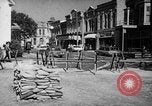
Propaganda film depicts dream sequence of Communist martial law imposed on a typical American town
Propaganda film made for the U.S. Defense Department during Cold War, entitled “Freedom and You.” Opening scene shows a typical town in the United States, except that soldiers are patrolling and sandbags and barbed wire fencing are seen in places. Narrator, Jack Webb, approaches the camera with comment: “Frightening isn’t it.” Overview of the town. Views through barbed wire of an armed soldier and local people. Ordinary automobile traffic on the street. (Narrator suggests that this town could created somewhere in the Soviet Union to teach young Communists about the United States.) View inside an ice cream parlor with soda jerk serving customers. Numerous views typical of what one would find in an American town: Inside a bank; White Church steeple seen through trees; men conversing in ice cream parlor; inside of a supermarket; (Communist civilian chatting with soldier near barbed wire fence); a baseball game; A tray of hot dogs; school building with students outside; (Teacher inside discussing explosives and listening devices.) Teacher and students in chemistry lab; Slate identifies film title: “Freedom and You.” Boy playing with his dog is chastised by his mother; Young couple conversing over car with open hood; Man going to work kisses his daughter; Men at work in a machine shop; An airmen, marines, and a woman at a table on an air base; KC-97 aerial refueling aircraft in background; Young couple sitting in hotrod car watching as a man races a Chevy Corvette car on the runway. Group at the table give woman timing report; A single engine Beechcraft airplane on the runway; Young couple kiss in front of a M101 105mm howitzer sitting in a building; They speak with an Army officer about postponing his active duty. More views of machine shop; Family at dinner saying goodnight to small children; Father talking with small boy wearing Cub Scout cap; Film is interrupted with a dream sequence showing Communist Martial law imposed on the town. Effects are shown in small vignettes of ordinary life. The machine shop now displays a sign with the day’s production quota. Children being packed to go away to a State School. Father rebels and is seized by military guards. The church is closed for worship, and now houses a Soviet museum. Father stands trial before a military court for rebelling against the Communist State. Family testifies against him. He is sentenced to be shot. He gives impassioned speech about freedom. He is hauled into a room and is shot by a soldier with a pistol. Film ends as he wakes from his nightmare and finds everything back to normal.
Japan denounces Washington Naval Treaty of 1922; Also: Helen Richey becomes the first woman to fly mail in the U.S.
Japanese Ambassador to the United States Hiroshi Saito calls on U.S. Secretary of State Cordell Hull In December 1934 to inform that Japan will denounce the Washington Naval Treaty on 1922 which limited the size of the Japanese fleet. A close up of the ambassador Saito. He exits the State, War, and Navy Building (later the Executive Office Building) and gets in a car. Next segment: A female pilot Helen Richey becomes the first woman to fly mail in the United States. Richey stands in front of an aircraft and shakes hand with an official. Richey in the cockpit and the aircraft takes off. From a December 14, 1959 newsreel recounting events 25 years earlier.
Oil production of the U.S. and other countries is compared and evolution of internal combustion engine is depicted.
The world struggle for oil is depicted. Oil production of the United States is compared with that of other countries. Relative production in 1900 is shown. A political map of the United States. A dot in some states represents 1 % of the world's production whereas a cross in other states represents less than 1 % of the world production. A map shows Russia, Germany, Italy, Galicia, Roumania and other neighboring countries. A box on the map shows Japan with a cross. Another map shows India, Tibet, Afghanistan and their neighboring countries. Still another map shows countries of South America. Evolution of internal combustion engines, whereby gasoline is used, is shown using diagrams.

Americans voting and electioneering in national election on November 7, 1944, during World War II.
On November 7, 1944, during World War 2, citizens of Marblehead, Massachusetts, United States, are seen entering the Old Town House (built in 1727) to cast ballots in 40th quadrennial presidential election (in which incumbent President Franklin D. Roosevelt is running for an unprecedented 3th term). Scene shifts to inside a polling place, where voters stand in booths to privately mark their ballots. Others are seen depositing their marked, folded paper ballots in a collection box, as they finish voting. Closeups of several aged voters. One, an African American man, the narrator says is old enough that he was sold as a slave early in his life. Scene shifts to a full-blooded Native American Indian voter in Maryland, entering his polling place to cast a ballot. An old man who is a United States Civil War veteran, is shown sitting on a bench in a park in Los Angeles California, with friends. He holds a newspaper and wears a Civil War Union cap. A U.S. soldier wearing field uniform and steel helmet, looks at a bulletin board containing State-by-State voting information. A Technical Sergeant marks his paper ballot and leaves to mail it. A soldier takes an oath confirming legitimacy of his ballot as he turns it in at a military collection site. Sign in commercial establishment window of a U.S. town declares "Election Today." A bank window sign reads: "this Bank will observe Election Day, Tuesday, November 7th, a Legal Holiday." Sign in Bar window reads: "Bar Closed during Election Hours, Tuesday, Nov.7, 1944. Will Open at 9 PM." Republican political party workers advertise for their Presidential candidate, Thomas E. Dewey. Democratic political party workers drive a truck towing a trailer office plastered with advertisements for their candidate, Franklin Roosevelt. Republican and Democratic party voter information booths are seen next to one another where advertise their respective candidates to passersby on the sidewalk. A voting place identified by white wash sign on a window, and another, in a rural setting, by a sign pointing to it on a fence post. More signs and voters showing sentiments for their candidates. One displays a picture of Dewey on his car. A woman wears a large Roosevelt button on her sweater. Views of more imaginative signs for candidates and for ballot issues. People discussing ballot issues on the streets.
During a presidential election debate in the US, John F Kennedy and Richard Nixon comment on the necessity to defend Berlin.
The third Kennedy-Nixon Presidential Debate in the United States. Moderator Bill Shadel introduces the candidates and tells that candidates will not share the same platform. Republican candidate U.S. Vice President Richard M Nixon is in a Los Angeles studio and Democratic candidate Senator John F Kennedy is in New York. He also introduces the panel of correspondents who will question the candidates. The panel includes Frank McGee from NBC News, Charles Van Fremd from CBS News, Douglass Cater from Reporter magazine and Roscoe Drummond from New York Herald Tribune. Frank McGee asks Kennedy whether he would take military action to defend Berlin. Kennedy answers and says that the U.S. has contractual right to be in Berlin coming out of the conversations at Potsdam and of World War II. He states that the United States must meet its commitment on Berlin in order protect the security of Western Europe. He concludes by saying that the U.S. will meet its commitments to maintain the freedom and independence of West Berlin. Nixon disagrees with Kennedy's statement that the Republicans are trigger-happy and lead the nation into wars. He talks about the Democratic presidents who led the U.S. into wars. He concludes and states that he thinks there isn't any question about the necessity of defending Berlin.
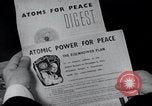
Voice of America broadcasts President's speech and USIS "Atoms for Peace" exhibits are presented worldwide
President Eisenhower of the United States addresses United Nations on December 8, 1953 about atomic bomb and atomic weapon dilemma in the nuclear age (part of Atoms for Peace initiative). Operators in radio transmission control rooms note down readings. View of time clocks of various places in the world including Honolulu, New York, London, Moscow, Calcutta, Bangkok and Tokyo displayed. The Voice of America broadcasts program in different languages by announcers. Scene of a family sitting in a living room as they listen to the president's speech on a console radio. People work at typing, printing, and translating the speech. USIA motion pictures service prepare newsreel of president's speech. A man views air mail of USIA films. Exterior views of several different United States embassy buildings worldwide. A guard standing outside the building. A Public Affairs Officer at the U.S. embassy in Japan, in Tokyo, meets with U.S. Ambassador to Japan Robert Murphy. USIA members seated around table for meeting, and, in Washington DC, creating publications about the Atoms for Peace program. People seated in a USIA library in Brazil read books and various USIA materials. Architects design 30 foot high Atoms for Peace exhibits. An exhibit being setup in a foreign country (possibly in North Africa). Exterior and interior views of the West Berlin, Germany Atoms for Peace exhibit. Prime Minister Jawahar Lal Nehru in India is seen arriving in a jeep to view the Atoms for Peace exhibit in India. Prime Minister Nehru inside the exhibit hall watching a presentation. In Japan, a woman operates remote-controlled robotic hands to hold radioactive materials, at a demonstration for Japanese citizens. In a city in Italy, a view of a mobile van unit carrying an Atoms for Peace exhibit. Scenes from a film "A is for Atom" that was translated into 30 languages and shown all over the world. Wide view of the Kremlin in Moscow, Russia, Soviet Union. A Russian radio commentator speaking at a microphone. Propaganda dramatization showing the Russian announcer attacking American plans for Atoms for Peace.
CRITICALPAST.COM: About Us | Contact Us | FAQs - How to Order | License Agreement | My Account | My Lightboxes | Shopping Cart | Advanced Search | Featured Collections | Website Terms & Conditions | Privacy Policy ©2026 CriticalPast LLC.
License Agreement |
Terms & Conditions |
Privacy Policy
©2026 CriticalPast LLC.