


 Francais
 Deutsch
 Italiano
Refine Your Search
United States 1982 stock footage and images
- Showing 11629 to 11634 of 26493 results more
more Hide
Hide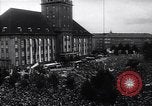
Berlin Crisis: The Western Powers respond to threats from the Soviet Union
Opening scene shows the Rathaus Schöneberg (John-F.-Kennedy-Platz, 10825 Berlin, Germany) where Mayor of Berlin Willy Brandt addresses a large crowd of West Berlin citizens, concerned about the building of the Berlin Wall by the Soviet Union. Many carry placards and signs, including some in English, reading: "We trust Kennedy, Pay any price, Bear any burden, for survival of Liberty" and "Millions behind the Iron Curtain ask for help." Scene shifts to a limousine driving into the center of a crowd. United States Vice President Lyndon B. Johnson steps from the car, accompanied by General Lucius D. Clay, who is seen next, with arm raised, acknowledging the crowd, while standing with Johnson and Brandt, at a podium cluttered with microphones. (Narrator refers to him as "Father of the Airlift.") The next day, British and American soldiers are seen driving in jeeps and trucks and M59 Armored Personnel Carriers, through cheering crowds, as they arrive to reinforce their Berlin garrisons. Closeup of cheering Berliners, waving handkerchiefs. Change of scene shows animated map of Europe illustrating the Westward expansion and growth of Soviet Communist occupation through World War II and the postwar era, concluding with East Berlin, in 1962. The threat to other Nations and regions is also illustrated. Legislators are seen in session in the plenary chamber of the German Bundestag in Bonn. Chancellor Konrad Adenauer is addressing the assembly. He states that Germany does not stand alone in the world. In France, Prime Minister Georges Pompidou addresses the National Assembly, regarding the Berlin Wall. In London, Prime Minister Harold Macmillan addresses Parliament. In the United States, on September 25, 1961, President John F. Kennedy, is addressing the UN General Assembly, in New York, about the dangerous crisis in Berlin. Scenes of the Berlin wall and Checkpoint Charlie. Memorials to persons killed attempting to escape East Berlin, are seen along the wall.
President Eisenhower speaks at Press Conference in White House in 1956.
View of newsmen seated and cameramen at a press conference. President Eisenhower enters the conference room. Journalist asks him questions regarding violence resulting from "Segregation Issues" (racial segregation) as schools reopen after the summer in the United States, under desegregation orders. President replies how local governments need to enforce the laws including federal law, and that the United States of America is ready to help. Journalists writing in notepads. Close view of President speaking. President is asked what he would say to young people who are responsible for unrest and tension during desegregation. The President states that it is difficult through law and courts to change the hearts of people. He advises people to explore the issues, and that we need to "bring about a change in spirit, so that extremists on both sides do not defeat what we know to be a reasonable and logical conclusion of this whole affair, which is recognition of the equality of man." He says the south is full of people of good will, but that we only hear from others in the south who are full of prejudice and who resort to violence, and the same way on the other side with people who want to have the whole matter settled today. President Eisenhower says of desegregation, "this is a question of leading, and training, and teaching people and it takes some time."
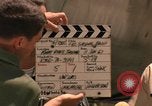
Captain James S. Walbridge being interviewed in Thailand about his experiences during a mission in North Vietnam.
United States Air Force Major James Walbridge being interviewed at Korat air base in Thailand during Vietnam War. Major James S. Walbridge being interviewed by Captain Charles D. Pellow with a United States F-105D aircraft in the background. Major Walbridge narrates his experiences of a mission in North Vietnam during the Vietnam war. He talks about how while carrying 750 lb bombs to strike North Vietnam his aircraft caught fire. He jumped from the plane with a parachute and landed up on the trunk of a tree. He speaks about the rescue from the jungle. He stresses upon the importance of radio as he states how he called for help from his radio. Audio explains about Walbridge's rescue from the jungle. Walbridge emphasizes upon the importance of a survival kit.
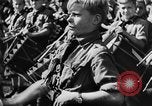
Fascism growth despite pre-World War 2 disarmament efforts including Washington Disarmament Conference, Nine-power treaty.
The background of World War II. German Hitler Youth children march with rifles, flags and a band beneath a camp entrance named Nordmark Lager 1935. Flag with Nazi symbol. Japanese flag and Japanese youth march in military exercises, followed by teenage Japanese forces. Italian fascist troops in uniform march in Torino Italy led by a band. Views of various German and Nazi forces parade and goose step in various cities. Units include brownshirts, goosestepping Storm Troopers, Wehrmacht. Civilians give a salute. Mostly sad looking men women and children watch the parades. The world globe. U.S. Capitol Building in Washington DC. French, Japanese and United States dignitaries attend the Washington Disarmament Conference or Washington Naval Conference at Memorial Continental Hall in Washington DC in 1921. View of the Washington Naval Treaty naval fleet reduction treaty book with signatures on it. Officials sign the Nine-Power Treaty that guarantees the integrity of China (per the John Hay "Open Door Policy"). Japanese delegation is shown at signing ceremony for the Nine-Power Treaty. Next scene shows 1928 signing ceremony in Paris of the Kellogg-Briand Pact renouncing war as a means of settling international disputes. French Foreign Minister Aristide Briand is seen speaking, and American Secretary of State Frank Kellogg is also seen at the treaty signing which was signed by 47 nations including Germany and Japan. In a 1930 scene, U.S. Secretary of State, Henry Stimson hands the London Naval Treaty to President Herbert Hoover. Scene of a U.S. Navy ship being blown up and scrapped in accordance with the treaty terms. View of American citizens in small town parades with floats marching as anti-war and isolationist groups.
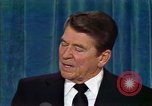
President Ronald Reagan gives a speech about U.S. Foreign Policy in Washington DC.
United States President Ronald Reagan's address on U.S. Foreign Policy at the National Press Club in Washington DC. President Reagan proposes mutual United States-Soviet reduction of nuclear weapons in Europe. He also talks about the elimination of the risk of surprise nuclear attacks. President Reagan states that talks with the Soviets on Arms Reduction Program are of utmost importance. The officials stand and applaud after the President's speech. President Ronald Reagan exits the room.
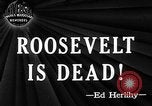
Life and death of U.S. President Franklin Roosevelt.
U.S. President Franklin Roosevelt passes away. Past events showing the President working for the nation. The President addresses the people. An aerial view of the Capitol building. The President stands in a balcony of the building for the inaugural ceremony. A large crowd gathers in front of the building to hear him. The President in car outside a building, he waves. The President with other dignitaries in a hall. The President at work in his office. He waves towards a large crowd lined up on the streets to greet him. He is seated in a car with his wife. People gather outside a building. The President with his family outside the building. He meets British Prime Minister Winston Churchill to discuss about World War II. He addresses the people and declares the state of war between Japan and the United States. The President seated in a jeep reviews troops. Churchill seated with the President. Other officials stand in the background. President Roosevelt seated with U.S. Vice President Truman. He studies a map with other officials. He addresses the people at the inaugural ceremony and takes the oath as the President. Exterior of a building. The President confers with other dignitaries at Livadia Palace near Yalta. He addresses the people about the war against Japan. The United States flag lowered on the flag pole.
CRITICALPAST.COM: About Us | Contact Us | FAQs - How to Order | License Agreement | My Account | My Lightboxes | Shopping Cart | Advanced Search | Featured Collections | Website Terms & Conditions | Privacy Policy ©2026 CriticalPast LLC.
License Agreement |
Terms & Conditions |
Privacy Policy
©2026 CriticalPast LLC.