


 Francais
 Deutsch
 Italiano
Refine Your Search
United States 1982 stock footage and images
- Showing 12349 to 12354 of 26493 results more
more Hide
Hide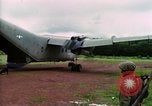
Cambodian refugees in a camp wait and board a C-7A aircraft which takes off from Boung Long, Cambodia.
United States Air Force (USAF ) support for the evacuation of Cambodian refugees from Boung Long, Cambodia during the Vietnam War. A C-7A aircraft taxi on a field. Cambodian refugees in a camp. The refugees wait and board the C-7A. "Maria Elena" written on the aircraft. The C-7A taxis out and takes off. The refugees in the background. The refugees and children sitting on the ground. A cart loaded with belongings. A sack of food supply from the United States.
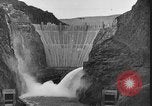
Industrial and cultural advances in USA contrasted with Nazi Germany; children sing a song in a church and play
A motion picture film explores the background of World War II. In the United States a view of a large hyrdoelectric dam with water gushing through its gates. Electrical towers of a power plant and a man throwing large switches to activate power. Newspaper headlines: 'Senator oppose the league of nation' and 'Senate passes tariff bill by 44 to 42 vote'. A crowd holds posters of Dewey, German Chancellor Adolf Hitler and other leaders. Books of competing ideologies for sales in the United States, including those of democracy, socialism, fascism including Mein Kampf and books about Stalin. Voting time in Germany with Hitler as the only candidate and signs promoting Hitler. Germans casting voting ballots for Hitler. People burning books in Nazi Germany. A church in America or Britiain with close up views of a boys choir singing hymn "Onward Christian Soldiers." Children in America playing at a playground on a jungle gym and slide. A girl makes a drawing of natural scenes. American children smiling, playing, and running.
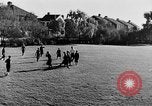
Children in various countries play military training games and earthquake relief fund is collected for Japanese children
Contrasts innocent play of children in America with military play and training in Axis countries during World War 2. View of children playing games and on jungle gym in United States. Scene changes to Germany, with German boys climbing over and around artillery pieces under watchful eye of a uniformed German official. Next shows children in Japan staging military training and a charge across a mock battlefield. Next scene shows boys in Italy in uniform engaged in a mock battle charge and putting on gas masks between advances. Also seen during the clip: The Japanese flag is raised, as well as the Nazi flag and an Italian flag. Slogan of the Japanese Army: ' To die for Emperor is to live forever'. Back in the United States, a woman collects funds to help Japanese children affected by an earthquake. Children pass by the collection bin and place money in the jar.
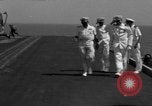
Paul R. Ignatius, SECNAV prepares to depart from and dons life jacket aboard USS Shangri La in Mediterranean Sea.
Paul Robert Ignatius, the United States Secretary of the Navy (SECNAV) visits USS Shangri La (CV-38) in the Mediterranean Sea. View of Vice Admiral Edward H. Martin being greeted by Capt. Coogan, upon his arrival to the Shangri-La, via helicopter. The group proceeds on down the flight deck. Vice Admiral Martin, Rear Admiral Lawrence Geis, and Capt. Coogan, chatting on the flight deck. View of the honorable Paul R. Ignatius, SECNAV, departing the area of the helicopter on the flight deck. View of the SECNAV being greeted by Rear Admiral Geis, they proceed down the flight deck toward the Marine Honor Guard. The SECNAV stops to receive Honors. Side view of SECNAV receiving Honors, the band playing in the background. The Marine Honor Guard, with SECNAV appearing in the BG inspecting the Marine Honor Guard, along with the 1st. Lt. Terrence D. Brown, United States Marine Corps (USMC), officer in charge of the Marine Detachment. View of SECNAV receiving a 19 gun salute, smoke from guns seen in the far background. SECNAV walks through the rank of sideboys and prepares to depart from the ship. SECNAV receives a souvenir book from Capt. Coogan. Capt. Coogan shakes hand with the SECNAV beside the C-2A Greyhound. View of crewman assisting the SECNAV with a life jacket. SECNAV removes his coat, hands it to the crewman inside the plane, then dons the life jacket.
A U.S. soldier examines an abandoned parachute packing case and white cap in woods in Belgium during World War II.
United States 1st Division troops flush out the German paratroopers in South of Eupen, Belgium during World War II. A soldier of squadron from United States 1st Division, 18th Infantry, 1st Battalion, M Co. examines an abandoned parachute packing case and white cap in woods.
Effects of the atomic bombing of Hiroshima, Japan, in World War II, and early international efforts to control atomic weapons
Film showing city of Hiroshima, Japan, before and after the August 6, 1945 dropping of the atomic bomb over the city in World War 2. Sequence opens on what the narrator says is August 5, 1945, the day before the event (but the footage is likely from before that date). Camera pans over the city of Hiroshima before the atomic bomb destroyed the city. Japanese air raid lookouts are seen on watch for allied bombers. View of atomic bomb detonation as seen from aircraft high overhead (this is actually a view of the Nagasaki blast, not the Hiroshima blast despite narrator's comments). Next, the complete destruction of the city of Hiroshima is seen from camera at low altitude showing the four and one half square miles of the city flattened and burned. A Japanese hospital still functioning, with red cross flag on it. Hospital workers retrieving wounded victims of the bombing. Ambulatory victims clustered in doorways and halls. Shadow image of a large industrial valve wheel burned onto wall behind it. Similar image of a ladder burned onto a wall. The decorative pattern on a woman's dress burned onto skin of her back. Japanese physicians treating victims of thermal and radiation burns. Views of various victims, including some children, and their respective injuries. Scene shifts forward one year, to August 6, 1946. Children are lined up outside a school building, and then seen inside their classroom. Disfiguration and wounds on children resulting from injuries are still evident on the children at their desks. Sequence shifts again, this time to an early United Nations meeting with delegates grappling with the issue of controlling nuclear power and atomic weapons. Closeup view of American delegates, including James F. Byrnes (Secretary of State)and James B. Conant, President of Harvard University in the assembly. Closeups of representatives from South Asian nations. Closeup of USSR delegation, headed by Foreign Minister, Vyacheslav Molotov. Signs identifying delegates from Colombia, Egypt, Iraq, Bolivia, China. Final sequence shows several U.S. atomic scientists in their respective laboratories, including Enrico Fermi and Vannevar Bush. United States representative to the UN, Warren Austin, speaking about the so-called Baruch Plan, for international control of atomic weapons. (Principal author, Bernard Baruch, is standing behind speaker's left shoulder.) USSR delegation, headed by permanent representative, Andrei Gromyko, who is seen presenting the Soviet plan. View of explosion and mushroom cloud during U.S. Operation Crossroads atomic bomb test in the Pacific.
CRITICALPAST.COM: About Us | Contact Us | FAQs - How to Order | License Agreement | My Account | My Lightboxes | Shopping Cart | Advanced Search | Featured Collections | Website Terms & Conditions | Privacy Policy ©2026 CriticalPast LLC.
License Agreement |
Terms & Conditions |
Privacy Policy
©2026 CriticalPast LLC.