


 Francais
 Deutsch
 Italiano
Refine Your Search
United States 1982 stock footage and images
- Showing 12757 to 12762 of 26493 results more
more Hide
Hide
V-mail procedures including cutting, microfilming, transport, photographic enlargement, and processing during WWII.
The use of V-mail (Victory Mail) by the United States during World War II. V-mail procedures including cutting, microfilming, transport, photographic enlargement, and processing of V-mail letters and post. A poster promoting the use of V-mail. Women in a line at a post office. The post office staff at counter windows serves the customers. A woman collects a V-mail letter, writes her message and then addresses the letter. The preferred use of a softer pencil in V-mails. Cutting: Specially trained soldiers unpack the V-mails and use a cutting machine to open each mail. Processing: The experienced staff sorts mails into the respective destination groups at sorting tables. Soldiers open mails to photograph them. A soldier sorts mail that can't be photographed and are to be sent back. These mails include stamps, enclosures, snapshots and bad writing. The correct mails are then sorted into given numbers in bundles. Microfilming: Women use Airgraph machines to photograph each mail on 16mm films. 1600 mails on 100 feet of film. The complete reels are sent for developing. Women put in new reels of negatives into the cameras. Developers dry the film reels. Stacks of reels on a table containing images of thousands of letters. Soldiers packing and stacking many hundreds of sacks filled with V-mail letter microfilm images. A Boeing 314 Pan American Clipper flying boat sea plane (military designation C-98) is seen taking off to transport V-mail to major destination points. A bag of microfilm reels is delivered to an officer. He unpacks the reels and sends them to the printing room. Enlargement: Enlargement machines are used to enlarge the snapshots. Men and women operate the printing machines. Soldiers with the printed facsimiles on tables. Processing: Women slice the prints into separate letters. Machines used to insert facsimiles into V-mail envelopes and seal them. The mails are then sent to the exact destinations by ordinary post. Soldiers gather around as a comrade distributes mail at a U.S. military base in the combat area.
Dramatization depicts production, black marketing of gas coupons and citizens' responsibilities in supporting World War 2 gas rationing.
'No Alternative' dramatizes citizens' responsibilities in supporting gas rationing in the United States. Dramatization: Group of men seated playing card game. Tom interrupts a poker game to lecture on rationing, after Bob offers an illegal gas coupon to Frank. He talks about the production of automotive gasoline, increasing price and limited production of crude oil. Uses of crude oil: U.S. airmen and soldiers use crude oil to fuel aircraft and tanks. A U.S. aircraft drops bombs made with the use of crude oil. Workers produce synthetic rubber from crude oil at a plant. U.S. Navy ships, merchant fleets, railroads and war industries use crude oil. Tom explains how "black market" coupons cause shortages that affect war industries and military activities. Dramatization depicts safe breakers breaking into a ration board and stealing gas coupons worth 11 million gallons. Gasoline used by farmers in tractors, to take produce to the markets, finished ammunition, guns and tanks to the railroad stations so that they can be sent to the front. Tom points out ways to make rationing work and save gasoline including: formation of car pools, scorning illegal coupons, identifying coupons with the user's license number.
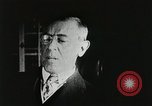
U.S. President Woodrow Wilson seated during an interview
U.S. President Woodrow Wilson in the United States during World War I. President Wilson seated in his office, talking. An map is shown with smoke rising from parts of the land masses. An overlay of a U.S. flag then is superimposed over the map. A U.S. military flag symbol with an eagle atop.

Technicians work to detect hurricanes at the Joint Hurricane Warning Center in Miami, Florida.
A film titled 'Hurricane Hunters' about the role of Airborne Early Warning Squadron Four in the United States. Propellers of an aircraft rotate and it takes off. A Hurricane Hunter aircraft in flight. Crew members aboard an airborne aircraft as they work to warn against a possible hurricane. A ship underway in the rough sea during a hurricane. A man runs on street as strong wind blows and rainfall occurs. Strong breeze blows and rainfall occurs during a hurricane. Submerged houses, damaged train, damaged vehicles and houses. Men clear debris. Exteriors of a Joint Hurricane Warning center in Miami. Technicians work on weather maps.
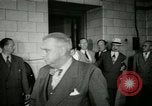
Julius and Ethel Rosenberg and associates following conviction of espionage.
David Greenglass attempts to hide his face from camera while a U.S. Marshal escorts him into a United States Marshal van. Julius and Ethel Rosenberg emerge from courthouse doorway and are escorted into a Marshal's van. Morton Sobell is held and photographers take pictures of him.
Training film from the U.S. Army 'Rifle squad in attack' Part I on the role of light weapon infantryman.
Training film from the U.S. Army 'Rifle Squad in Attack' Part I depicts the role of light weapon infantryman. United States soldiers check their rifle to prepare for an enemy attack. Squad leader sergeant Collins with his teams has studied the area and checked the ground before attack. They discuss the plan of attack through a diagram and a formation they will follow. The teams take their position and advance ahead amidst enemy attack.
CRITICALPAST.COM: About Us | Contact Us | FAQs - How to Order | License Agreement | My Account | My Lightboxes | Shopping Cart | Advanced Search | Featured Collections | Website Terms & Conditions | Privacy Policy ©2026 CriticalPast LLC.
License Agreement |
Terms & Conditions |
Privacy Policy
©2026 CriticalPast LLC.