


 Francais
 Deutsch
 Italiano

Refine Your Search
United States 1982 stock footage and images
- Showing 1273 to 1278 of 34981 results more
 Hide
Color Sound

U.S. Marines cruising up a river; USS Saufley sails underway in harbor at United States Naval Station Guantanamo Bay
United States Marine personnel on a rubber boat (with outboard motor) sail up the Guantanamo River within the United States Naval Station Guantanamo Bay (GTMO or Gitmo). The U.S. Nay Fletcher-class destroyer USS Saufley (DD-465) sails underway in Guantanamo Bay harbor. View of Guantanamo Bay from the USS Saufley.

U.S. Marines relax during off-duty time at United States Naval Station Guantanamo Bay (GTMO).
A twin masted sailing ship docked just off shore at United States Naval Station Guantanamo Bay (GTMO). A black gardener tending to plants in a garden. Young men dressed as boy scouts meet in a garden and apparently pose for a photo. An elderly man in swimming trunks dries himself with a towel. Off-duty U.S. Marine personnel relax in lounge chairs by the pool. Coconut trees growing inside a garden or recreation area of the naval station. A woman in swimsuit attire reads a paper while reclining on an outdoor lounge chair. A fan palm. A white boat sailing away. Two men walking to the waterfront. A horse-drawn cart waits outside a building. “Sunshine” is written on the building. Closeup view of a United States Navy PBY-2 Catalina flying boat (seaplane aircraft) with a black staff car parked near.
Signal Corps weekly film reports sent to Photographic Center and used in training films for U.S. troops during World War II.
The role and contribution of the U.S. Army Signal Corps in combat and war. Amphibious landings of the first wave of Allied troops including Signal Corps Units in Normandy, France on D Day during World War 2. The Joint Assault Signal Companies (a Signal Corps Unit that accompanies the soldiers on every beach landing) go ashore in Normandy. Soldiers in landing crafts approach the beach. Landing crafts anchored along the shore line. A U.S. flag on the beach. Crafts approach the beach. U.S. Army Signal Corps combat photographers using motion picture cameras to film the battle that ensues on the beach and in the fields. Gun fire and explosions in the battlefield, filmed by combat cameraman. Allied aircraft in flight. Airmen load weekly film reports of the war in all Theaters made by Signal Corps officers from a van into an aircraft. The films are sent to the Photographic Center in New York. A soldier assembles the films. Technicians organize and arrange the films. They place the film reels onto racks. The film content is used to make training and orientation films for the U.S. troops. Troops watch the films in order to cut down the training period, and stay informed about the order of event in other Theaters of Operation. The films include 'Why We Fight' and 'The Fighting Men' series. Clips and recordings from these films.
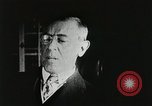
U.S. President Woodrow Wilson seated during an interview
U.S. President Woodrow Wilson in the United States during World War I. President Wilson seated in his office, talking. An map is shown with smoke rising from parts of the land masses. An overlay of a U.S. flag then is superimposed over the map. A U.S. military flag symbol with an eagle atop.

General Eisenhower as a World War II officer and as the U.S. President.
Scenes from life and career of Dwight D Eisenhower, 34th President of United States. U.S. Air Force plane lands and the President disembarks the plane in India, in 1959. He is greeted by the Indian President Dr Rajendra Prasad and other dignitaries. Emblem of 'Panama'. Sign of 'welcome Ike Crusader'. Large crowd welcomes Eisenhower. Motorcade goes through the city's street. Milestones in General Eisenhower's life and the international esteem with which he is held. Lt Col Eisenhower concerned about U.S. isolationism in 1940 as World War 2 is underway. Explosions in Europe due to bombing by German aircraft. Eisenhower and other officers in the General Staff study a map. Eisenhower plans the strategy as the commander of Operation Torch (he is shown talking to General George C. Marshall and Winston Churchill). President Eisenhower visits 4 continents and meets several leaders. Large crowds welcome him. General Eisenhower prepares for D-Day Invasion of France during World War 2. June 5, 1944: The Allied forces including troops, artillery, equipment, ammunition, aircraft and ships prepared. June 6, 1944: The Allies invade Normandy. Troops wade through the water during D-Day Normandy beach landings, while under enemy fire. German soldiers surrender. May 7, 1945: Nazi General Alfred Jodl signs the unconditional surrender of his government. General Eisenhower returns to the U.S. He receives a hero's welcome in New York during a parade. He visits his hometown in Kansas. Pictures of his family, childhood and college days. Eisenhower on his visits to various countries as President.

Frank Carlucci answers questions on WorldNet about the United States reaction to the Guatemala peace plan.
Television discussion about United States- Latin American relations in United States. Frank Carlucci, Assistant to the President for National Security Affairs, answers the questions of people regarding this topic. Maria C Siccardi presents the show. A question is asked from Bogota regarding the United States reaction to the Guatemala peace plan. The discussion involves the refusal of the U.S. for more aid and complies with the Guatemala plan. Opinions about President Ronald Reagan's views on the issue are shared.
CRITICALPAST.COM: About Us | Contact Us | FAQs - How to Order | License Agreement | My Account | My Lightboxes | Shopping Cart | Advanced Search | Featured Collections | Website Terms & Conditions | Privacy Policy ©2026 CriticalPast LLC.
License Agreement |
Terms & Conditions |
Privacy Policy
©2026 CriticalPast LLC.