


 Francais
 Deutsch
 Italiano
Refine Your Search
United States 1982 stock footage and images
- Showing 12817 to 12822 of 26492 results more
more Hide
Hide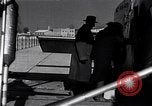
Transcontinental Air Transport (TAT) carrying passengers from St. Louis to Waynoka, Oklahoma, on coast-to-coast trip from New York
Early commercial passenger airplane travel in the United States. Transcontinental Air Transport (TAT) company's coast-to-coast passengers proceed on their flight legs from Saint Louis, Missouri to Waynoka, Oklahoma. TAT employee closes door on Ford 5-AT-B tri-motor passenger airplane, at St. Louis airport. Ground crewman plugs in compressed air hose to assist start of engine number three. TAT logo seen on side of the airplane. Next, the airplane taxis and takes off on plowed runway of snow-covered field. Animated map shows airplane heading to Kansas City, Missouri. View of cockpit as co-pilot shows weather report to pilot. Shift to a TAT weather station where meteorologists launch a weather balloon to check winds aloft. Closeup of the pilot's weather report being prepared. TAT officer serving lunch food to passengers in the aircraft. View from airplane of Kansas City, and then aerial view as it descends to Wichita, Kansas. Pilots in cockpit. Copilot radios Wichita. View of TAT radio operator responding and saying they should lookout for Lindbergh who is flying the route today. Next, Colonel Charles A. Lindbergh is seen flying past the Ford Tri-motor in his Curtiss Falcon biplane. Passengers look out to see him. View from the passenger plane descending over the city of Wichita, Kansas. Aerial view of aircraft factory buildings in Wichita. Animated map shows next stop as Waynoka, Oklahoma. View from the air of numerous oil wells and oil derricks in Oklahoma. Passengers leaving the airplane and boarding a trailer-bus at Waynoka. Closeup of flowers and sign on restaurant table, reading, "TAT, Reserved for TAT travelers." Passengers dining.
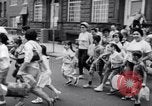
Head Start children and mothers.
Operation Head Start in United States offering early childhood school and preschool programs for children living in poverty. Volunteers cross road with children and get on a bus. Teacher writes on a board in classroom. Replicas of fruits and vegetable lay on cabinet. Mothers of deprived children sit and listen to volunteers at Head Start Center. Volunteer asks a mother about her family members. She replies that her nine children live in a four-room house. Curtain at window. Exteriors of a building. Volunteer discusses the housing problem with a man and request to provide two apartments to this family. Interiors of the house of a poor rural woman with seven children and no job. African American woman seen with several children at house watching as men deliver a stove.

Head start teacher visits family, farewell gifts given to children, kids play with a pinata.
Operation Head Start in United States. Head Start teacher visits a family. A woman gives bag of vegetables to the teacher as a gift. A couple and their child arrive at Head Start with a dish of food for pot luck. Kids hit a pinata with a stick and then reach for candy when the pinata opens. Volunteers give paper bags with gifts enclosed to children and their parents. A child wearing a graduation cap leaves Head Start pre-school with his mother and father.
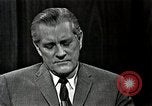
Senator J.William Fulbright in television conversation about Dominican Republic Invasion..
Senator J. William Fulbright interviewed on television in United States. Interviewer asks Fulbright about Dominican Republic Invasion. He questions Fulbright who responds. He says that there are diversions between fact and actual intervention. He said that facts have been misinterpreted and the work should not have done that way. He talked about contribution and work in Dominican Republic.
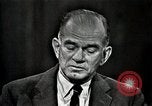
During a TV interview, Senator Fulbright is asked about the Soviet Union's involvement in North Vietnam.
Senator J. William Fulbright in the United States.Television interviewer asks Fulbright about the Soviet Union involvement in North Vietnam. Fulbright says that they are involved. The involvement of the Soviet Union in the controversy between Pakistan and India was a propaganda ploy, and the Soviet Union have succeeded in it.

Wilbur H. Durborough, America's famous Press photographer, goes to Germany during World war I
Closeup scenes show Wilbur H. Durborough-America's famous press photographer, seated behind the steering wheel of a 1911 Alto touring car parked on a street in Chicago, Illinois, getting ready to depart for Germany, during World War 1. Sitting behind him is his assistant cameraman, Irving G. Ries. Both have goggles pushed back on their foreheads. and both smoke cigars. Some spare tires are seen behind Mr. Ries. As camera moves back, they are seen surrounded by numerous friends and well-wishers as they prepare to depart from Chicago. Next, Durborough is seen standing on the bridge of the Holland-America steamship, S.S. Nieuw Amsterdam, with ship's Captain Jan Baron, who is on lookout for mines and submarines. Captain Baron passes his binoculars to Mr. Durborough. Captain Baron and Mr. Durborough stand on the deck looking at some documents. Lifeboats on davits behind them are ready for emergency. Durborough drives his car from the ship terminal onto a street in Rotterdam, with Captain Baron standing on a running board. The car is loaded down with luggage and equipment. He drives away as the Captain and others wave goodbye. Displaying an American flag on the hood, Durborough arrives at the German border. Dutch officials examine the car's contents, including a look into the engine compartment. Next, Durborough is stopped by German border guards, who examine his passport and greet him in a friendly manner. Durborough is seen in the offices of U.S.Ambassador James W.Gerard, as he describes his plans for visiting. He is honored by a visit from Prince of Reuss of German General Staff, Prince Max of Baden and Count Von Bernstorff- son of German Ambassador to the United States, who are seen chatting with him, before entering their car to depart.
CRITICALPAST.COM: About Us | Contact Us | FAQs - How to Order | License Agreement | My Account | My Lightboxes | Shopping Cart | Advanced Search | Featured Collections | Website Terms & Conditions | Privacy Policy ©2026 CriticalPast LLC.
License Agreement |
Terms & Conditions |
Privacy Policy
©2026 CriticalPast LLC.