


 Francais
 Deutsch
 Italiano

Refine Your Search
United States 1982 stock footage and images
- Showing 1297 to 1302 of 34981 results more
 Hide
Color Sound

Soviet Premier Nikita Khrushchev and President Eisenhower meet at Camp David in Maryland, United States.
Major events of the year 1959. United States Vice President Richard Nixon with Soviet Premier Nikita Khrushchev where they engaged in the so-called "Kitchen debate" at United States Trade and Cultural Fair in Moscow, Soviet Union. Nixon talks to Khrushchev leading to the former's visit to United States. Khrushchev arrives in United States and President Dwight D Eisenhower welcomes him at the airport. Soldiers march as the Presidential motorcade follows them. President Eisenhower and Premier Khrushchev after a meeting at Camp David in Maryland.
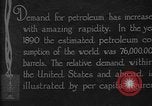
Total consumption and per capita consumption of petroleum of the United States is compared to that of the rest of the world.
The consumption of petroleum in the United States is compared to that of the rest of the world through an animation. The animation shows the population of the U.S. and the world outside of the United States in the year 1890. The animation also compares total consumption in barrels and per capita consumption in gallons of the U.S. and the rest of the world.
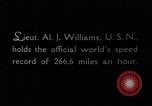
A Curtiss R2C-1 racer flies over and lands on an airfield in the United States.
Development of air power. U.S. Navy Lieutenant Al J. Williams in the United States. He holds the official world speed record at 266.6 miles an hour. A United States Navy Curtiss R2C-1 racer parked on an airfield. Lt. Williams in the cockpit of the aircraft. U.S. Navy Rear Admiral W. A. Moffett shakes hands with Lt. Williams. Cameramen and officials in the background. The Curtiss R2C-1 racer flies past and overhead around a pylon. The aircraft comes in for a landing.
Beginnings of successful powered heavier-than-air flight. Wright Brothers flights in U.S. and Europe. General Hap Arnold
History of aviation. A balloon in flight. Historic glider such as that which interested U.S. War Department as early as 1898. In 1903, a crew of men moving a Wright Flyer into position. Two men turn over propellers on a Wright Flyer, and the engine starts. View of the Wright-designed water-cooled engine. View of Orville Wright. The famous first powered flight, at Kitty Hawk, North Carolina, with Orville Wright at controls. Animation shows that 120 foot flight juxtaposed against a B-36 wing. Wilbur Wright in Europe, in 1908, gesturing as he converses with interested parties. A gallery of spectators including the President of France, King of England, King of Spain, and King of Italy. Wilbur Wright places a wheel under the right wing of a Wright Flyer and lashes it to the strut. A team of horses pulls the plane across the field. Men maneuver the plane onto a monorail on the ground. Men pull on a heavy rope to raise a weight in a tower, for a catapult. Two men spin the propellers and the Wright Brothers airplane motor starts. Wilbur Wright and his passenger, a French journalist, board the plane. The catapult weight drops, launching the aircraft which flies low over the field. U.S. President Theodore Roosevelt speaking (He is seen on a podium campaigning for the Bull Moose Party nomination at the Kansas State Fair in Hutchinson, Kansas on September 22, 1912.) War department issues specifications for a heavier-than-air craft. Reenactment of a Wright brother signing a bid contract. A Wright Flyer airborne at Fort Myer, Virginia, as the Wrights meet the Army specifications and sell, U.S. Army airplane number 1, to the War Department, in 1908. Gold Aviator wings being pinned on the uniform of a U.S. Army pilot. Photograph of Army Air Forces Chief, General Henry (Hap) Arnold, wearing his original aviator wings on his service uniform. A Glenn Curtis training airplane starting up and taking off. View of a DH-4 airplane and a Wright Flyer taking off together.

Chaplain hands wreath made in shape of the USS Thresher to P2H aircraft crew at the Portsmouth Naval Shipyard,United States.
Memorial services for the U.S. Navy nuclear fast attack submarine Thresher (SSN-593) at Portsmouth Naval Shipyard,United States. Crew of a United States Navy Lockheed P2H Neptune aircraft stand in a group in front of the aircraft. Engine revs up. Plane director directs the landing of the DH43D helicopter. Chaplain removes a wreath made in shape of the U.S. Navy nuclear fast attack submarine Thresher (SSN-593) from the helicopter. The wreath is carried toward the aircraft and handed to one of the crew members of the P2H aircraft . Chaplains and member pose with the wreath. Crew member sets the wreath in the P2H aircraft for dropping over the area where the USS Thresher sank.
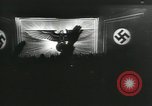
U.S. President Franklin D Roosevelt signs Selective Service Training Act of 1940. American men are drafted for military service
German Chancellor Adolf Hitler addresses officials in Germany. German military aircraft in flight . Bombs falling on targets. German troops march through streets. U.S. President Franklin Delano Roosevelt, at a desk in his office, signs the Selective Service Training Act of 1940. Officials mix serial numbers in a glass container. President Roosevelt announces the serial numbers of the men drafted into the U.S. Army. A large crowd of civilians gathered on the streets await the announcement. Selected men are shown in all places and in all walks of life, in the United States, including an African American man. The men undergo a medical and physical checkup at the induction center to begin service as new military recruits. Those inducted receive basic training and begin tours of duty in the U.S. Army. (World War II period). Background music during recruitment scenes is a chorus singing "This is the Army Mr Jones" by Irving Berlin.
CRITICALPAST.COM: About Us | Contact Us | FAQs - How to Order | License Agreement | My Account | My Lightboxes | Shopping Cart | Advanced Search | Featured Collections | Website Terms & Conditions | Privacy Policy ©2026 CriticalPast LLC.
License Agreement |
Terms & Conditions |
Privacy Policy
©2026 CriticalPast LLC.