


 Francais
 Deutsch
 Italiano
Refine Your Search
United States 1982 stock footage and images
- Showing 13111 to 13116 of 26492 results more
more Hide
Hide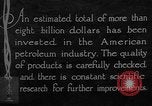
Men carry out experiments to check the quality of petroleum products in the U.S.
Quality of petroleum products is checked and scientific research for further improvement is carried out in the United States. A man carries out an experiment to check the quality of a petroleum product. He heats the product on a Bunsen burner using a pair of tongs. Then he lights a lamp using the petroleum product. Another researcher looks through a tube at a screen and makes some adjustments. He makes a note on a container and pours in the container. Scientific glass apparatus in a box on a stand. A man looks at them. He makes a note on a paper and takes a look at a paper in his hand.
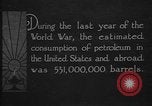
Water flows over the Niagara Falls and a globe with nine circular parallel lines along the equator rotates in the U.S.
The total consumption of petroleum of the U.S. and the world outside of the United States for the year 1918 is compared. Animation is used for this. Per capita consumption is also compared. Water flows over the Niagara Falls. A globe with nine circular parallel lines along the equator rotates. The 9 circular lines denote that if the per capita consumption of petroleum had increased as rapidly abroad as in the U.S. the world's petroleum requirement in 1922 would have been 10 times the actual requirement and if this volume had been loaded into tank cars of the capacity of 10,000 gallons each it would have made a solid train extending around the world at the equator 9 times.
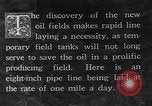
Men work using levers and other equipment to lay an oil pipe line and bolt river clamps to strengthen joints in the U.S.
Laying of oil pipe lines in the United States. Men lay an eight inch pipe line. They work in unison using levers and other equipment. Men work together at the bank of the Red River to lay a pipe line across its bed. River clamps are bolted to strengthen the joints.
American pioneers conquer the west in the 1800s, compared to 1940s workers
The U.S. Capitol dome at night. Montage of U.S. Declaration of Independence with view of U.S. founding fathers at time of American Revolution. Reenacted depiction: 17th century immigrants or pilgrims arriving in the U.S. on large sailing ships. Group of men marching while carrying a "Don't Tread on Me" Gadsden flag. Depiction of Betsy Ross with U.S.A. flag. A covered wagon at sunset. 18th century men cutting down trees. 18th century men building a log cabin. Settlers arrive to the remains of their burned out cabin. A stage coach on the U.S. prairie. A covered wagon in the midwest. A stage coach traveling through grass lands. 18th century depiction of a western town in the United States. A white man and a Native American Indian man driving the last spike to complete a railroad as the steam locomotive starts. An 18th century steam locomotive passes by. Actual footage of external view of 1940s factory or production plant. Inside 1940s factory men are building engines. Wide shot of workers entering factory. New York City street scene. Los Angeles street scene. A rancher mends a barbed wire fence. Cowboys-ranchers on their horses. Fisherman pulling in nets on shore. Tobacco farming. Leather worker. Shirtless worker wielding a pick axe. Plant worker turning a large valve. A woman painter with a maritime village scene...perhaps Provincetown. A woman scientist in a laboratory. A 1940s family at the dinner table. Farm laborers harvesting melons. Man drives a tractor with woman riding behind him.
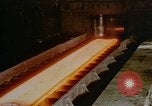
Coal which is drilled out and transported to industries forms the backbone for the industrial development in the U.S.
A documentary depicts industrial development in the United States and shows scenes of commerce, industry and natural resources. Red hot iron sheets on a conveyor belt in a factory. An industry. Men at work in factories. A small waterfall depicting natural resources. Miner in blue denim shirt in a wagon. A goods train carries coal. A coal cutter in operation. Coal is drilled out and transported to industries. A woman at work in a factory. Smoke comes of chimneys and stacks. Miners come out of a mine.
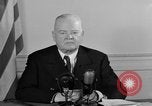
Comments by former President Herbert Hoover, serving as honorary chairman of the Famine Emergency Committee
Former United States President Herbert Hoover seated at a desk and delivering comments for the media. The U.S. flag behind him. The 71 year old Hoover is speaking in his role as honorary chairman of the Famine Emergency Committee, appointed by President Truman after World War II. President Hoover speaks of difficult conditions and suffering of people in post-war Europe and England, but also discusses the balance needed between relief and rehabilitation over the world, and the need to prevent starvation, without putting too much drain on the American economy. He calls for providing only what is needed for "the bare maintenance of human life." He notes how difficult the difficult winter of 1946 has been for all of Europe and the UK.
CRITICALPAST.COM: About Us | Contact Us | FAQs - How to Order | License Agreement | My Account | My Lightboxes | Shopping Cart | Advanced Search | Featured Collections | Website Terms & Conditions | Privacy Policy ©2026 CriticalPast LLC.
License Agreement |
Terms & Conditions |
Privacy Policy
©2026 CriticalPast LLC.